Saturday, May 28, 2005

Aggiunto Non di Piu'

*BREAKING*

The buzz has come in fits and starts and spanned years and two pontificates. But after conversations across the pond, Benedict XVI now seems prepared to send his predecessor's heart back to Poland, appointing Stanislaw Dziwisz as the new archbishop of Krakow.

As John Paul neared the end, it was whispered that the succession to Cardinal Francizek Macharski, who turned 78 last week, would be handled on the pope's deathbed. There were even reports around 1pm on April 1 that Dziwisz had been named a cardinal. Neither came to pass at the time, but it's good that timetable wasn't followed -- for Don Stanislaw, the emotion of sending his brother-mentor of 40 years home required a "breather."

Well, he's back -- Stani and Ratzi have long enjoyed a good rapport, whilst the former papal secretary and Sodano legendarily clashed all the time. And this Pope is giving Dziwisz pride of place; he was at Benedict's side when he reopened the Apartment after his election, and at the screening of a film on John Paul last week, the place at the pope's left usually occupied by Ganswein was given to Dziwisz, Georg taking a back-seat for the evening.

If Papa Ratzi didn't like Dziwisz, he would've been banished immediately. But the title of "Adjunct Prefect of the Papal Household," created for Dziwisz in 1998, was created to get the longtime keeper of John Paul out of the clutches of the Secretariat of State (where papal secretaries are traditionally accredited) -- Sodano interfered with Dziwisz too much, and John Paul took care of that by promoting Dziwisz and putting Jim Harvey, who would never get in his way, over him. The job function was no different, it was just a chart reshuffling to ensure that Dziwisz could get done what the Pope wanted done, and that he could keep the backdoor to the Apartment wide open. (Friends who have gone through that backdoor speak with great love of Don Stanislaw, that his gentleness and kindness are exactly those of John Paul II.)

But Benedict has his own people, rendering the aggiunto role of Dziwisz redundant. And the man needs a new sense of mission after having lost the raison d'etre of most of his 66 years.

Lastly, John Foley (who, if the buzz is to be believed, will be hacked into four pieces and made ordinary of San Francisco, Baltimore, Washington and Lake Charles) tells a story about a lunch that illuminates Dziwisz's qualities and the role he played for John Paul the Great:

"The pope knew that I didn't drink. I don't drink alcohol. And his secretary, Archbishop Dziwisz, knew the same thing, so Archbishop Dziwisz, when I'm eating this rum-soaked cake with gusto, said, "Archbishop Foley, what do you call a person who doesn't drink alcohol but eats it?" and I looked at him and I said, "A hypocrite." And the pope had his mouth full and went...."


The pope had to cover his full mouth, because he was laughing so hard -- keeping the late pope balanced and happy was the aggiunto's most important job. And now, a new mission seems to await....

-30-

Saturday, February 23, 2008

The Dziwisz Diaries

Early March will see the English-language release of the memoir of Pope John Paul II's closest aide of four decades.

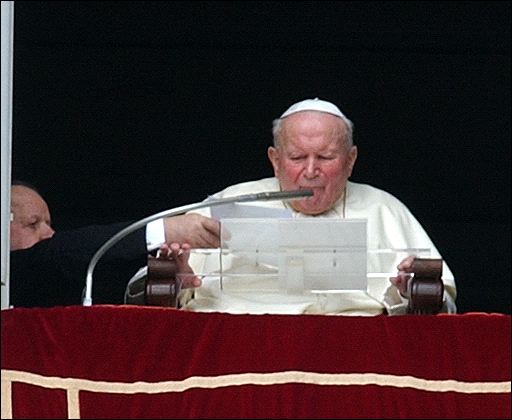
First published last year in Italian and Polish, A Life with Karol recounts the late pontiff's journey through the eyes of Cardinal Stanislaw Dziwisz, who served as John Paul's private secretary from 1966 until his 2005 death, functioning in turns as his principal gatekeeper, messenger, adviser, comic relief and "backdoor" through which not a few blocked through the usual Vatican channels found their way into the papal apartment. (Dziwisz is shown at left, over the Pope's shoulder.)

While the current dynamic of the Apostolic Palace sees the Secretary of State effectively functioning as this pontificate's top "deputy," few would question that John Paul's 27 year reign saw that capacity filled by the inconspicuous Pole with the booming voice who became the closest thing to family that Papa Wojtyla had. Always understood to be speaking with the pontiff's voice, "Don Stanislao," now 68, exerted unparalleled influence over matters from appointments and access to arranging John Paul's secret escapes from the Vatican's gilded cage and advancing the Pope's public support for his favored movements and causes.

Rome being Rome, a clout of this sort -- unprecedented for a papal secretary in recent times -- was bound to arouse resistance and rivalries. And when the Vatican flow-chart got in the way, John Paul revamped it in Dziwisz's favor, naming him a bishop and adjunct prefect of the Papal Household (an appointment that moved the secretary from his post's traditional assignment in the Secretariat of State). As the late Pope lay on his deathbed in his final moments, his top aide reportedly kept even his successor-to-be -- Cardinal Joseph Ratzinger -- out of the room, only admitting the future Benedict XVI and John Paul's Secretary of State Cardinal Angelo Sodano after Wojtyla breathed his last.

While the next Pope was said to be hurt by the move, he never showed it publicly, instead naming Dziwisz to the archbishopric of Krakow two months after John Paul's death and conferring the red hat on him shortly thereafter. As head of the ancient local church -- the post from which John Paul himself rose to Peter's chair -- the longtime aide has found a new life on his own as a pastor and a force in the life of the Polish church, while unfailingly promoting the legacy and sanctity of his longtime boss with an eye to his canonization.

Totaling 260 pages of brief, vivid, anecdote-filled chapters, A Life chronicles Dziwisz's memories -- and John Paul's doings -- large and small, from the late Pope's bond with Blessed Teresa of Calcutta ("God's Sister"), the force of his mystical spirituality, his "Jewish roots" and daily routine to his 1978 election, the 1981 assassination attempt and the final years of the pontiff's battle with age and Parkinson's disease.

Despite being sought out by almost every world leader and living down the hall from some of civilization's most priceless cultural treasures, "he actually practiced poverty to a heroic degree," Dziwisz writes, "and did it effortlessly.

"He didn't have anything and he never asked for anything, either" he says, adding that while "as Pope his needs were provided for," in reality "he never had a cent to call his own."

Along the way, the author repeatedly underscores the "option for man" -- John Paul's impassioned, unstinting advocacy for life, for peace and for the dignity of the human person.

Presenting Wojtyla as a Gospel-rooted man of the center, Dziwisz even takes direct aim at the misconception, still operative in some quarters, that the Polish Pope's successful, long-waged crusade against Communism could be construed as a green light for unbridled, Western-style capitalism.

"Karol Wojtyla wasn't a party man," Dziwisz says. "Or, to put it bluntly, he was a man who didn't belong to either Moscow or Washington.

"He was a man of God who was always open to everyone," he added. "He was a free man. And he never let himself be governed by political choices."

Repeatedly declaring the independence of the "option for man" from the exploitation of politics and the confinement of secular ideologies, he concludes that, in his stewardship of the Magisterium, the late Pope "was progressive where he needed to be; and where necessary, he remained a traditionalist in the right sense of the word." In a separate reflection on the contemporary model of the papacy fleshed out through Wojtyla's landmark reign, his secretary writes that "the tradition John Paul II's pontificate changed was by [the time of his election] partly obsolete, if not actually indefensible."

He might've been one of the most traveled, most heard, most loved and admired luminaries to ever walk the earth, but the aide who knew him best emphasized that what kept John Paul going most lay far from the cameras, crowds and paperwork that came with the office.

"He got everything from prayer, from the encounter with the Lord," Dziwisz wrote, noting that the Pope's spirituality of "total abandonment" often found him prostrate on the floor of his private chapel when he thought no one was looking.

"He was in love with God. He lived on God. And every day, he would start over again."

Released by Doubleday, the Dziwisz memoir is but the latest ecclesiastical coup for the publisher, whose recent roster has included Raymond Arroyo's best-seller bio of the EWTN foundress Mother Angelica, the spiritual diaries of Bl Teresa of Calcutta and, of course, the first volume of Benedict XVI's Jesus of Nazareth. With Papa Ratzi immersed in preparing the second volume of his Christ chronicle, which he's driven himself to completing within this year, the house will also drop Denver Archbishop Charles Chaput's election-year treatise on church and state; Render Unto Caesar is slated for a summer release.

Last week, the Vatican announced that B16 will again preside at an open-air Mass in St Peter's Square on 2 April to mark the anniversary of John Paul's death.

PHOTOS: AP/Paolo Cocco


-30-

Saturday, June 04, 2005

Saturday Night Potpourri

A few quick things before a Vaticanologist goes out to drink -- Amstel Light and/or Hoegaarden, for the curious:

1. As he tends to do when he speaks, Dziwisz made news today when he said that, contrary to the expressed request of John Paul II in the 1980 draft of his testament, the late pope's papers have not been burned.

"Nothing is fit for burning," the new archbishop of Krakow told Polish State Radio. "These are great riches that should gradually be made available to the public." He went on to say that he will maintain his own notes of the day-to-day of John Paul's Vatican -- the real chronicle of the time, a veritable treasure-trove of goodies.

As Dziwisz is executor of Wojtyla's estate, and as he enjoys the favor of Benedict XVI, his wishes in regard to JP's legacy will not be challenged. Talk about doing history, and historians, a great favor....

2. Dziwisz gave an interview to La Stampa a few weeks back. The English translation might've already appeared elsewhere, but here are a few snippets:

On John Paul's cause being opened on May 13:

Interviewer: Surely, Pope Wojtyla had a great devotion to the Madonna of Fatima.
Dziwisz: It wasn't just devotion. John Paul II told me: on that day the Lord gave me new life. It was as if I were reborn. And, in a certain way, with this announcement [of the cause's early opening], it can be said that he is born again in a new way, into eternal life."
Interviewer: A coincidence?
Dziwisz: I believe that it can be read as a sign.... When you read the signs, you can see an extraordinary message.

The topic turned to Ratzinger and his election:

Interviewer: Was he the successor John Paul II would've wanted?
Dziwisz: [John Paul] had a great esteem for [Ratzinger], truly great, always. He was the first collaborator, especially on the most serious, the gravest, of issues."
Interviewer: Was he the man whom the late pope trusted most?
Dziwisz: He called him to the Vatican and, thereafter, from the start of his pontificate, he wanted him here.


In anointing B16 with the blessing of John Paul from beyond the grave, Don Stanislaw also got his digs in -- he and Sodano had a notoriously rocky relationship, and Ratzi was always Dziwisz's guy and, ergo, the late pope's "first collaborator" (a distinction which, by default, usually belongs to the Secretary of State).

3. For possibly the first time in history, there was a post-it on the papal desk yesterday. The handlers likely went bonkers.

And, lastly, this nugget: It's being whispered that the first encyclical of Benedict XVI is being targeted for a December 8 publication, to coincide with the 40th anniversary of the close of the Second Vatican Council.

-30-

Monday, July 10, 2006

A Visit With JP's "Soulmate"

Cute story -- a small-town newspaper reporter from New York state visited Krakow recently, where she got some face-time with the city's archbishop, Cardinal Stanislaw Dziwisz. Dzwisz was, of course, Karol Wojtyla's secretary from 1966 until John Paul II's death, and his visitor refers to him in her recap as Wojtyla's "soulmate."

As always with the most powerful papal secretary of all time, the Polish connection remains alive and well. If you're surprised about that, you haven't been paying attention.
Last summer while on a tour of Poland, I attended the first Mass of Cardinal Dziwisz as the Archbishop of Krakow, but left Krakow without formally meeting him. By chance, at this open-air Mass viewed by a crowd of some 80,000 faithful, I made the acquaintance of a German woman, Angelika Maassen, who had met with Cardinal Dziwisz earlier that week. He had made time during an exceptionally hectic period to greet one of "the little people" at the Archbishop's Palace. His kindness toward her and his deep-rooted spirituality inspired Angelika to convert to Catholicism.

In June of this year, a two-week pilgrimage to Poland led by Father David Bialkowski of Buffalo consisted of 18 Americans and one German as Angelika and I were headed back to Krakow, this time as friends and roommates. Angelika brought with her a letter from Cardinal Dziwisz, stating that he was delighted to hear she had found her place in the Catholic Church and inviting her to contact him when she arrived in Krakow....

When I presented him with a wall plaque bearing the U.S. flag and the words "God bless America," his response was a booming "God bless America and (gesturing to me) God bless YOU!" I immediately thought of how Pope John Paul II might very well have spoken the identical words in the same expressive manner.
Seems the late Pope's lunchtime exhortations for Stasiu to speak "Inglese! Inglese!" have finally paid off.
Cardinal Dziwisz graciously posed for pictures with us and consented to our request to attend his private morning Mass in the palace chapel. He then left the room with a wave of his hand and an informal "Do jutro!" ("See you tomorrow.")

The Mass in the chapel was in stark contrast to the open-air Mass he had celebrated the day before, which was the Feast of Corpus Christi in Poland. This close-up opportunity to participate in a Mass celebrated by such a devout man was a deeply moving spiritual experience for me and Angelika. Afterward he prayed in a back pew much like Cardinal Wojtyla had thousands of times over a 20-year period. Although it was in this chapel that the pope was ordained a priest, its appearance was astonishingly simple and unadorned. No bells and whistles here. It was truly a place for prayer, reflection and reverence to God.

Our third and final meeting with Cardinal Dziwisz was impromptu and spontaneous. Prior to departing for the airport, Angelika and I had arrived at the palace gate about 7 o'clock that Sunday morning to leave my gift for Fr. Darius with the security guards. To our amazement, the cardinal was slowly strolling the perimeter of the courtyard on the other side of the locked inside gate. When he noticed us, he motioned for security to let us in.
Still must be terribly tough for him, though, no?

-30-

Sunday, July 10, 2005

Santo Subito a Koln

The Legend's media blitz continues.... And, true to form, he's speaking his mind -- this time to Victor Simpson of the AP.

Pope John Paul II's closest aide said Saturday that he hoped the late pontiff would be made a saint during World Youth Day in Cologne, Germany next month.

"Everything is possible, but I don't know if it would be opportune," Archbishop Stanislaw Dziwisz told The Associated Press in an interview. But he said the Cologne setting would be perfect because "no one loved young people like the pope and they loved him."

"It would be wonderful for a German pope to canonize a Polish pope in Cologne," he said.

Dziwisz also said Pope Benedict XVI will visit Poland next spring. "He has promised it," he said.

So far, Benedict has only one confirmed foreign trip on his calendar, the Aug.
18-21 visit to Cologne.

Speculation has been swirling about whether he might beatify John Paul during the World Youth Day celebrations - placing the late pope on an even faster track to possible sainthood. Already, Benedict waived the traditional five-year waiting period and allowed the beatification process to officially begin just three months after John Paul died April 2.

Dziwisz, John Paul's trusted private secretary, specified that he wanted John Paul canonized - not just beatified - during the Cologne visit.

Asked if Benedict might declare John Paul a martyr - which would spare the Vatican from having to find and confirm a miracle attributed to John Paul - Dziwisz responded: "In any case, people want him to be a saint."

What is important, he said, is a candidate's "moral rectitude."

"There's no question about that," he said.

Don Stanislaw is floating some interesting balloons these days. But hey, he's earned it. Personally, I'd like to know what Dziwisz thinks of his successor's crass catfighting with all of his perceived rivals.

Stan is off for a new mission, but the longer Georg and Clemens keep up the public spatting as if they were Boy George and George Michael, the strongman role Dziwisz, Capovilla and Macchi held will be but a faded memory.

-30-

Tuesday, January 23, 2007

Wojtyla, Incognito

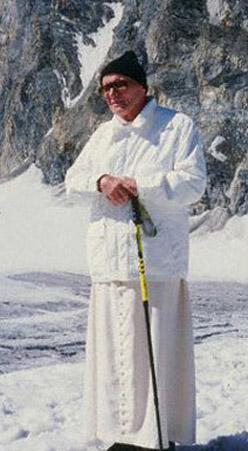
Way back when, a friend told me that, as he came to grips with the Vatican fishbowl in the early days of his pontificate, John Paul the Great would slip out of the walls in a Panama hat, trousers and open-necked shirt, discreetly trailed by plainclothes security.

But as time wore on and his profile grew, people started noticing the more than curious resemblance, and the papal breakouts in the Urb had to be curtailed.

Not so for the late amato's beloved mountains, however, as Don Stasiu reveals in his new release, A Life with Karol, out this week in Italian and Polish:
Pope John Paul II made more than 100 clandestine trips to ski or hike in the Italian mountains and was rarely recognized by others on the slopes, his former secretary said....

The cardinal, who was Pope John Paul's personal secretary for 38 years, wrote that the pope, an avid skier and hiker in his youth, often felt pent up inside the Vatican.

In the winter of 1981, the pope, his secretary and two of his Polish aides decided to make a "getaway" to the mountains from the papal villa in Castel Gandolfo.

They packed into a car owned by one of the priests, in order not to raise suspicions, and when they passed the Swiss Guard post one prelate opened wide a newspaper to hide the pontiff in the back seat.

Then they drove to the central Italian ski town of Ovindoli without an escort, winding through mountain towns and carefully respecting the speed limits.

Once they arrived, they chose a deserted slope and the pope was able to ski all day long. On the way back, the pope smiled and said, "We did it!" It was the first of many such escapes, the papal secretary said....
One of the first people to recognize the pope was a young cross-country skier, a boy no more than 10 years old, who was lagging behind the rest of his family when he came upon the papal party. He asked them if they had seen his family go by, and one of the priests pointed to the trail.
At that moment, the pope arrived at the bottom of the slope.

The boy looked astonished, pointed to the pontiff and began yelling, "The pope! The pope!"

One of the pope's aides intervened quickly: "What are you saying, silly! You'd better think instead about hurrying up, you're going to lose your group."

The boy skied away, and the pope and his friends quickly returned to their car and headed for Rome before the word got out.
Another CNS report hones in on Dziwisz's look at life inside John Paul's Vatican:
Pope John Paul II consulted with top aides about possibly resigning in 2000 and set up a "specific procedure" for papal resignation....

Cardinal Dziwisz said the pope, in fact, decided at the time to consult on the question with his closest aides, including then-Cardinal Joseph Ratzinger.

The pope concluded that he would remain in office, saying that God had called him to the papacy and that "God will call me back, in the form that he wishes," Cardinal Dziwisz wrote.

"At the same time, John Paul II also established a specific procedure for giving his resignation, in case he would not have been able to carry out his ministry as pope to the very end," Cardinal Dziwisz said.

"So, as one can see, he considered this possibility," he said....
On 9/11, the pontiff got news of the attacks while at Castel Gandolfo:
"On the other end of the line was the frightened voice of Cardinal (Angelo) Sodano, the secretary of state. We turned the television on, and the pope was able to see those dramatic images, the collapse of the towers with so many poor victims imprisoned inside."

The pope passed the rest of the day going back and forth between the television and the chapel to pray, he said.

"He was worried, strongly worried that it wouldn't end there, and that the attack could set off an endless spiral of violence," Cardinal Dziwisz wrote.
And the final act:
"It was 9:37 p.m. We had noticed that the Holy Father had stopped breathing. But only in that precise moment did we see on the monitor that his great heart, after continuing to beat for a few moments, had stopped." Someone, he said, blocked the hands of the clock to mark the hour of the pope's passing. Those around the pope's bed began singing a "Te Deum" of thanksgiving, not a requiem.

"We were crying. How could one not cry! They were tears of both sadness and joy. It was then that all the lights in the house were turned on. ... And then, I can't remember. It was as if it had suddenly become dark. It was dark above me, and it was dark inside of me," he said.
-30-

Monday, October 02, 2006

Stasiu: The Memoir

In what instantly becomes the most highly-awaited volume on the Vatican's "must read" list, excerpts have trickled out from Life with Karol, the memoirs of Cardinal Stanislaw Dziwisz of Krakow, who served as Wojtyla's personal secretary for four decades.

The book by the most powerful and omnipresent papal aide of modern times is slated for release next year... in Italian, at least.
In a chapter called "Those Two Bullets," Dziwisz recalls his feelings when Turkish gunman Mehmet Ali Agca shot the Pope while his open jeep was being driven through St Peter's Square on May 13, 1981 at the start of his weekly general audience.

"I tried to hold him up (after he was hit by the second bullet) but it was as if he was letting himself go sweetly," writes Dziwisz, who served Karol Wojtyla for nearly four decades from the time the future pontiff was a bishop in Poland.

"He had a grimace of pain but at the same time he was serene. I asked him 'where?' and he said: "In the stomach."

Dziwisz, who wrote the book together with Italian author Gianfranco Svidercoschi, said the jeep rushed the Pope inside the Vatican walls to its clinic, where he was laid "on the floor" of the building's atrium.

"It was only then that we realized the large amount of blood that was pouring out of the wound caused by the bullet that had pierced him," he writes....

"The siren did not work well and there was a lot of traffic. The driver was honking his horn non-stop. The Pope was losing his strength but he was still conscious."

"He was murmuring 'Why did they do it?' He uttered words of forgiveness for whoever shot him. I heard him pray, invoking 'Jesus, Mary my mother'."

The Pope lost consciousness when the ambulance reached the Gemelli. In the confusion and shock, he was taken by mistake first to the 10th floor and then to the operating theater on the ninth floor. Workers forced open two doors to get there quicker.

"The doctors who carried out the surgery told me later that while they were operating they were convinced that the patient would not survive," Dziwisz writes.

-30-

Thursday, March 23, 2006

THE CONSISTORY: The "Star"

The transition of Stanislaw Dziwisz from papal confidante par excellence to global prelate in his own right will be consummated tomorrow morning when the new archbishop of Krakow receives his red hat from the successor to the man he served for four decades.

A month off his 67th birthday, Dziwisz's elevation to the College of Cardinals caps a year of drastic changes, a return home, and a heightening of his own profile -- something he never sought.

Having been Karol Wojtyla's chaplain and personal secretary from 1966 until John Paul's death last April, Dziwisz has come into his own as the torchbearer of the John Paul legacy, and the quiet secretary who could always be found a discreet few paces away from his Pope has found himself showered with the affection and attention which marked the life of Wojtyla and his travels on the world stage.

Two weeks after being entrusted with the millennium-old See of Krakow last June, when Dziwisz received his pallium from Benedict XVI, as his name was announced in St. Peter's Basilica, the structure erupted into a spontaneous, extended ovation, which continued as he approached the pontiff to be vested in the symbol of the office Wojtyla once held. For his August installation in the ancient capital of Poland, the Holy See had to charter a plane which carried a score of cardinals, and a flock of bishops, clerics, Italian politicians and former Curial co-workers who sought to be on hand.

Dziwisz, who kept a notoriously quiet public presence during John Paul's lifetime, blossomed as a media presence only weeks following the pontiff's death. He disclosed, controversially, that he was keeping the late Pope's papers -- contrary to Wojtyla's request that they be burned -- and has made no bones about being the chief booster for John Paul's cause for canonization, a project with which he is said to be all-consumed. Such is the new cardinal's allure among the media that he has had to hire a full-time press liaison in Krakow to handle interview requests.

As Krakow, and Poland, prepare to welcome Benedict XVI at the end of May, the see founded by the Martyr Stanislaw will be a relative rarity for the next year as home to two cardinal-electors; Cardinal Francizek Macharski, John Paul's handpicked successor as archbishop, turns 80 in May, 2007.

After tomorrow, the other Sees to share that distinction will include Bologna's past and present Cardinal-Archbishops Carlo Caffara and Giacomo Biffi, and Cardinals Dionigi Tettamanzi and Carlo Maria Martini, S.J., both of Milan.


PHOTO 1:
AP/Pier Paolo Cito
PHOTO 2: Reuters/Alessandro Bianchi


-30-

Sunday, January 29, 2006

The Dangerous Precedent?

ZENIT has a piece up on the newly-released memoirs of Cardinal Julian Herranz, president of the Pontifical Council for Legislative Texts (and a numerary of Opus Dei)....

Herranz reveals a 2004 conversation with Dziwisz, in which the secretary revealed that John Paul II did consider resignation, so much so that Herranz was asked to offer his opinion on the topic.

The canonical justification might be seen in some quarters as suspect, but here it is:
Commenting on the "famous Canon 332," which in the Code of Canon Law refers to the possibility of papal resignation, Cardinal Herranz quoted the phrases he himself wrote after his conversation with Archbishop Dziwisz.

"We spoke of the opinion I expressed to him -- at his request -- on the appropriateness of the Holy Father resigning on his 75th or 80th birthday. I answered that he 'should not' do so for reasons of age: Very different is the 'canonical mission' that Bishops receive from the Pope to govern a particular Church or diocese with respect to the mission that the Pope receives at the very moment of the election and acceptance." ....

Archbishop Dziwisz "limited himself to comment that 'the Pope -- who is personally very detached from the office -- lives abandoned to the Will of God. He places himself in the hands of Divine Providence.'"
"Who is personally very detached from the office...." Now that's saying a lot.
"'Moreover,'" he quoted Archbishop Dziwisz as saying, "'he is afraid of creating a dangerous precedent for his successors, as some one of them might be exposed to subtle maneuvers and pressures by those who wish to depose him.'"
Sooner rather than later, it's still going to happen. Not the deposition bit, but a papal resignation for reasons of health. Paul VI also considered it, but Paolo Dezza talked him out of it.

Ironically, it is the increasing visibility and concentration of authority in the papal office -- enhanced most of all in the pontificate of John Paul -- which have created the scenario that the Pope must always be on top of his game and able to fulfill the functions of his office, thus bringing the issue of papal resignation to the fore with particular importance.

For the last half-decade before John Paul's passing, we saw what happens when that central force is dimmed: the curial wheels fall off, and everything can easily be seen not as an initiative of the Pope, but a vindication for this or that staffer who was able to force his hand. Not to mention the lines of communication and coordination being thrown terribly out of whack.

That's no way to govern a highly-centralized church.

-30-

Saturday, August 27, 2005

Widows and Orphans

As he marked his coming full-circle, Stasiu's supporters were out in full force. The Poles have actually made a weekend of it.

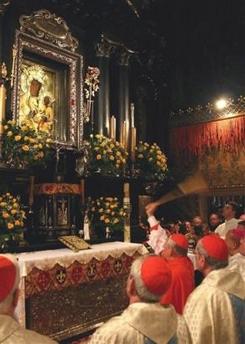
Yesterday, the Krakow prelate participated in the blessing of a new "screen" for the Black Madonna of Jasna Gora.
Dziwisz and Poland's primate, Cardinal Jozef Glemp, blessed golden crowns from John Paul, who died April 2, on the head of the icon's image of the Virgin Mary and on the image of the baby Jesus.

The crowns were "the last gift of his life to Mary, the queen of Poland," said Dziwisz, who will be installed as the archbishop of Krakow on Saturday.

Church leaders also placed a 20-pound panel of amber decorated with nearly 1,000 diamonds on the painting. The covering — commonly called a "dress" — leaves only the faces of Mary and Jesus and their crowns visible beneath the screen.

By placing the crowns on the icon, we were able "in a way to fulfill the last will, the testament of Pope John Paul the Great," Dziwisz said.

The priests of Jasna Gora estimated the crowd present at 100,000. And there was another great crowd in Tower Square, Krakow, for today's installation mass, which was held outdoors.


The canonical possession, itself -- i.e. the presentation of the bull of appointment to the chapter of canons of the Krakow cathedral, followed by the enthronement rite -- took place at the Wawel, followed by a procession through the streets to the Mariacki, where the mass itself took place. As it wended its way through swelling crowds, the successor of Stanislaw was preceded by a small gold coffin containing the relics of the martyr-bishop. The reliquary was kept on the altar for the liturgy.

Dziwisz was attended by an all-star international cast of prelates. Law, Ruini, Marini, Meisner, Sepe, Re and, not to be outdone, the Most High Pharaoh all turned out to witness the event. So it wasn't just a Homecoming, it was a Romecoming.

And now, with the Romans heading homeward, the work begins....

PHOTO 1: AP/Jacek Stroda
PHOTO 2: AP/Alik Keplicz

-30-

Friday, August 26, 2005

Dziwisz Comes Full Circle

Tomorrow, The Legend -- he who will forever define discretion in the role of personal secretary to the Pope -- will be installed in Krakow... God love him, he's still doing interviews:

As he lay dying, Pope John Paul II was aware of the presence of the crowd in St. Peter's Square below his apartment window and calmly viewed death as a "passage from one room to another," his longtime secretary said in an interview broadcast Friday night.

"He heard everything. He heard the square, he heard the prayer, the presence of the young people. The Holy Father heard, because he was conscious right to the end, almost to the end, even the last day," Archbishop Stanislaw Dziwisz told private Italian Canale 5's TG5 news in an interview....

The long-standing reports of "Amen" as last word are formally debunked.

The former papal secretary said the last words he heard the pope utter were "Totus tuus," the pontiff's Latin motto for "Completely yours," dedicating himself to Mary.

A nun who was nearby John Paul in the pontiff's final hours told him that she heard the pope say: "Let me go to the Lord."

"We were at his side in these last moments," Dziwisz said. "For him, death was really a passage from one room to another, from one life to another."

"In the last hours of his life there was a great tranquility and peace. He knew that he was going to his destination, to the Lord," the archbishop said. "He had not one bit of fear," but was in "great peace the last day," Dziwisz said.

It seems that Stan's at great peace as well... knowing that he's OK makes me a happy camper.

Tip to a Trad seeking alternative episcopal oversight. And, as we all know, that's so Catholic.

-30-

Sunday, July 17, 2005

More on The First 100

A lot of hay has been made of the piece from Magister the other day.

Bettinelli says that B16 "is less likely to leave matters of ordinary governance to his subordinates, like JP2 did with Navarro-Valls and Dziwisz. While he does have a certain group of people who work with him, they are much less influential than JP2’s inner circle, especially at the end of his life."

To put Navarro-Valls on a plane with Dziwisz as a policymaker is, at best, a naieve understanding of the operations of the Holy See from 1984. At worst, it's inept and an insult to Dziwisz, who has been insulted too much these days. JP had an inner circle of one: Dziwisz. Period. This Pope's circle, though wider and spread more thinly, is no less influential. Look at The Man Who Will Be Kingmaker, lo Statiunitense....

Even before the www.chiesa story broke, and having written extensively about Ingrid, I've become very intrigued with the figure of Birgit Wansing. While Stampa is not a theologian but a musician, translator and guardian of the Pope's sanity, Wansing is a force of theological heft whose voice carries weight with Ratzinger. Now that Ingrid has been integrated into the Curia, I'm told, her influence keeps increasing markedly, and her gentle hand is being felt.

Ostensibly with her Prefect's blessing, John Allen noted in The Rise that Birgit Wansing wrote an essay for L'Osservatore a few years back condemning animal cruelty as incompatible with Christianity. That's just fascinating. But it remains to be seen if she'll remain at the CDF or if she, too, will make the move once Levada is installed in Rome come September. Amato said in a recent interview that Wansing "is destined to change palaces," i.e. from the Holy Office to the Pope's direct service.

A major difficulty in the central coordination of the Curia -- a top reason why it speaks with so many voices -- is that, for all its many organs, there is no entity which could be seen as the Office of the Pope. The closest thing to this is State, to which his secretaries are accredited, where his correspondence is handled and the details of his major travel are worked out. The Prefecture of the Pontifical Household handles visitors and logstics, but where conflicts arise there is no gravitational force to balance the two, just the Pope himself and his secretary.

I have a funny feeling that this will be rectified in the coming shake-up, that we'll see the establishment of a properly constituted gathering of the Pope's own officials accountable to him alone and under his direct leadership, to assist in the increased effectiveness both of his own mission and that of the Curia which operates in his name. There'd be Georg, Ingrid, Birgit, etc... maybe a TNT or two to add to the glamour quotient.

And, of course, there'll be cats to keep the State mice at bay.

-30-

Saturday, August 27, 2005

Homecoming

On the throne of the martyr-bishop Stanislaw, the throne of Sapieha, and of Wojtyla....
Pope Benedict XVI... described him as "the best person to hold this position" in a papal bull read out by Rev. Jan Zajac during a ceremony in Wawel Castle cathedral.

"By now, the faithful have come to know your responsibility and dedication and I am sure they will be obedient to you," the bull said.
And, guess what, he's got the people in the palm of his hand:
Dziwisz blessed the crowds as he walked through the city, smiling as he repeatedly made the sign of the cross. Tens of thousands of people who lined the streets under the scorching sun responded with applause and shouts of "Bravo!"
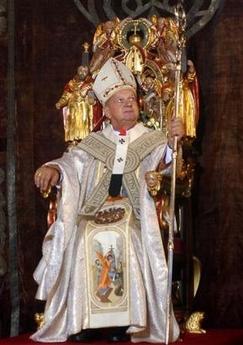
Because Krakow is the ancient seat of the kings of Poland -- its Cathedral is at Wawel Castle, the old royal headquarters -- the investiture of its archbishops is an occasion of added ritual over what we usually see. In these photos, you can see under the pallium, Dziwisz is wearing another around-the-shoulder wrap. It's the pendant, the ancient collar of the archbishops of Krakow, which the holders of the office have worn in a continuous line since the 1500s.


Over the years, Dziwisz grew into an important figure at the Vatican, where he was known simply as Don Stanislaw. His role as John Paul's gatekeeper developed as the pontiff's health worsened in the last years.

But to John Paul, he was simply "Stasiu," an affectionate nickname that revealed the closeness of the two men.

And the word's already going 'round that Stasiu wants to bring Wujek home.

PHOTOS: AP/Alik Keplicz

-30-

Thursday, June 09, 2005

Keeper of the Notes

Dziwisz speaks, again. And the notes ain't goin' anywhere.

"The Holy Father gave me an absolutely free hand on the matter,'' Dziwisz said [at a Krakow press conference]. "It is my responsibility what to keep. And I absolutely don't see that anything should be burned, destroyed,'' he said. "I think this belongs to the Church, to the society and to the general culture.''

He's right. By the construction of the sentence, it seems the "Holy Father" who has given "an absolutely free hand" here is not John Paul, but Benedict XVI. Dziwisz is not so stupid as to make this kind of move without the approval of the incumbent pope, so we can be sure that B16's on the wagon. And as the Pope is the supreme governor of the church and the Vatican State, there is no way it can be challenged.

But for some paranoid reason, CWNews -- the Catholic right's equivalent of (anti-)Catholics for a Free Choice -- are extremely anxious to defy the Pope (again) and throw John Paul's papers in the furnace. They've even begun to turn Don Stanislaw into Annibale Bugnini, a distortion which could be considered as sinful, if not criminal, character assassination. Check this priceless comment from one of the Lawler faithful:

Shall we perhaps look at this as an early test of Pope Benedict? A 'phone call to Krakow, maybe, quietly saying, "Stan, ol' buddy: burn the notes. Got it? Or would you rather be Archbishop of, say, Mecca?" Naturally, none of us would ever know. The Archbishop could just say he'd changed his mind.

It just gets worse every day. Even John Allen -- who could stay calm and cool as bombs drop around him -- is losing his patience.

****************

For a good while, I've been getting requests from interested parties as to my speculation on the succession to Archbishop Levada in San Francisco.

Because early spec is just that, speculation for its own sake, I resolved, for once, to avoid the fray -- because where there's a vacuum of truth, rumors and innuendo easily take over. And then, of course, there's the Washington situation, where it's not just spec for its own sake but bitter people who want to shoot Cardinal McCarrick to the moon on his birthday. God help us.

Nevertheless, it's still early in the process, the names are abounding and so much can change, but I've been briefed enough to posit for San Fran the name of Michael Sheehan, the 65 year-old archbishop of Santa Fe.

Sheehan is possessed of extensive episcopal experience (made bishop of Lubbock at 41), a stellar track-record of restoring confidence in local churches ravaged by abuse scandals (Santa Fe and Phoenix), and a Levada-esque pragmatism, nuance and constructiveness on translating doctrine into practice.

That's the tip right now, but who knows what the future brings?

******************

Lastly, as much as I hate to do it, I have to return to reality and make another pitch.

The hits keep coming. As it looks, between 200 and 300 people drop in every day to check the news and views. It's simply overwhelming.

But times are tough for a starving Vaticanista -- "pope-fatigue" has ravaged the secular press, compelling me to craft new and innovative ways to work on, literally, a shoestring. And despite the threats and bile of crazy people who e.mail me everyday, I'd like to keep on keeping on without selling out to advertisers or anyone who could dilute what I say and how I say it.

Along the right sidebar is a donation button. If you've gotten some enjoyment out of my scoops and believe in the value of this work, please consider dropping a couple coins in a blogger's guitar case. A little goes a long way these days.... Grazie mille for reading and for your support.

-30-

Friday, June 03, 2005

More Dziwisz

John Allen? John Allen? Hello?

I just got off the phone with a colleague who said, "You had the three biggest appointments of the past three months down, and Allen was nowhere to be found on them -- the Pope, Levada, and now Dziwisz."

Your Humble Vaticanista (I don't get paid for this) has won the Ecclesiastical Triple Crown. And from Philadelphia, no less. I might have to show at the Wawel on 27 August.

I actually ran the Don Stani stuff here on February 8, while JP was still alive. Feel free to check it, but here's a snippet:

We'll know John Paul II sees time as being short when he dispatches his great widow, Dziwisz.

...he will send his beloved secretary and companion of four decades as the final gift of his heart to the place where it's always remained -- to Krakow, to ascend the chair of another Stanislaw as archbishop there. The passing days make such a transition ever more feasible, given that John Paul's handpicked successor at home, Cardinal Francizek Macharski, will be 78 in May, thus his retirement letter has long been on the desk in Rome.For Karol Wojtyla to send his first student to continue the work in their beloved diocese would be bittersweet beyond words....

This is the story of stories, and when it happens just remember you heard it here first.....

You heard it here first -- twice. And now, it is what is. What else do I have to say?

-30-

Thursday, February 03, 2005

Three Taps of a Mallet

First off, all apologies as I haven't posted in a good while. A lot of small-bore stuff's been going on, and somebody had to handle it. Then I turned 22 and took a week off to celebrate -- fortunately it was a slow news week... And then Tuesday rolled around.

No, the pope is not dead... yet. But the world's press has converged on Policlinico Gemelli with all the fury of the Italian travel agents screaming into their cellphone earpieces who flurry about Fiumicino airport all day.

Is this the end of John Paul II? Probably not, but it's just another sign that the inevitable is drawing nearer and nearer.... As Dziwisz has said on multiple occasions, "The pope has outlived many of those who have predicted his imminent death." But a scare of this sort speaks to something which, until Tuesday, wasn't big news: that the complications of the pope's Parkinson's, and not the disease itself, would be the final straw -- its toll on his posture, bone structure and respiratory system is the area of weakness to be focused upon.

The coverage -- albeit apocalyptic in nature, at times (the Big Three leading their evening newscasts with live dispatches from Rome) -- has been comprehensive and sound, so no need rehashing here. But there are some interesting nuggets to be found:

  • When asked for a Bush statement on the "papal illness event," Scott MacLellan replied that the president's prayers "are with the Holy Father." This White House -- filled as it is with the spiritual descendants of those who saw Rome as the Great Satan -- has never used the term "Holy Father"; kudos to The Mahareshi Mahesh John Allen for noting that, in prior meetings with JPII, Bush 43 and Colin Powell addressed the pope as "Sir." But the use of "Holy Father" indicates the place conservative American Catholics -- a.k.a. the Petrine Rockettes -- hold in Rove's vision of the permanent Republica majority.
  • A colleague and I spoke last evening of the possibility of a DNR (do not resuscitate) situation, and what the plans would be. In prior times, the advisers would huddle behind the walls, safe from the attention of a waiting world learning every detail instantaneously. But if it came to the point where the question of heroic measures arose -- and I'm not saying we're at that point, but just as a hypothetical (the last thing I need is Phil Lawler, George Weigel ("VEEEE-gil," as a curalist would have it) and their sycophants jumping down my throat) -- I'm firmly convinced that the decision rests in the hands of Stanislaw Dziwisz, who Wojtyla has trusted his life with for almost four decades. No one knows this pope's mind, heart and soul like Dziwisz, and there's no real blood family gathered around. How the seeming change in teaching on life support these last few years might affect that is anyone's guess.
  • I've been doing a lot of talking these last few days, and one point I keep hitting is that John Paul saw everything after 6 January 2001 as something akin to "bonus time." He saw his mission as Wyszynski told him at his election, "God has called you to lead the church into the Third Millennium." At a late 2000 interdicasterial meeting on priorities and plans in the coming months, the focus turned to '01 and the pope lifted his hands and said "That is another's business." Since the end of the Jubilee, as I've been telling around, Wojtyla basically took one hand off the wheel -- not so much looking down at the papers on the desk as looking up.
So that is what is, for now -- stay tuned.

-30-

Monday, February 07, 2005

The Pope's Conscience, Part II

Well, the judgment of where all this goes will be if Sodano gets a dressing-down from Dziwisz which brings him to tears. Ratzinger made a comment in '02 just slightly skimming the question of resignation, and the chief confidante tore him a new one, forcing a white flag of pained sobs from the Panzerkardinal.

Anyone who needs reminding of where the truth ends and the Joaquin Navarro spin begins would be well advised to check this contribution from Bob Moynihan, editor of the aesthetically fabulous, superbly informed, quasi-theocon journal Inside the Vatican. I have to give Moynihan a tip of the hat as we share a teacher and mentor in the great historical theologian Jaroslav Pelikan, for whom I wrote a paper -- and with whom shared lengthy conversations -- on the communication of political ideas in the pontificate of John Paul II. Moynihan relates that the pope was, in fact, near fatal suffocation on the evening of 1 February, and only the persistent demand of Dziwisz got Wojtyla to the Gemelli.

Possible suffocation leads to the question of potential brain death and incapacitation beyond the point of dispute, but I'm not a physician and won't proceed to discuss the nuances of the medical situation.

As I said earlier, I could never get to a point through these years where I thought resignation a necessary option for JPII. But, given the comments of the day and having a better brief of what looks to come, it is time -- and it would, in the process, not dilute Wojtyla's diligent adherence to his mission, but enhance it. Here's why:

One of my great fears for the church after John Paul has always been the cult following among conservatives who have viewed him in a manner akin to how Rastafarians view Haile Selassie -- something more than human, more than mortal (and if the pope told them to light up, their children would never pass a drug test again). Let's face it, any successor who steps into the shoes of the fisherman will have a tough act to follow, but the Phil Lawlers, EWTNs, George Weigels ("VEEEE-gils," as senior curialists would have it) and other Papal Rockettes of this world have been so emboldened by the back-channels of the apartment in this pontificate that they will hunt down the successor and gladly serve as judge, jury and executioner if he dared do anything which didn't meet the litmus test they have established.

For them to declare obeisance to a pope who doesn't necessarily share their vision of what church is, and to be faithful to him, will be the test of their faith -- although, of course, they didn't stand with their "beloved daddy whom we adore to bits and pieces" on Iraq, strengthening the welfare state, working to curtail laissez-faire capitalism, advocating third-world debt relief, building a culture where life can be cherished and embraced at all socioeconomic levels, etc. etc. etc.

With that record, in essence, the papal cheerleaders have just served to make the church more insular and ostentatious. And if they're asked to do the work of Jesus for once, they'd shit. Just watch.

But these cultists will have a very hard time accepting any pope who isn't Ratzinger -- and even he has a few tricks (well-hidden, of course) up his sleeve that will cause some shock to the base. Were JPII to resign and be able to embrace and endorse his successor in life, then fade to the recesses, the message to the church (and especially to the polemicist choir) would be twofold:

1. A message of humility, that the papacy is bigger than any one individual, and it is not so much about the holder of the office as the one its occupant is believed to represent. One of the finest critiques of this pontificate came from the secretary to John Paul I, who said of the Second on his silver jubilee, "This is a pontificate where humility is trumped by zeal," and JPII would be seen as offering a final stroke of humility for the stability and vitality of the church.

2. A message of continuity. If a successor were chosen after the pope's death who had (even slightly) new ideas, the potential for a rupture in the Catholic world would be great, given the lack of ideological movement of the last quarter-century. Were a seamless transition to take place -- all details of interregnum would have to be worked out before all else, of course -- a new agenda, and a new torch-runner to carry it, would seem less drastic as there would be no real vacancy of office and things could have a more fluid path. There is the great possibility of a new generation of sedevacantists, and the only way they will stay within the walls is if the object of their devotion short-circuits them himself.

Every other bishop has to retire at 75 -- they may hand their dioceses to another, but fourty years of age limits has shown that a life's ministry is far from over when the administrative side ends. So it's a question of humility vs. zeal: Moses handed Israel to Aaron and went up the mountain, Jesus gave himself over to the cross. Will John Paul II follow their examples this time?

It's Wojtyla's (and Dziwisz's) call.

-30-

Monday, March 05, 2007

Nycz: SB-Resistant, Ratzi-Tested, Dziwisz-Approved

Named on Saturday, Archbishop-elect Kazimierz Nycz of Warsaw will be installed on 25 March, Annunciation Day, in the city's St John's Cathedral.

This time, Cardinal Stanislaw Dziwisz of Krakow -- the late John Paul II's private secretary of four decades -- has voiced his unabashed pleasure at the appointment of the former auxiliary of Wojtyla's homebase to Poland's premier ecclesiastical post, telling the state broadcaster that, not only is he grateful to Benedict XVI for picking Nycz, but that "the whole nation rejoices" at the selection.

And the Krakow priest who's made his name looking into church collaboration in the time of the Communist regime has added his voice to the chorus....
Fr. Isakowicz - Zaleski, author of a major publication on the Catholic Church in the times of communist regime in Poland said that the new nominee has an exemplary past of heroic opposition to the temptations of collaboration with communists. According to the communist secret services documents, archbishop Nycz was approached by communist functionaries numerous times and pressured to become a secret spy, but had the courage to say "no".

PHOTO:
AFP


-30-

Friday, November 23, 2007

The Cardinals' "Come-to-Benedict"

In the final count, the daylong meeting of the cardinals drew 143 red-hats, and reds-to-be.

Writing on the resurrected NewsHub, CNS' John Thavis blogs the flavor from the New Synod Hall:
A pool of journalists watched as cardinals entered the Synod Hall building one by one. Some came by foot, some were chauffeured and one — 75-year-old Dutch Cardinal Adrianus Simonis — rode a bicycle to the meeting hall.

Cardinal-designate John P. Foley stepped out of his car and began chatting with reporters on the other side of the press pen. Within seconds he looked up, a bit surprised, to see a cluster of fuzzy boom mikes overhead. “I guess my every word is being recorded,” he remarked....

Near the building’s entrance, a vehicle dropped off Cardinal Bernard Law, the former archbishop of Boston, who went directly inside. Cardinal Angelo Scola of Venice, energetic as always, jumped out of his car before it even stopped moving and began conferring with fellow Italians in the parking lot.

Those who walked were sometimes intercepted. Down near St. Peter’s Square, Portuguese Cardinal Jose Saraiva Martins, head of the Vatican’s saintmaking office, was sidelined by a stamp collector who asked him to autograph a recent commemorative series.

Inside the atrium of the hall, each cardinal was handed a red folder, which presumably contained a program and the text of the day’s main address on ecumenism by Cardinal Walter Kasper.

Old friends and colleagues greeted each other: Cardinal William J. Levada, the Vatican’s doctrinal chief and the former archbishop of San Francisco, conversed with Cardinal Roger Mahony of Los Angeles. [Friends for a half-century, the two were seminary classmates.]

Polish Cardinal Stanislaw Dziwisz of Krakow was warmly welcomed by everyone in his path. I asked Cardinal Dziwisz how it felt to come back to the Vatican, where he had spent more than 26 years as secretary to Pope John Paul II. He paused a moment and said, “So many memories,” and then moved into the Synod Hall.
The morning's topic, of course, was a discussion on ecumenical and interreligious dialogue, with facilitating duties falling to the president of the Pontifical Council for Christian Unity, Cardinal Walter Kasper, who subsequently briefed the press:
On relations with Anglicans, Kasper said the 77-million member Anglican Communion was in "a very difficult situation" with the challenges by traditionalists -- many from the Third World -- against liberal bishops in western countries.

The Anglican Communion is in internal crisis over the ordination of women and openly homosexual bishops.

"We hope they make a decision very soon. They cannot postpone all this crisis. There must be a decision made. But it is not in our hands."

Relations with Protestant Churches were getting more difficult because of "an inner fragmentation" among them, Kasper said. "Some of them have turned to liberal (positions) and there are now new ethical problems dividing them," he said.

He said that evangelical churches were spreading quickly and noted there were now 400 million Pentecostals around the world.

These two conservative Christian movements have been spreading especially rapidly in Latin America, often wooing away the faithful from the Catholic Church there.

"We must not ask first what is wrong with the Pentecostals but ask what is wrong with our pastoral work and come to a spiritual renewal," he said.
PHOTO 1: L'Osservatore Romano
PHOTO 2: AP/Plinio Lepri


-30-

Thursday, October 16, 2008

"From a Far Country"

Thirty years ago today... the cardinals shocked the world:


(Translation.)

...and now it's come to light that he didn't just survive one assailant:
Previously unpublished details of an assassination attempt on the late Pope John Paul II in Portugal in 1982 have been revealed in a film based on the memoirs of the Pope's former private secretary.

In the film, due to be shown at the Vatican this week, the late Pope's aide Cardinal Stanislaw Dziwisz tells how a deranged priest drew blood when he tried to kill John Paul with a bayonet during a religious ceremony at the Fatima shrine....

It came exactly a year after a Turkish gunman, Mehmet Ali Agca, had shot and wounded the pope in Saint Peter's Square in Rome.

But that same evening, the Vatican formally denied there had been another assassination attempt.

The following day, Portuguese television broadcast footage of the attack.

It was carried out by a mentally unbalanced Spanish priest who was arrested after being jumped on by the Pope's bodyguard, Archbishop Paul Marcinkus.

Archbishop Marcinkus laughed this off when I asked him what had happened.

"You can't always believe what you see on television," he told me.

The Pope continued his trip without disclosing his wound.

The priest who carried out the attack, Juan Maria Fernandez y Krohn, was later tried and sentenced to over six years' imprisonment for his crime. He was then expelled from Portugal.
The film -- Testimony, an outgrowth of Don Stanislaw's memoir of "Life with Karol" -- premieres tonight in the Paul VI Hall in the presence of Benedict XVI.

Papa Wojtyla's closest aide for nearly four decades, fresh vidstream's up of a long interview Dziwisz gave on his North American tour last summer. Per custom since the Polish Pope's death, today is marked as "Pope Day" in his homeland.


-30-