Sunday, January 28, 2007

It's TC Time

At a Vespers/Lectio Divina tonight in Toronto, Archbishop Thomas Collins kicks off the public festivities to mark his arrival as the 12th head of Canada's largest diocese. The media rollout, however, is already up and running.

The Sun is impressed:
[W]hat is most striking about Toronto's new Archbishop Thomas Collins is how supremely human he is.

Talking to him is like talking to a thoughtful, engaging next-door neighbour, excited about his future responsibilities, yet clearly in touch with his roots....

He's an open book. No question goes unanswered. Nothing is off the record....

Though he considered being a teacher -- "I was always a studious type" -- or a lawyer -- "because of my mother's work" -- those aspirations changed with the inspiration of one special priest.

Collins will never forget Father Newstead who went to the hospital every day to visit the sick, he said. "That kind of faithfulness really impressed me."

Newstead was also Collins' Grade 11 English teacher at Bishop Macdonnell Catholic High School, and one day, he said, "Tom, you should really think about becoming a priest," and that influenced him profoundly.
The paper also runs a fun Q&A.
WHAT'S YOUR FAVOURITE BOOK, BESIDES THE NEW TESTAMENT?

The Lord of the Rings.

YOUR FAVOURITE MAGAZINE?

I don't really get magazines and if I do, they relate to my religious life. The one I subscribe to is First Things.

FAVOURITE MOVIE?

A Man for All Seasons

MOVIE STAR?

I don't watch a lot of movies.

FAVOURITE TV SHOW?

I don't watch TV very much, but I sometimes watch the Antiques Road Show.

BEATLES OR ROLLING STONES?

I like classical music, Bach. My favourite piece is the Christmas Oratorio.

WHAT HISTORICAL FIGURE WOULD YOU LIKE TO HAVE DINNER WITH OTHER THAN JESUS CHRIST?

Oh, shucks. Gosh. Interesting. I love reading biographies of American presidents, so Abraham Lincoln.

WHAT'S SOMETHING ABOUT YOURSELF THAT NO ONE KNOWS?

I used to be a take-out waiter in a drive-in restaurant, it used to be that we took the stuff out to the cars. This was a long time ago now, but it was my first job. We served hamburgers and French fries and I remember once knocking over a big thing of chocolate milk shake. And at the end of the night, when we were finished our shift, we all got to eat all the left over French fries.

IF YOU COULD BE ANYTHING OTHER THAN A PRIEST, WHO WOULD YOU BE?

Gosh, I don't know because I'm in one of those situations where I am what I want to be. I love being a priest and I love being a bishop. I love being what I am.

WHO WILL WIN THE SUPER BOWL, CHICAGO OR INDIANA?

This is a question too profound and deep for a humble soul like me. Too profound. Too profound.

STEAK OR SEAFOOD?

(Laughs) Depends if it's Friday. No. Oh, I like them both. I don't have any preference. I'm not very clear on these things, am I?"
And on the op-ed page, Basilian Fr Thomas Rosica -- CEO of Salt and Light TV, who interviewed Collins earlier this month for the network -- writes that the city should "Rejoice."
[From Edmonton] I have never heard of so many people, especially young people, who are so sad to be losing their bishop to Toronto. That's quite a statement in this day and age in the church -- and for that matter in any organization. Archbishop Collins spoke to the mind, but even more so, to the hearts of many people. He knows how to walk humbly, and listen compassionately, yet he is no ecclesiastical wallflower. He is a teacher at heart and a man of the church in the best sense of the word.

Archbishop Collins learned how to teach and reach people not only in the pews in church, nor in a formal classroom or lecture settings (even though he did a great job at that!)

Legend are the teaching moments that took place in Tim Hortons' doughnut shops in Edmonton, meeting young people and spending time in conversation with them. They listened to Archbishop Collins in Alberta. And they will listen to him in Toronto. God knows how much we need good teachers in the church today....

His appointment to Toronto has been hailed as an emblematic appointment by Benedict XVI. Why should Toronto be thrilled and grateful to be getting a bishop like Thomas Collins? The first and most fundamental quality any bishop must have is personal holiness. We Catholics understand holiness as not being "otherworldly," pie-in-the-sky spirituality, but rather a description of someone who walks humbly among us, reflecting in one's life love of God, personal integrity, humility, decency, honesty, intelligence, kindness, uprightness and sincerity....

What do we desire in a new bishop and shepherd? A preacher who can convert souls; a prudent administrator and disciplinarian, shrewd in finances and not governed by human respect; honest; experienced as a parish priest -- not symbolic, but a real, lifelong pastor; highly intelligent and learned in theology and scripture; familiar with secular culture and able to address it in its terms, and effective with -- and not intimidated by -- the media.

To Archbishop Collins: Welcome to Toronto, you breath of fresh, crisp, Western Canadian air! "Toronto the good" will be "Toronto the better" because you said 'yes' to Benedict's invitation to come to this great metropolis.

And to the rest of us who are watching and waiting, let us work together to make his burden light, and to be open to the many lessons this new shepherd will teach us.
A couple notes to bring you all up to date: the final numbers are out on Tuesday morning's installation, which is expected to pack 1,000 guests (Canada's three cardinals, 60 bishops, 300 priests and leaders of government, commerce and culture) into St Michael's Cathedral downtown. The lone American among the hierarchy in attendance will be Archbishop Charles Chaput OFM Cap. of Denver, a friend of the man of the hour.

Collins' feline "furry friend" Frodo made the trip from Edmonton with the archbishop. At least for the time being, however, the cat's staying with the prelate's sisters at the family home in Guelph.

And while Tuesday's installation marks the formal inauguration of Collins' ministry as archbishop of Toronto, the legal formalities have already taken place. In a private meeting of the archdiocese's college of consultors on Friday morning, the archbishop presented his bull of appointment to its seven members, at which point he took canonical possession of the post.

-30-

Sunday, December 17, 2006

Lead, Kindly Light

Putting his stamp on Canada's largest and most visible local church, Pope Benedict yesterday named Archbishop Thomas Collins of Edmonton as archbishop of Toronto. It's a homecoming for the Ontario native, who turns 60 next month and becomes the tenth archbishop of the nation's sprawling hub of media and commerce.

Collins succeeds Cardinal Aloysius Ambrozic, who reached the mandatory retirement age of 75 almost two years ago. With a reputation for quiet kindness and an earthy holiness -- he's been called "the gentlest man on the planet" -- the Rome-trained theologian and scripturalist with a background in priestly formation, a Master's in English and an affinity for John Henry Newman was a dark-horse in the conversations leading up to yesterday's announcement.

Once the news broke, it didn't take long for the rejoicing to light up phone lines and inboxes in Canadian church circles. In a thinly-veiled jab at the perceived frontrunner, Archbishop Terence Prendergast of Halifax, one elated northern hierarch chimed in that Benedict XVI "chose the man of prayer over the man of politics"; a Jesuit and former Toronto auxiliary, Prendergast was in the news earlier this week after a gay couple who had civilly married in Canada were prohibited from receiving the Eucharist at his directive, and the couple announced their departure from the church.

Even in his own province, the appointee's understated style has often been overshadowed by his outspoken suffragan, Bishop Frederick Henry of Calgary, a darling of conservative church activists. Last Monday, however, it was the leader of Edmonton's 340,000 Catholics who received word of his appointment to head the 1.6 million-member flock of Anglophone Canada's lone cardinalatial see.

So, how's he feeling?

"I'm kind of in a daze," Collins told me hours after the announcement as, holed up at his desk in Edmonton, he got his first taste of the profile that comes with his new charge. It was still early in Alberta, but Toronto's archbishop-elect said he'd already had "quite a day."

By turns playful and pensive, Collins was consistent in his almost-overwhelmed surprise at the move, and in displaying the positive, open tone Benedict's choices have almost unilaterally manifested to date. While acknowledging that Canadian society "is heading in directions which are often against the Gospel," the prelate said the church there must "be sure that we connect with the society we're in... not doing that in a way of condemning, but of inviting."

"We've got to make the light shine and reach out. We've got to build bridges to people," Collins said, citing GK Chesterton and Archbishop Fulton Sheen as "heroes" in the effort.

"We've got to be engaged."

Recently invited to preach retreats for two regional groupings of the United States Conference of Catholic Bishops, Collins has made one-on-one contact a priority of his ministry over ten years as a bishop in the west. Named to Edmonton in 1999 after two years in St Paul, Alberta, he'd tell parishioners that if they wanted to talk, "just give me a call," giving out his phone number from the pulpit, but with a warning: "If you don't get the digits right, you'll get a pizza place."

An easterner by birth who only went west on his appointment as a bishop in 1997, Collins says he isn't daunted at returning to his home province, as "the church is the same everywhere you go." While Canada's cultural and geographic divides each provide a unique "flavor," "the issues of individualism and living with a secular society, reaching out to young people, and trying to encourage people to participate in the church, encouraging people for vocations" remain largely the same, he said.

As the intimacy of his current setting gives way to the MTA's vast diversity and scope, however, he admitted that keeping up a similar outreach amid the multiplied responsibilities of the new archbishopric would be more difficult. It's not the only sacrifice of his new reality; Collins' two sisters, who still live in his hometown of Guelph and spend their Christmases with him, are flying west on Tuesday. While he was looking to greet them, they'll be arriving as heads to Toronto for his first visit since the appointment and two days of transition meetings.

"We're going to pass each other somewhere over Manitoba or Saskatchewan," he said, joking that he would "wave out the [plane] window as theirs goes by."

When the archbishop met with Pope Benedict on his ad limina visit in late October, he said he just "babbled on about the diocese," and was taken aback on hearing yesterday that the pontiff was likely auditioning him for Toronto. Benedict delayed action on the appointment until he could spend some time with Collins, who was part of the final group of prelates on the Canadians' quinquennial pilgrimage to the Vatican. The Pope is believed to have had his eye on his eventual choice after the archbishop's interventions at last year's Synod of Bishops on the Eucharist.

While, in their private meeting, the Pope probably noticed Collins' bookishness -- the latter confessed to a "coffee table... stacked with books: history, biographies, poetry, a lot of stuff" -- one thing that didn't come up in the session was their shared affinity for cats. At the suggestion of his sisters, shortly after arriving in Edmonton he got himself a "furry little fellow with furry feet," which he didn't name at first.

"I thought if I called it 'Rex,' I might give it an identity crisis," he said. "I thought if I called it 'Gandalf,' that'd be kind of pretentious."

He eventually settled on Frodo. And the cat's coming with him.

Though it must take place within two months of yesterday, Collins' installation date is yet to be determined.


PHOTO:
Archdiocese of Edmonton


-30-

Friday, December 22, 2006

"A Ray of Hope"

Word's come from Toronto that Archbishop Thomas Collins' installation will take place on 30 January at 10.30am in St Michael's Cathedral.

To think: almost two years exactly after an early Friday morning of pre-Super Bowl revelry in an Irish pub here in Philly, the "T.O." chant will be getting quite the unanticipated resurrection. (Don't expect to hear it from me on Christmas evening, however.)

Writing in yesterday's National Post, the columnist Fr Raymond De Souza -- a priest of Kingston and onetime student in Rome -- offers his take on the appointment:
While Toronto's archbishop has no formal authority outside his diocese's boundaries, the sheer size of Toronto and its status as the nation's media capital make the archbishop the sine qua non of the Church's presence in Canadian public life. While it might pain those of us outside the metropolis to admit it, it is often the case that if doesn't happen in Toronto, it doesn't happen at all. Cardinal Ambrozic recently reorganized his communications office for this reason, appointing a new communications director who understands that in order to communicate the Gospel, you first have to communicate. In so doing, he prepared the ground for his successor, a formidable intellect with a winsome way of preaching the Gospel.

In this, Archbishop Collins is cut from the same cloth as the Archbishop of Quebec City, Cardinal Marc Ouellet, appointed in 2003. Both are modest men, rather soft-spoken, authentic scholars able to propose the Catholic tradition to a skeptical, even hostile, culture. They are both men who, if left to their druthers, would probably choose the library and the classroom, but, given their vocations, are quite content to serve as bishops too. They are not long-faced pastors, wearing their sacrifices on their sleeves. They were both made bishops by John Paul II, but are more in the mode of Benedict XVI, the reserved scholar-pastor.

In Ouellet and Collins, the leading French and English bishops respectively, Canada has moved to the front rank in terms of the quality of its Catholic leadership. Ouellet is already regularly consulted in matters of concern well beyond Canada, and it won't be long before Collins is in demand far and wide....

On my last visit to Edmonton, I stayed with him in his very modest home, the basement of which was given over to a makeshift library. Even the altar was alongside a long shelf of books. I offered the Holy Mass there privately, a circumstance in which there are rarely distractions. Not the case that time, where my eye was constantly drawn to the library -- the Thomas More section was closest. Yes, he has a Thomas More section, to which he will no doubt be frequently referring in his newly prominent role in dealing with political and cultural leaders who, now as then, only wish to go along to get along....

Every new archbishop is welcomed by all parties. Those who loved his predecessor think he will carry on in like manner; those who didn't will hope a revolution is at hand. Thus Archbishop Collins comes to Canada's largest city as a ray of hope. Once the decisions come which displease this or that group, his mission will be to remind the Church and the city that a bishop, despite his manifest talents, cannot bring hope himself, but only point to the One who does.
-30-

Tuesday, January 30, 2007

The New Jerusalem, A New Beginning

A transition marked by a level of hope and excitement befitting the Second Coming hits its peak today when Thomas Christopher Collins formally takes the reins of Canada's largest local church as Toronto's 10th archbishop.

Underscoring the demand on space in St Michael's Cathedral for the Mass, which begins at 10.30am local time (1530GMT), invitations to the local presbyterate have largely been limited to the pastors of the archdiocese.

After his first public engagement since arriving in the 1.6 million-member local church -- a Sunday evening Vespers and Lectio Divina service arranged at the last minute and still able to attract a large, and largely young, crowd to downtown's St Basil's Church -- Collins spent yesterday with the media, including back-to-back sessions with the editorial boards of the two main national dailies and a sit-down with the Toronto Star where he cited the church's imperative to be engaged in a wider variety of issues.
"Look at what we say. Look at what we are engaged in. The Catholic Church is at the forefront of social justice issues," Thomas Collins says.

He points to the many food banks, soup kitchens, housing projects and clothing and toy drives run by Catholic parishes as evidence of the commitment of the church to addressing the needs of the poor.

"These people are there every day," he says....

Catholic leaders, acting on instructions from the Vatican, have become more engaged in the political process over the past year.

This means urging parishioners to consider Catholic teachings when voting, and lobbying politicians to do the same when setting public policy.

Collins says that mandate must apply to fighting poverty.

But too often, he frets, Catholic leaders are called upon to comment only on such issues as reproductive rights or same-sex marriage.

As important as those issues are, the church also needs to get its voice heard on social justice topics such as poverty and housing, he says.

"We need to speak, to be engaged in the dialogue of the broader community."

His first priority, however, will be to become reacquainted with Toronto and the Ontario political scene after 10 years in Alberta, where he was named archbishop of Edmonton in 1999.

"God gave us two ears and one mouth. We need to listen more than we speak."

But before long, Collins says, the church will speak out more about finding solutions to the root causes of poverty – including inadequate incomes, social supports and housing – while still addressing the immediate needs of the poor.

"There has to be that immediate reaction. If someone is hungry, we feed them. If someone is homeless, we house them," he says.

"But we also need to look at the roots of those sorts of things. Are there policies of the society that could be changed?"

All churches and church leaders, he says, have not only a right but also a reponsibility to be active in such political and policy discussions.

"We are part of society. We've been here since the beginning and are massively involved."

Although no media outlets took up the 60 year-old prelate's offer of beginning interviews as early as 6.30 am, his installation day is getting its public start with a live interview on CBC television's national morning show.

Slated to run in the area of 15 minutes, Collins' homily today will play to his strengths as a Scripture scholar, hinging on the Book of Revelation's vision of the "New Jerusalem" and its message for the life of the church.


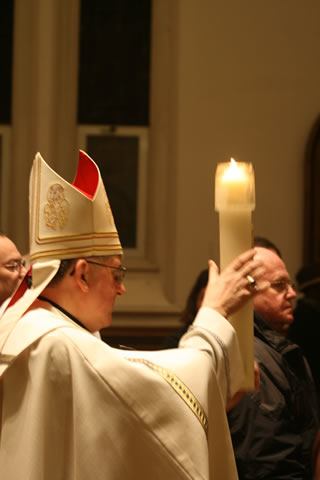
PHOTO:
Archdiocese of Toronto


-30-

Sunday, January 14, 2007

"...Now Off to Ontario -- and Dalton McGinty"

Especially after the church universal's spent the last week focused intently on The Installation That Wasn't, it's only fair to shift gears and start looking at The Installation That Will Be, eh?

Sixteen days before Thomas Collins inaugurates his ministry as archbishop of Toronto and two days before his 60th birthday, the church of Edmonton bade its departing head an affectionate farewell earlier this afternoon; a Liturgy of the Word was held in the western city's St Joseph's Cathedral-Basilica, followed by a public reception. Among nine presenters paying tribute were Alberta's Chief Justice AH Wachowich, Sr Geraldine Kelly, the chair of its Council for Women Religious, and Basilian Fr Timothy Scott, president of St Joseph's College at the University of Alberta -- who, in a fitting sendoff for the English lit scholar, offered a poem titled "The Ballad of the Roaming Metropolitan."

B16's mid-December appointment of Collins to succeed the retiring Cardinal Aloysius Ambrozic as shepherd of the 1.7 million Catholics in Canada's commercial and media capital is the sitting pontiff's most significant move in the English-speaking world to date. The high level of interest in the pick, both in the Great White North and from points far beyond, evidences this. It's part due to Toronto's prominence as the nation's largest local church and its Anglophone sector's lone cardinalatial see, and part curiosity as, despite being Benedict's emphatic choice for the post, the eventual nominee was viewed as a dark-horse contender in the prelude to his selection.

As he prepares to return to his home province of Ontario with his massive library and feline housemate Frodo in tow, the prelate of the hour is going viral -- as in video.

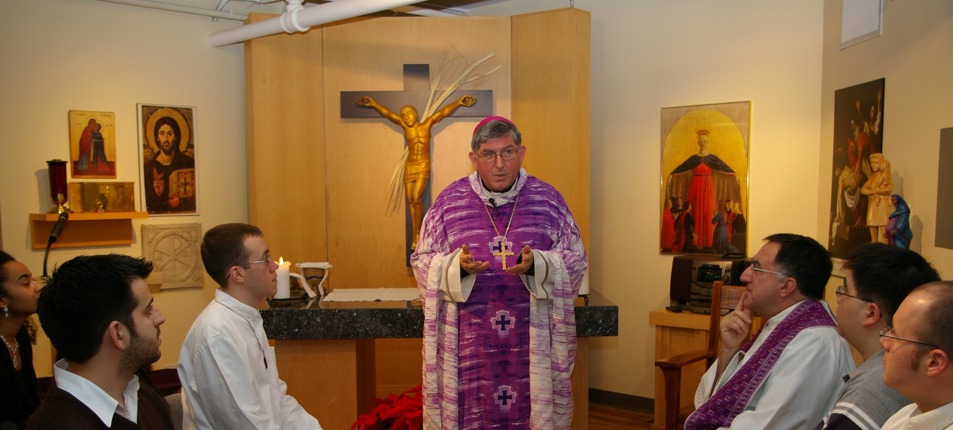
A scripturalist by trade, Collins taped the Edmonton archdiocese's first set of weekly reflections on the Sunday readings for the month of January, the Catholic Insider podcast recently re-ran a Collins interview from WYD '05, and in advance of today's leave-taking of the see where he's served for eight years, the archbishop sat for an extended interview with Salt and Light, the Toronto-based Catholic TV outlet. (The above shot was taken during an impromptu Mass the archbishop celebrated at its studios over his pre-Christmas swing-through.)

The half-hour session for Witness, the channel's flagship program, won't be broadcast until Installation Weekend. Fresh from the editing room, however, the first view of it is yours, with thanks aplenty to S&L CEO Fr Thomas Rosica CSB and his staff for providing the sneak preview.

Among topics covered: "abuses" of the Book of Revelation (the subject of the archbishop's doctoral dissertation), integrating the new movements, engaging both the "gathered and the scattered," the media, vocations, Fulton Sheen, and the suggestion of a dedicated "ministry for politicians" as opposed to turning the altar rail into a firing line.

More to come, of course. Canucks, get the Tim Hortons on the ready.

PHOTO:
Joe Sinasac/The Catholic Register


-30-

Friday, May 18, 2007

"The Priest Is Not His Own"

Up in Toronto on Candlemas Day, I found myself in a hallway of the rectory at St Michael's Cathedral.

Fuelled by the famous Horton's coffee and "Timbits," the new archbishop was up and running, but his permanent suite was still being prepared. In the interim, the 30ft main corridor was, excepting the various doorways that marked it, lined with cardboard boxes, stacked about five feet high along both sides.

Only on seeing the little strips of masking tape with one or two word notes on the sides -- things like "Eucharist," "Newman" and "Politics" -- did it become clear that the boxes contained not socks or knick-knacks, but Thomas Collins' library.

Having served as rector of London's St Peter's Seminary when his call to the episcopacy came, it shouldn't come as a surprise that several of Collins' book-boxes were marked "Priesthood." But even so, he turned to an old favorite -- Fulton Sheen's "The Priest Is Not His Own" -- in ordaining his first class for Canada's largest local church last week. (Like the pontiff who named him there in December, TC is given to the extemporaneous, so an audio version of his homily has been posted; whenever, in a space of minutes, you get to hear ministry described as "being a feather on the breath of God" and clericalism denounced as "a profound lack of appreciation for the majesty of the priesthood," it's a rare treat to behold.)

Speaking of priesthood and vocations back on Candlemas, Collins -- probably the first senior prelate to be interviewed whilst perched on an ergonomic chair -- told me that "if we're going to be who we're called to be, we've gotta live it to the full and do our best, and do it for our Lord," emphasizing "all those countless, countless, wonderful, wonderful priests" whose witness has served "to lead people into the priesthood.

"The reason the guys are there in the seminary," Collins said, "is because they met -- largely, often -- some really wonderful priest, who was just living it to the full."

As for vocations strategy, the subway-hopping prelate came down firmly on the side of an approach he termed as "people, not paper," repeating it to underscore the point.

"That's gotta be the way," he said. "We can always retreat into a bunker surrounded by paper, and we can give ourselves the illusion that we've done a full day's work.... You can hand guys [who've already expressed interest] information on the seminary -- that's fine. But posters, brochures, stuff like that -- I think they probably have zero influence."

In his days as rector, the archbishop -- who said that "hearing confessions" has been the greatest joy of his 34 years of ministry -- recalled that he once asked his seminarians what influenced them to enroll in formation. From the group of 50 or so, he said, "I forget the exact numbers, but it was something like this: 'the example of a priest,' 45 of the 50 said yes. 'I was invited by someone' -- I think that was 40 of the 50. 'Vocation literature,' zero."

"John Paul I used to say how some books are good for keeping doors open and things like that," he said.

It didn't seem like any of those were taking up space in the boxes outside.

Keeping with his prior practice, within days of his arrival as the chief shepherd of Toronto's 1.6 million Catholics, Collins set up a phone number for men considering the priesthood to be able to call him directly.

He gives the digits out from the pulpit at every Mass he celebrates. When that moment arose at the close of last week's ordination liturgy, the crowd responded with a standing ovation.


PHOTO:
Archdiocese of Toronto

-30-

Wednesday, September 12, 2007

Lectio TO, Vol. I

Everytime the archbishop of Toronto appears on these pages, people from all over respond in a uniquely enthusiastic way, and in notable numbers.

Why, you ask? Because, in the finest sense of the term, Thomas Collins "gets it." And whether the 60 year-old prelate's talking up cats, the priesthood, his boyhood hero Fulton Sheen, or preaching amidst the lilies of the field -- the YouTube debut that scored him over 4,000 views -- Benedict XVI's most-prominent appointee to date in the Anglophone world echoes the teacher-Pope's knack for engaging the faithful with the same mix of gentleness, sincerity and substance that've won the pontiff a captive global audience.

But seven months into his stint as pastor of Canada's largest diocese and its 1.7 million Catholics, the approach is what Collins promised it'd be on his arrival: a ministry not just to the "gathered," but the "scattered," too. And though the archbishop says he's still learning the lay of the land, the fruits are already popping up; a reader wrote in over the summer that a friend of his "who left the church decades ago... now attends Sunday Mass at St Mike's [Cathedral] hoping that TC will be preaching."

"There is a pastoral way about this man that is remarkable," the reader wrote.

Already, Torontonians have learned of Collins' love for chili and heard a drive-time radio host dub him the "Wayne Gretzky of the Catholic church," they've gotten used to seeing him riding the subways and streetcars or passed around the phone number the onetime seminary rector gives out at the close of every liturgy with an invitation for young people considering a vocation to call him directly. But even for all that, only earlier this week did TC roll out the element of ministry that's become his public hallmark...

...well, aside from the coffee-and-donut-fueled chats over a table at Tim Horton's.

As archbishop of Edmonton, Collins -- at the prompting of some of his Alberta flock -- began a monthly series of Lectio Divina services in St Joseph's Cathedral there. In a short amount of time, the Sunday night gatherings for formal Vespers, followed by meditation and reflection on a short Scripture passage, became a hit. And, it could be said, the return of the ancient practice in the Canadian West was ahead of the curve; in 2005, the Pope himself said that "if it is effectively promoted," Lectio Divina "will bring to the church – I am convinced of it – a new spiritual springtime."

On Sunday night, the first of the Toronto sessions took place in St Michael's, with the Sermon on the Mount as its text.

With the "scattered" in mind, the Lectio series will be podcast in full; the first evening comes in two parts (links open as mp3): Collins explaining the practice, and his meditation/reflection in its entirety.

Tolle, exaude...
Take and listen.

Rather, click and listen.

-30-

Friday, June 29, 2007

Canada Day in Rome

As previously mentioned, a record five archbishops from Canada received their pallia this morning. Shown above following the Mass are (from left) Archbishops Terence Prendergast SJ of Ottawa, Brendan O'Brien of Kingston, Thomas Collins of Toronto, Gerard Pettipas C.SS.R of Grouard-McLennan and Richard Smith of Edmonton.

Prendergast departed for Rome hours following his Tuesday installation in the capital's Notre Dame Basilica, and O'Brien doesn't take the reins of Anglophone Canada's founding fold for another month. For three of the recipients, as CNS noted the other day, it's something of the deja vu kind -- Prendergast, Collins and O'Brien are each receiving the insignia for a second time, having headed other archdioceses prior to their transfers. Considering that there are only 17 Latin-rite provinces up north, that 30% of them have changed hands within six months is a rather unusual stat. And that's not counting the appointment of the Vatican's #2 man on Catholic Education, Archbishop Michael Miller, as coadjutor of Vancouver on the first of this month.

Then again, Luigi Ventura is no ordinary nuncio.

It's worthy of note, too, that the rapid cycle of transfers only began after Pope Benedict vetted the individual bishops following the Canadian hierarchy's yearlong set of ad limina visits (coming for the US all through 2009).

The States, meanwhile, had but one recipient this morning -- Archbishop-elect Joseph Kurtz, who doesn't take the reins in Louisville until 15 August.

Just before flying out for Rome earlier this week, Kurtz called into the home office to offer some reflections on the days ahead. Appointed to succeed Archbishop Thomas Kelly only 17 days ago, he's had quite the month, with the last-minute trip necessitating his absence from Wednesday's launch in Denver of the first stage of the US bishops' nationwide initiative geared toward strengthening and encouraging marriage. (More on that in a bit; Kurtz is chair of the USCCB's Committee for Marriage and the Family.)

Traveling with a delegation of just five, the incoming head of Louisville's 200,000 Catholics, shown here during his big moment earlier today, said he had never been to a Pallium Mass, let alone concelebrated one, let alone on such short notice.

Having met Benedict XVI in his time as prefect of the CDF, the archbishop waxed filial of his "great admiration" for the Pope; "I love his writings, his pastoral leadership," he said.

"I just think we're really blessed with this Holy Father."

As the incoming metropolitan over the province he's been a suffragan bishop of for the last seven years, the archbishop-elect said the in-house move had a deeper meaning to it as opposed to entering a province as a newcomer. He praised Kelly, who he singled out among the nation's 34 archbishops for having "really worked hard on bring together the bishops of our province for prayer, for support -- for unity, really."

Noting his happiness that "there are no strangers" among the bishops of Kentucky and Tennessee, Kurtz pledged to maintain the close ties. Continuing Kelly's work "is a great blessing," he said.

Saying he's spent the last few weeks boning up on the history of the pallium, the 60 year-old pilgrim prelate said he was expecting a "very moving" morning. He "didn't expect" to be making the trip this year, he said, noting that it was the nuncio to Washington, Archbishop Pietro Sambi, who "urged" him not to delay his reception of the lambswool band until 2008.

Even so, Kurtz looked on the bright side, musing that "having such a small group might make me focus on the more spiritual aspects of this great event." Two Knoxvilleans with him in the Eternal City, and the outgoing head of its burgeoning local church said he "didn't think it'd be as emotional" to leave as it's proven itself to be.

"I've really felt a great bond with the people here," he said. Even though Louisville offers a wealth of opportunities for new bonds, he mused that missing the "great warmth" and "great unity" of Tennessee and his team there "would be the hard part.

"We have a wonderful diocese here," he said, "it's such a vibrant church.

"People really desire to live the faith and to be true to it.... Being bishop here is kind of like being pastor of a larger [parish] church."

While Kurtz's delegation includes two Tennesseans and two representatives from Louisville, it should come as no surprise that -- as with every ecclesiastical party worth its salt -- the group includes a Philadelphian: Kurtz's longtime friend and seminary classmate Msgr Herbert Bevard, who celebrates a new ministry of his own this weekend as he's installed as regional vicar of the city's northern half.

For those curious about the pins he'll need to keep his new garb weighed down, they're staying within the family -- Kurtz said his set of the traditional three gemmed spikes will be, at his precessor's insistence, a gift of Archbishop Kelly.

Elsewhere in the Basilica seats, the famous Frodo might've had to stay back in Guelph, but Toronto's archbishop got to bring both his sisters and a dozen friends to see him return for his pallium part deux.

It's something of an upgrade from 1999 -- when, receiving the band of wool as the new archbishop of Edmonton, TC recalled that his first pallium delegation numbered "zero, moi, just me."

For all your Petrine and Pauline needs -- and just in case anyone hasn't yet heard Vatican Radio call Collins a Peruvian -- Salt + Light is running this morning's Pallium Mass on a webstream.

And to all our readers up in the Great White North, all good wishes for a relaxing and enjoyable Canada Day this Sunday.


PHOTO 1:
Fr Owen Keenan/Archdiocese of Toronto
PHOTO 2: Alessia Giuliani/CNS/CPP

-30-

Thursday, March 22, 2007

Bishop Smith Goes to Edmonton

At January's end, whilst doing the (ecclesiastical) star-gazing during Archbishop Thomas Collins' installation in Toronto, one couldn't help but notice the bishop of Pembroke standing solidly head and shoulders above the other prelates grouped on either side of the cathedra.

Sure, Richard Smith is tall. But, me being me, I took it as a bit of an omen....

This morning, the Pope named the 47 year-old Smith as archbishop of Edmonton, succeeding the aforementioned TC.

The appointment is but the latest step in a rapid rise for Smith, currently president of the Ontario bishops and also spiritual advisor to Canada's highly-influential Catholic Womens' League (CWL). A native of Halifax, where he served as vicar-general prior to his 2002 appointment to the northern Ontario diocese of 65,000, he was a professor of theology at St Peter's Seminary in London in addition to serving simultaneously as pastor of three communities. A Roman alum, he earned his doctorate in theology from the Greg in 1998.

When Smith addressed the Pope in the name of his confreres on the Ontario ad limina last fall, this readership was advised that the Pembroke prelate "seems to have the makings of a rising star" and "might want to keep an eye on him."

Suffice it to say, message received.

Word from the north deems the appointment an "inspired" one and another Luigian triumph. For his part, the archbishop-elect said this morning that his move "gives rise... to mixed feelings."

Edmonton was moved upon quickly following Collins' January departure for Canada's most-prominent ecclesiastical post. The Pembroke opening is the third one pending in Ontario, alongside the vacant archdiocese of Kingston and the archdiocese of Ottawa, where Archbishop Marcel Gervais has announced that his successor will be in place by June's end.

As Collins' road didn't end in Edmonton, Smith's buzz has already indicated likewise. But that can wait for another time.


PHOTO:
Diocese of Pembroke


-30-

Monday, January 22, 2007

To TO, To Stay

Earlier this morning, Archbishop Thomas Collins entered into his new See, where he'll be installed next Tuesday before a crowd headlined by 60 bishops and Canada's three cardinals.

The 60 year-old prelate made a characteristically unassuming arrival from his birthplace of Guelph, on the bus he's taken "countless times" since his boyhood. This time, however, something was different: "now I am heading home to Toronto," Collins said in a message sent en route from his Blackberry.

The week of festivities inaugurating TC's ministry as the 12th head of Anglophone Canada's flagship local church begins with one of his signature flourishes Sunday evening as the archbishop-elect presides at a Vespers service with Lectio Divina at TO's St Basil's Church. A series of regional Masses around the diocese begins in St Michael's Cathedral three days following the 30 January installation. The week following, Collins has blocked out two days for private meetings with his new presbyterate.

Due to space restrictions, attendance at the installation liturgy will be limited to ticketholders. Due to cost considerations, a live feed has been tabled, but the feed will be available on a delay to Canadian viewers via Vision TV and Salt and Light. At press time, an archived webcast hasn't been ruled out.

(And, speaking of S&L, in tribute to Archbishop Meagher a moving interview with the just-homegone Kingston prelate has been re-posted.)

As it all nears, keep it here for the wall-to-wall.

-30-

Thursday, October 09, 2008

"An Encounter with the Word": Synod Requests "Lectio"-n Day

In a notable request, the Fathers of the Synod have requested not just an explanation of lectio divina, but to be led in it that they might better understand the ancient practice of contemplative Scripture reading better.

Addressing a 2005 conference marking the 40th anniversary of Dei Verbum -- the Vatican II decree on the Word -- B16 said of lectio divina that "if it is effectively promoted, this practice will bring to the church - I am convinced of it - a new spiritual springtime."

Ergo, the Synod's request can be filed under "better late than never."

Regardless, the tradition takes many forms -- individual and collective, earthy and liturgical, monastic and urban, etc. -- and resources abound out there on each... but of 'em all, one of its best-known celebrations takes place at St Michael's Cathedral in Toronto, where Archbishop Thomas Collins leads a monthly pontifical Vespers and lectio divina on Sunday nights that he began after an unexpected request for it from young people in his prior post in Edmonton.

A Scripture scholar (specialty in Revelation) named to lead the 1.7 million-member Toronto church -- Canada's largest diocese -- in late 2006, Collins' first lectio series (focusing on the Sermon on the Mount) began last September in St Michael's, and at its start he explained some of the practice's general principles:


Video of the entire first year of "Lectio TO" is available on-demand... yet before rolling it out at the cathedral, the telegenic cardinal-in-waiting warmed up by leading lectio in a field at a youth retreat:


...and here's part two.

-30-

Monday, January 17, 2011

Between "Both Great Scandals," the Visitation Continues

It might've been his 64th birthday, but yesterday saw Archbishop Thomas Collins faced with a less-than-celebratory task -- leading a penance service for the Irish clergy sex-abuse scandals on his Apostolic Visitation to the country's southern province.

During the rite at the Cathedral of the Assumption in Thurles, Co. Tipperary -- seat of the archdiocese of Cashel and Emly -- the Toronto prelate revisited the lone-voiced approach to the crisis that he first employed during its European eruption last year: a line of thought that, among others, won plaudits from no less than the New York Times....
“What does the most persistent journalist who reports priestly evildoing have in common with St John Vianney, the holy Curé of Ars, patron of parish priests?

“They both expect priests to be holy.”
...and more:
Collins said a practical way in which the Catholic Church could show its concern was by "doing all that we can to learn from this experience of evil, and so to try to be sure that it never happens again"....

"We cannot escape the horror of this by pointing out that the great majority of priests serve faithfully, with integrity and compassion....

"[E]ven one priest gone wrong causes immense harm, and throughout the world priests have done unspeakable evil, sometimes within the very sacramental setting which should above all environments be most sacred and safe.

"But it is the sacred responsibility of us all, but most especially of the authorities in the church, to do what we can to prevent such evil, and to deal with it effectively whenever it is found.

"The crimes themselves, and the failure of church authorities to respond adequately to them, are both great scandals.

"We recognise the courage of the victims and their families who came forward and shone the cleansing light of truth on their suffering."
* * *
On a related note, with the seminary leg of the Visitation begun over the weekend as Archbishop Timothy Dolan arrived at the Irish College in Rome, it's emerged that, in tow, the Gotham prelate has brought along a "dream team" of prelates with top-shelf formation cred to aid him in the process.

Beyond the previously-reported addition of Archbishop Edwin O'Brien of Baltimore -- Dolan's predecessor as rector of the Pontifical North American College (as well as a two-time rector of New York's St Joseph's Seminary, Dunwoodie) -- the group likewise includes President Tim's top protege, Bishop Bill Callahan OFM Conv. of LaCrosse (a highly-regarded spiritual director at the NAC before being dispatched back to the States as Dolan's auxiliary in Milwaukee); Msgr Francis Kelly, a priest of Worcester currently serving as rector of the Casa Santa Maria (the NAC's home for priest grad-students), and two sons of Pittsburgh: the once-longtime head of the USCCB's vocations desk, Bishop Ed Burns of Juneau, and Bishop Bernie Hebda of Gaylord, a former #3 at the Vatican's canon-law council, who doubled as a spiritual director atop the Gianicolo while in the Curial post.

From Rome, the team heads to the Isle's four domestic seminaries, beginning with St Patrick's, Maynooth, on 31 January.

While the seminary look-in's lead is, of course, no slouch it comes to articulating a gold-standard of formation, as yardsticks go, it could be said that the guiding vision for what Dolan & Co. will be seeking was given on Irish soil last year: the address the Visitor gave last May at Maynooth, only hours before the Holy See announced the unprecedented inquest.

-30-

Thursday, January 14, 2010

"Prophet, Witness, Servant"

At Tuesday's ordination of one of his two new auxiliaries for Canada's largest local church, Archbishop Thomas Collins of Toronto preached a challenging catechesis on the bishop and his ministry, especially in moments of crisis, that won raves from many on-hand to hear it.

Before all else, the homily's subtext bears noting: this week's rites elevating Bishops Bill McGrattan and Vincent Nguyen were the True North's first since late September's sudden resignation of Bishop Raymond Lahey of Antigonish, only after which it emerged that the Nova Scotia prelate had been arrested on charges of possessing child pornography. (Lahey's quickly-named successor, Bishop Brian Dunn, will be installed in a low-key liturgy on the 25th.)

A Scripture scholar, longtime formator and sometime retreat-master for Stateside clerics now approaching his third anniversary at the 1.7 million-member TO church's helm, Collins turns 63 at the weekend. Last week, Pope Benedict named the media-friendly cleric to the membership of the Pontifical Council for Social Communications.

The archbishop's fulltext is below.... Considering the frequent temptation to focus more on the office's prestige than its responsibilities, it's an especially useful read.

The shot above comes from yesterday's ordination (audio/photos) of Nguyen, Canada's first-ever Asian prelate, whose moving story of faith, family, fortitude and firsts has garnered national coverage.

PHOTO: Archdiocese of Toronto


-30-

Friday, November 06, 2009

Pope Engineers TO Church

Almost three years after Archbishop Thomas Collins took the helm of Canada's largest local church, this morning Pope Benedict named the cardinal-in-waiting's first two auxiliaries for the nearly 2 million-member Toronto archdiocese.

Canada's first Asian prelate, Bishop-elect Vincent Nguyen, 43, left his native Vietnam at 18, was ordained in 1998, completed a licentiate in canon law last year and, just last month, was named TO's moderator of the curia. Notably, in its announcement this morning, the Holy See said that one of Nguyen's great-grandfathers was among the 117 Vietnamese Martyrs, who were collectively canonized in 1988 by John Paul II.

The second pick, 50 year-old Fr William McGrattan, has served until today as rector of St Peter's Seminary in London, Ontario -- in which post he succeeded Collins on the archbishop's 1997 appointment as bishop of St Paul in Alberta. Ordained a priest in 1987, the bishop-elect served along the way in parish work and as a vocation director.

Notably, both appointees came to the priesthood from backgrounds in engineering; McGrattan earned his bachelor's in chemical, working both in the field and as a research assistant until his ordination, while Nguyen picked up his degree in electrical, entering a discernment house a year after graduation.

No ordination date has yet emerged for the duo -- and, per Northern custom, no Appointment Day presser takes place.

* * *
The appointments are Canada's first since mid-September's shocking resignation of Bishop Raymond Lahey of Antigonish following the prelate's arrest on charges of possessing child pornography.

While a successor at the helm of the 150,000-member Nova Scotia diocese is said to be quickly in the offing, the scandal's fallout led the president of the Northern bench to dub the mood an "annus horribilis" at the Canadian bishops' recent plenary, while -- following reports that suspicions over Lahey's behavior were raised as far back as the late 1980s and never acted upon -- TC recently used his annual turn at Toronto's Cardinal's Dinner fundraiser to speak of the need for discernment:
Anyone who has participated in the awesome rites of ordination is conscious of the majesty of the priesthood of Christ, which He has chosen to share with frail humans, "vessels of clay" as St. Paul calls them, so that He might work through them in a sacramental way. I celebrate several ordinations each year, and every time I am filled with awe. When I place my hands upon the head of the candidate at the moment of ordination, I silently pray in my heart: "Lord, may this man be a faithful and holy priest all the days of his life."

To me, as a bishop, the pain of any priestly scandal is a sharp personal reminder that I need to do all that I can to be sure that those who are ordained, for all their inescapable human frailty, are living their vocation with integrity.

In our seminaries, over the long period of preparation for the priesthood, we continually strive to improve our procedures for solid human, intellectual, pastoral, and spiritual formation, so that only those candidates who are suited for the priesthood will proceed to ordination.

As for the choice of bishops, the process is extremely thorough, with detailed letters of reference from dozens of men and women. A thorough process, but not perfect. If no one in that extensive reference net is aware of a problem, it will be missed.

Those entrusted with discerning who should be ordained as priest or bishop need to be diligent, and to pray for wisdom, always aware that they might fail to spot an unsuitable candidate, especially if the problem is deep seated and hidden from everyone behind a splendid exterior.

As for improper behaviour by those already ordained, I and all of us who exercise authority in the Church have a solemn obligation to God and to the people we serve, especially to the most vulnerable, to act clearly and effectively if a problem is discovered, although also with great care that injustice not be done to an innocent person, whose name and life can be destroyed be a false accusation.

The basic reality is that in the sacrament of Holy Orders God works through frail humans, and always has done so, and always will. In the twelve apostles we see the whole range of raw material from the beloved disciple to Judas. As long as the human heart is susceptible to iniquity, we will face scandals among the apostles.
-30-

Tuesday, October 05, 2010

The Benedictine Majority

And so, folks, it's time....

Or is it?

Some might've already seen its earlier leak via Page Three, but here below -- formatted for A1... and with some bonus "Director's Cut" feed -- is the final installment of this scribe's very own "Ring Cycle": the Q&A delved into last week for Michael Sean Winters at the National Catholic Reporter's Distinctly Catholic, this one's focus on a rapidly-changing College of Cardinals in what could be the run-up to the third consistory of B16's pontificate.

Again, to be clear, that's could be -- while reports have circulated since May of a 20 November date for the elevation of new members into the "Pope's Senate," said timetable has not sufficiently been confirmed for the house's customary comfort level; as of this writing, a conspicuous lack of chatter amid what would usually be the final approach to a papal announcement of the next intake bears particular note. (Keep in mind, too, that the prospective slate of cardinals-designate has likewise appeared to evolve since the initial warning sirens and, of course, could continue to do so -- not just until Announcement Day... but, at least in theory, all the way to Consistory Morning itself.)

While the winds of "when" could well make a turnabout over the coming days -- and if they do, as ever, you'll know quick -- a concerted push is understood to have been made from some quarters for a later date. By early April, the Pope will have at least eight additional openings in hand (25 in all) to return the current contingent of 103 cardinal-electors to its full complement of 120, to say nothing of the logistical nightmare that the Christ the King weekend scenario would augur for Stateside pilgrims; not only would the now-customary Consistory Eve consultation between the pontiff and his cardinals begin all of 15 hours following the close of the US bishops' Fall Plenary in Baltimore, but the festivities' end would either see the American delegations heading home amid the costly chaos of Thanksgiving Eve (traditionally the nation's busiest air-travel day of the year), or pilgrims stranded in Rome for the holiday. That said, the take below applies regardless of when Red Dawn deigns to break.

To sum things up editorially, the (one, two, three) four long-frame analyses you've seen here over the last week represent the most intense writing cycle this scribe's undertaken over these last six years -- some 12,000 words in all, the final product crammed with more facts, stories and all-around institutional memory than you'll probably find anywhere in open circulation on this beat.

If anything, that's a perk of the medium -- these pages' ability to be frank, faithful, fair and fluent on this most daunting of subjects is, admittedly, unique; to do this kind of stuff anywhere else would involve a trade-off, whether of nuance and depth on the mainstream-news side... or, on the other, the freedom born of a distance from the institutional or ideological constraints that dominate the "official" ecclesial realm, especially in these polarized days.

Over 20 million hits later, the perch has yielded its dividends in many ways... that is, except in the one place it hasn't: a solvent budget. (And just to be clear, this last week's pieces, while commissioned by an outlet, were produced gratis -- as ever, simply for love of the game... and, candidly, to remind oneself that the A-game remains intact.)

Put simply: per usual, but even moreso now given the distinct possibility of double-whammy road stories just ahead, the fate of this work lies in its readership's hands. As things stand, just the usual bills have served to suck up the shop's traditional shoestring resources, and the short-term outlook doesn't just rule out traveling to cover the stuff, but being able to cover the stuff at all....

As ever, whether Quittin' Time is just around the corner rests in the ineffable design of Providence. Either way, God is good, the ride's been tremendous, and if the day's indeed close at hand, as swan songs go, this would be pretty tough to top.

But let's cut to the fun part. The Final Question is... "According to some reports, Pope Benedict is preparing to name new cardinals, possibly as soon as next month. What can we expect in the College’s next class?"

And here, your narrator's stab at it:

* * *
I’d normally be reluctant to compare people to bulls... but there’s something about that scarlet that really drives folks wild -- and not just in the church. Indeed, a friend once mused that if Martians ever descended, not knowing our languages, customs, anything about us, even they’d be able to quickly tell the difference between a bishop and a cardinal because of how everybody just seems to charge toward anyone wearing the rank’s distinctive color, and what it represents.

Thanks to that, consistory time -- or, as my readers have come to know it, “Red Dawn” -- has a particular magic to it, and one I’m especially fond of. To cite just one example, when Texas got its first cardinal at the last intake in late 2007, the H-Town horde that wildly stormed Rome for the week provided the Eternal City’s first mass-taste of Catholicism in the American South, and the group’s typically-Texan buoyancy served to considerably brighten the impressions of many Vatican folk on the state of the US church after the scandals. (OK, to cite another example -- because I can't resist -- thanks to the coverage that surrounded it, it's because of a consistory that I'm here, doing what I'm doing... so I literally owe my life to one.)

On his return, Dan DiNardo was suddenly thrust into the top rank of the city’s -- and the Lone Star State’s -- civic leadership as no Catholic cleric had ever been. No less than an Evangelical dubbed it the "Second Coming," and above all, I remember hearing that, out of nowhere, at least some local parishes found themselves deluged with calls from people who’d become curious about the church thanks to the wall-to-wall media coverage and were looking to learn even more. As good times go, especially these days, you can’t really ask for more than that.

In its broadest sense, though, the week of celebrations highlights the universality and spirit of the faith at its best -- Vietnamese, Mexicans and Kenyans dancing in St Peter’s Square, Italians kicking (and Spaniards pushing) their way through the crowds to the customary horde of receptions, Americans finding a fresh sense of faith and perspective at absorbing a living history far more extensive than anything we have... all in all, one big happy family -- even if the period inevitably leads one to consider what the mainstream press have come to term the PDE: that is, the “papal death event.”

As of this writing, Benedict XVI has 17 open seats in the college that’ll elect his successor, with two more cardinals reaching the age of 80 -- and, ergo, becoming ineligible to enter a hypothetical conclave -- by 14 November. So that makes nineteen slots to return to the maximum 120 (a number set by Paul VI in 1975).

Already, in the red hats he doled out in March 2006 and November 2007, the pontiff has named thirty -- that is, at least a quarter -- of his successor’s eventual electorate, so restoring the “papal senate” to its voting maximum would give Papa Ratzinger 42% of “his” cardinals in the electoral college, the remainder named by John Paul II.

But here’s where it really gets interesting. Between now and the end of 2012, at least an additional 23 seats will open up just on account of electors “aging out.” The result: within just seven years of his own election, B16 will have an unfettered hand to choose not just a majority of the voting college, but a contingent just shy of the two-thirds necessary to elect the Roman pontiff. What’s more, while John Paul II -- who repeatedly broke with Paul’s 120 limit, once ballooning it as high as 135 -- tended to name his cardinals significantly older, especially toward the end of his reign, as of today Benedict’s additions to the scarlet tide have an average age of just over 68 -- a figure bound to fall considerably once the new class takes its seats.

Lastly, this rapid turnover of the college presents the specter of a scenario that could end up being a rather pointed last word on John Paul’s legacy: the distinct -- and, with time, ever-growing -- possibility that one of Karol Wojtyla’s chosen cardinals will never don the papal white. (A month after becoming archbishop of Munich, Joseph Ratzinger was elevated by Paul VI at his last consistory in 1977 -- only one other Montini creation voted in the 2005 conclave.)

All this is of especially crucial import for the Stateside church: of the cardinals turning 80 within the next two years, no less than six -- almost half of the 13 electors the US started 2010 with -- are ours, four of them either becoming ineligible over the next year or already so rendered since January. For American Catholicism, a glut of openings of this sort is without any precedent. And just as he has with his appointments of bishops, Benedict is playing a conspicuous game of long-ball -- of the two residential prelates he’s already elevated on these shores, Boston’s Sean O’Malley is 66, DiNardo all of 61; upon their elevations, each became the youngest cardinal named on these shores since LA’s Roger Mahony received the scarlet biretta at 55 in 1991.

While we’re at it, one would be wise to recall the relative youth of those who the pontiff’s placed in the pipeline to fill those rapidly-opening seats -- Mahony’s successor-in-waiting, Archbishop José Gomez, is 58; New York’s Archbishop Timothy Dolan is 60, and the coming go-round’s most bankable American pick, the Vatican’s “chief justice” Archbishop Raymond Burke, is 62. In other words, they won’t just be around to elect Benedict’s successor, but maybe even his successor’s successor, to say nothing of the impact they’ll respectively have over nearly two decades among the nation’s topmost church leadership.

At the same time, the pontiff’s already begun undertaking another kind of domestic shake-up: shifting the distribution of the US’ red hats -- a strategy intended both to more accurately reflect the drastically-altered demographic spread of the nation’s 68 million Catholics, and to reward the “growth and dynamism” of the shift's new leading outposts.

Before DiNardo’s elevation, the last time an American city saw its first cardinal came in 1967, when Washington -- still freshly severed from the Premier See of Baltimore -- celebrated the elevation of Archbishop Patrick O’Boyle. Prior to that, you’d have to go back to 1953, when -- the conferral of the red hat (left) still taking its medieval form -- the New York-born archbishop of Los Angeles, James McIntyre, became the nation’s first Roman prince to reign west of Chicago.

While the gameplan began in Texas, the coming churn is, in time, practically certain to make more red-hat history in the South -- most likely with the Harley-riding, cigar-chomping, hyper-competent and ever-colorful native son now heading the 1.3 million-member Miami church, Archbishop Thomas Wenski, or Atlanta (now home to a million Catholics) and Archbishop Wilton Gregory, the much-acclaimed USCCB president in the opening throes of the sex-abuse crisis, and a figure said to enjoy the pontiff’s particular high regard from those turbulent days. And maybe even both. As a bonus, just as Gomez’s certain red hat will mark the rise of the States' first Hispanic cardinal, elevating Gregory -- an especially beloved figure among the progressive crowd -- would see no less a watershed moment: an African-American prince of the church.

While we’re at it, it’s worth adding that, between Wenski’s blasting of "xenophobic politics" and handy summary of Catholic social teaching -- “No man is a problem” -- and Gomez’s bilingual Installation Day message that “no one is a stranger for [God] and no one is an alien for any of us,” thanks to Benedict, the migrant to these shores, irrespective of legal status, hasn’t had such faithful, forceful and high-ranking friends enter the US' top rank since Mahony, whose commitment to migrants has famously been a hallmark of his nearly half-century of priesthood.

In a press conference on his appointment, the pontiff’s Miami pick -- who likewise held a Mass of Reparation over Notre Dame's choice of President Obama as its 2009 commencement speaker and, even before his installation, urged Florida Gov. Charlie Crist to sign a (subsequently vetoed) bill that would’ve mandated ultrasounds for women considering an abortion -- memorably compared the illegality of undocumented immigration to getting “a parking ticket.” Additionally, last week saw history in the South Florida church as Wenski's top aide in Orlando, Sister of St Joseph Elizabeth Worley, took office as Miami's Chancellor and Chief Operating Officer, making the archdiocese the largest Stateside see by far to have a woman in its lead administrative post. (While the even larger churches of Los Angeles and Rockville Centre also have female chancellors, Worley alone holds the distinction of serving as de facto "moderator of the curia" -- a title that, per the canons, can only be formally given to a priest.)

All that said, let’s take a look beyond these shores and toward the class whose ascent is, so they say, soon ahead.

Above all else, the next consistory will almost certainly bring something I’ve been chomping at the bit about for some time: the day when TC makes TC -- that is, at long last, the entrance of Toronto's Archbishop Thomas Collins into The College.

To be sure, the red hat has literally hung over the head of Canada's largest and most diverse local church since early 2007; the galero of TO's first cardinal, James McGuigan, is suspended from the rafters of St Michael's Cathedral, directly above the archbishop's chair. Still, it couldn't find a better head to land on. In a nutshell, Collins is one of the most prayerful, unpretentious, generous, happy and holy prelates I’ve ever been blessed to know... and, truth be told, I’ve known him since I was a kid. That he’s gone on to lead the True North's mega-fold -- its Catholic population quickly approaching 2 million -- never ceases to be astonishing, simply because he’s remained his priceless, earthy, clear and charitable self throughout. (Case in point: you’re almost as likely to find him alone, queued up for a coffee and Timbits on a run to one of downtown TO’s numerous Tim Hortons’ stands -- “St Timothy’s,” to the archbishop -- as in the sanctuary of St Michael’s.) When I simply mentioned the coming inevitable to Collins on a Sunday evening we spent catching up over the summer -- the beginning of a week in Toronto when, among other talks, he asked me to speak with his priests on the value of integrating technology into their ministries -- his face turned even more scarlet than the biretta heading his way, less out of anticipation than a seeming sense of dread.

Recently, though, the signs of Benedict's approving eye have begun to tick up: a January appointment to his first Curial membership (a nod most cardinals only get post-elevation); the May commission to serve alongside Dolan, O'Malley, Ottawa's Jesuit Archbishop Terry Prendergast and other top-shelf Anglophones in leading the high-stakes Apostolic Visitation of the Irish church, and in late 2009, Rome's provision of two auxiliaries for the burgeoning TO church, one of them the archbishop's hand-picked top administrator: 43 year-old Vincent Nguyen, a refugee from Vietnam and engineer by training who became not only Canada's youngest bishop, but its first from an ethnic minority.

A Scripture scholar, longtime seminary formator, cat lover and committed technophile, the “hard-charging” 63 year-old prelate is a refreshing antidote to the frequent griping over the alleged “anti-Catholicism” of media one tends to hear from senior prelates, especially whenever a scandal’s afoot. As the global press bore down on the Vatican over the European revelations in the run-up Holy Week, Collins issued a markedly different message than the chorus of American bishops who slammed what they saw as a battering of the church, telling his Chrism Mass crowd in the cathedral that, if anything, “we should be grateful for the attention which the media devotes to the sins of Catholic clergy, even if constant repetition may give the false impression that Catholic clergy are particularly sinful.

As opposed to scandal-mongering, he added, “that attention is a profound tribute to the priesthood” as “people instinctively expect holiness in a Catholic priest, and are especially appalled when he does evil.”

While the natives were declaring war on The New York Times -- and the paper ferociously blasted right back -- the Grey Lady’s op-ed columnist Ross Douthat saw fit to highlight Collins as a “bishop who gets it.”

Especially these days, high praise, indeed.

* * *
Across the Pond, meanwhile, another global star of the next class presents itself in the person of Joseph Ratzinger’s hand-picked successor in Bavaria’s top post: the archbishop of Munich and Freising, 57 year-old Reinhard Marx.

As the abuse crisis’ most recent turn erupted in Germany earlier this year -- its impact said to have taken a particular toll on the pope -- Marx quietly slipped the scene in early April to make his first major US tour, stopping in New York and Chicago after delivering a well-received turn at Notre Dame, where he devoted the annual Vatican lecture to “The Social Message of the Church in the Context of Contemporary Challenges.”

A trained sociologist, media magnet and long the German bishops’ lead hand on issues of work and the economy, in late 2008 the motorbike-loving, “larger-than-life” Munich prelate -- said to have been part of his predecessor’s drafting committee for what would become B16‘s social teaching manifesto, Caritas in Veritate -- published a book-length retort to Karl Marx’s Das Kapital, today’s Marx subtitling his rebuttal “A Plea for Man.”

The country that, with the US, underwrites the Vatican budget more than any other, not since 2001 has the head of a German diocese been elevated to the Pope’s senate. Beyond his age, Marx’s mind, savvy, provocateur's taste -- and Benedict’s clear über-favor -- make him an ever-rising figure beyond the bounds of the pontiff’s cherished homeland, with the red promising just to speed up the ascent.

* * *
And lastly, the coming consistory will reportedly see B16 go a ways toward remedying one of his early pontificate’s glaring oversights -- the number of cardinal-electors given to the church’s ever-booming contingents in Africa and Asia.

Between the two continents (now home to a combined 270 million Catholics, over a quarter of the world total), the pope bestowed only a combined five red hats in his first two editions of the biglietto -- the document that literally comprises a new batch’s “ticket” to the College -- and this time around could see the figure double.

So the early line has maintained, among several other potential cardinals from the developing church are the archbishops of Tokyo, Bangkok, Yaoundé and Kampala, a first-ever Myanmarese in Rangon’s Salesian Archbishop Charles Maung Bo, and the head of Africa’s largest diocese -- Archbishop Laurent Monsengwo Pasinya of Kinshasa, named by Benedict to lead the 4 million-member fold in 2008, while the 70 year-old prelate was serving as an international co-president of Pax Christi. Even for these, however, one figure particularly stands out, for reasons that speak to both sides of the global north’s ecclesial divide.

Widely anticipated to be among the cardinals-designate is the first Roman prince Sri Lanka could claim in almost half a century: the 62 year-old archbishop of Colombo, Malcolm Ranjith.

More astute readers are probably well familiar with the name; after his first tour of Roman duty -- a four-year stint at the Vatican office overseeing the missions that saw him exiled after reported clashes with one of the “sacred palaces’” quintessential old-guard players, Cardinal Crescenzio Sepe (himself banished by Benedict to Naples in 2006) -- within months of his election the pope restored Ranjith to the Holy See, naming him #2 of the global church’s top liturgy office, the Congregation for Divine Worship and the Discipline of the Sacraments.

During his time between Vatican tours, Ranjith served as nuncio to Indonesia -- the world’s largest Muslim country -- giving him a useful immersion in Islamic society. Once back at the Home Office, meanwhile, the archbishop likely stirred up more flack among the Curial establishment thanks to his staunch support for Summorum Pontificum, Benedict’s landmark 2007 “liberation” of the 1962 Missal. Either way, the pontiff’s dispatching Ranjith back home saw the native son re-immerse himself in peace and justice work; as a young auxiliary in the capital, the prodigal prelate served as a government-tapped mediator between the factions in Sri Lanka’s decades-long civil war, and on his return, one local wag went so far as to recall him as “an outrageous supporter of cease-fire.”

On the wider scene of what’s become Catholicism’s global frontier, however, no Asian prelate -- perhaps no African, either -- enjoys Benedict’s favor and closeness more, so for those keeping score at home, remember Colombo... as a “secret weapon” in Papa Ratzi’s arsenal.

* * *
Back home, meanwhile, the two American archbishops most likely to see red at the new intake are the aforementioned, ever-controversial Burke -- whose pointed jabs at President Obama have reportedly seen at least one diplomatic complaint made by the administration -- and the efficient, ever-meticulous theologian archbishop of the nation’s capital, Washington’s Donald Wuerl, himself a Curial veteran from the decade (1969-79) he served as priest-secretary to Cardinal John Wright, during which time he's said to have essentially "run" the Congregation for the Clergy.

Since taking up the appointments given them by Benedict, each has received additional marks of Roman favor -- the DC prelate as the Pope's first host during B16's 2008 visit to the East Coast (most likely to be this pontificate's lone trip to these shores) and, just last month, his selection by the CDF as its Stateside delegate for Anglicanorum coetibus, while the "chief justice" has been gifted with memberships of several key dicasteries, most notably becoming the fifth American to sit on the all-powerful Congregation for Bishops.

In the collective, however, as dynamic duos go, the two more than hold their own; on his arrival as archbishop of St Louis in early 2004, the Wisconsin-born master canonist sparked an enduring national tempest when he famously told an interviewer that he “would have to admonish” the eventual Democratic nominee, Senator John Kerry, “not to present himself for Communion” given Kerry’s pro-choice stance on abortion.

In response, Wuerl (above) -- then bishop of his native Pittsburgh -- led the pushback, writing in a lengthy essay that while “one may well understand the national implications on the part of any diocesan bishop who would rightfully wish to make declarations” on a politico’s fitness to receive the Eucharist in light of public stances that skirt church teaching, the broad “ramifications” of an ordinary's decision to deny Communion demanded a more collegial response. Months later, in his first major American appointment, Benedict named Wuerl to Washington on his own initiative, turning aside the recommendation of the Congregation for Bishops.

After Burke’s 2008 transfer to Rome, the spat flared again early last year as, in a video interview with the prominent anti-abortion activist Randall Terry, the newly-installed prefect of the Apostolic Signatura said that church law “puts the burden upon the minister of Holy Communion” to deny the host to “someone who in any way contributes in an active way to the murder of innocent defenseless infants in the womb.”

“The Canon is completely clear,” Burke said. “It is not subject in my judgment to any other interpretations.”

Within 24 hours -- after Terry released the video at a Washington press conference with a call for Wuerl's removal -- the archbishop issued a statement apologizing for the “confusion and hurt” his remarks caused, adding that he was speaking in a personal capacity and, above all, did not realize that the interview “would be used as part of a campaign of severe criticism of certain fellow bishops.”

Even so, on the eve of Burke's keynote at a Washington prayer breakfast six weeks later, Wuerl responded in an unusually high-profile forum, telling PoliticsDaily’s Melinda Henneberger that “I stand with the great majority of American bishops and bishops around the world in saying this canon was never intended to be used this way,” adding for good measure that he had “yet to see where the canonical approach has changed anyone's heart.''

The Communion Wars provided but the latest stage for a colorful history, one which goes back some two decades. Provided they both make the biglietto, however, Elevation Day will inevitably unite the two for a priceless moment.

Once the Pope places the red hat on the heads of his picks, each new cardinal wends his way around the ranks of the College to exchange the sign of peace with his confreres.

When Wuerl reaches Burke, just remember to take in the scene... and see it as yet another example of every Consistory Week’s great lesson -- that the church is far bigger than any one of us.

-30-