Thursday, October 30, 2008

Deja Vu in Munich: Marx Releases "Das Kapital"

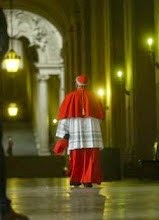
A conspicuous namesake of the Father of Communism, B16's recently-named successor as archbishop of Munich and Freising -- a sociologist who's serving on the drafting team for the (delayed) social encyclical -- is set to publish a manifesto of his own.

Reinhard Marx's Das Kapital: A Plea for Man rolls out next month:
[T]he Roman Catholic archbishop who is the most outspoken of Germany's 27 diocesan leaders in his criticism of big business, says that his work is to some extent "an argument with Marxism."

The book begins as a letter addressed to his "dear namesake."

"The consequences," he tells the 19th-century ideologist, "of your thinking were disastrous."

The modern-day Marx demands that the whole world adopt a market economy that is kinder to the weak and downtrodden instead of "heaping even more rewards on those who behave immorally."

"That's not utopia. It's a necessity for the sake of humans," said Marx in Munich.

The 300-page book, "Das Kapital: A Plea for Man", deliberately borrows its title from the "bible" of communism in which Karl Marx claimed 140 years ago that capitalism would automatically collapse.

With this new book, however, Marx intends to highlight the value of Catholic social teaching in a globalized world.

"Capitalism without humanity, solidarity and justice has no morals and no future," Marx writes.

He said we need to take a fresh look at social justice, or the world might veer back to dangerous ideologies such as Marxism.
As head of Bavaria's mother-church, Marx is a lock for the cardinal's cap at the next consistory.

Let the "red" jokes commence.

-30-

Thursday, January 31, 2008

Reinhard Marx the Spot

Fresh from a private audience earlier this week with his second predecessor, Archbishop-elect Reinhard Marx of Munich and Freising formally touched down in his new charge yesterday in advance of his Saturday installation.

As rain fell on the Marienplatz -- the great square outside Munich's Cathedral of Our Lady -- the long-awaited successor to 79 year-old Cardinal Frederich Wetter performed the traditional homage to the Mariensaule, the statue of Mary that's stood atop a pillar there since 1638 as a "monument of peace."

Joined by the city's mayor and other top politicians as a large crowd looked on, the rite was the final "station" of the customary three-stop tour that sees each incoming head of Germany's Catholic heartland whisked to the ancient see's most venerable foundations: the 12th century Benedictine monastery at Scheyern, and Ss. Peter and Paul at Feldmoching, along the city's northern edge, where a church was first built in the 6th century.

At Saturday's installation, Marx becomes the 73rd successor of St Corbinian, the "apostle of Bavaria" who settled at Freising in the year 723, his relics still enshrined in its cathedral.

The Pope surprised most observers with his November appointment of the 54 year-old bishop of Trier to the post for which Fr Joseph Ratzinger was made a bishop and held from 1977-81.

Described as "outspoken" and a "larger-than-life" character who's shown a flair for mixing it up in Germany's political and media circles, the sociologist-by-training -- and longtime head of the episcopate's social justice efforts -- had largely been viewed as in line for the archbishopric of Berlin. After an unusually protracted yearlong vacancy, however, his dispatch instead to Papa Ratzi's home diocese places an even more pointed stamp of papal approval on him, one which could well see the sometime biker (above right) riding off in mid-February with the chair of the German bishops' conference in succession to its longtime head, Cardinal Karl Lehmann of Mainz, who cited a "necessary generational shift" at the helm among his reasons for leaving the influential post midway through his fourth six-year term.

With Wetter's 80th birthday just three weeks away and the pontiff's longing for his homeland remaining strong, better still are Marx's odds of donning the red hat of a cardinal at his predecessor's next consistory.

In accord with the longstanding practice of Munich's archbishops, the post's 13th holder has incorporated the traditional Moor's head onto his coat of arms, but leaving Corbinian's famous pack bear behind in Rome... with the Pope.

PHOTOS: Thomas Klinger(1,3)


-30-

Wednesday, November 28, 2007

Papa Ratzi's Hometown Heir?

After a ten-month wait, Pope Benedict has reportedly chosen a new archbishop of Munich and Freising, the post he held from 1977-81.

According to today's edition of the Bavarian paper Süddeutsche Zeitung, the name of Bishop Reinhard Marx of Trier was forwarded to the state government for its consent earlier this week. Under the provisions of the concordat between the Holy See and the Catholic-heavy southern land, the civil authority enjoys veto power over episcopal appointments.

The paper reported that the Vatican is expected to announce the move on Friday.

Marx, 54, would succeed Cardinal Frederich Wetter, whose retirement was accepted in early February.

While the social scientist with a reputation for mixing it up in the public square is seen as cheerful, "larger-than-life" and a whiz with the media, he's also said to "know no pardon" when church discipline is violated. As Papa Ratzinger's first major appointee in his homeland and head of the 1.8 million-member Munich church, the appointment would catapult Marx into the hierarchy's top rank... and not just in Germany.

Ordained an auxiliary bishop of his native Paderborn on his 43rd birthday in 1996, Marx was named to Trier -- Germany's oldest diocese, founded before the 3rd century -- in 2001. Over the last three years, Marx has been given three new auxiliaries to assist him in the diocese of 1.5 million, two of whom are in their early 40s.

In German church circles, the news is being greeted with "surprise." Benedict was expected to give Munich a nominee with closer personal ties to the papal apartment, and was especially seen as keen to name a Bavarian to lead the church in the nation's Catholic heartland.

Previously cited as a potential successor to Cardinals Joachim Meisner of Cologne or Georg Sterzinsky in Berlin -- with the capital post buzzed due to the rising prelate's policy savvy -- Benedict's choice to send Marx instead to his hometown diocese would further burnish the latter's likelihood to eventually take the helm of the powerful German bishops' conference in succession to its longtime head, Cardinal Karl Lehmann of Mainz.

Apostolic administrator since leaving the archbishop's office, Wetter turns 80 in February. Ergo, the appearance of the cigar-chomping "happy warrior" on his Munich predecessor's next list of new cardinals would seem a safe bet.

SVILUPPO: In its brief, the German news agency DPA dubs the reported appointee "left-of-center," while a "moderate conservative" on matters doctrinal.

PHOTO: DPA


-30-

Thursday, November 29, 2007

Tomorrow: Hope, Munich and Media... All By Noon

The top line of tomorrow's Vatican News will be the release of Benedict XVI's second encyclical, Spe Salvi ("Saved By Hope"). The 65-pager's Roman Noon unveiling won't, however, be the only noteworthy drop of the day as the Pope takes care of two of the longest-held items in his personnel queue.

First, the Bavarian pontiff appears set to formally name Bishop Reinhard Marx of Trier as archbishop of Munich and Freising.

First reported on these pages yesterday, implied confirmation was given earlier today by Bishop Gerhard Muller of Regensburg before a media scrum. For his part, Marx (shown above in a Francis George moment) was more circumspect, telling a reporter in Würzburg that "the Pope names bishops, not the press."

(Reality check: the Bavarian government -- whose pacts with the Holy See required its consent to the appointment -- had more to do with it than any arm of the media.)

The German media has gone into overdrive, with the national wire's headline blaring "Joy Over Marx." From Social Democratic politicians to Protestant clergymen, the air appears to be near-exuberant, with only the liberal reformist group "We Are Church" registering ill feeling toward Benedict's choice. Recalling Marx's 2003 suspension of a theologian who invited Protestants to the Eucharist, the activists used the occasion to issue a laundry list of demands for the presumptive appointee.

But that's not all.

After a record 36-month long holdup, the Pope is also expected to finally name a secretary for the Pontifical Council for Social Communications, with the choice reported to have fallen on Msgr Paul Tighe, currently director of Public Affairs for the archdiocese of Dublin.

The choice of Tighe -- a moral theologian who studied in Rome -- correlates with prior indications seeking a native Anglophone to hold the #2 post in the Vatican office that interfaces with the worlds of entertainment and media. Precedent holds that the holder of the post is accordingly elevated to the episcopacy.

The new secretary will succeed Bishop Renato Boccardo, who was named Vatican City's "deputy mayor" by John Paul II in February 2005. Since that time, the council has moved into a new pontificate, a new presidency, and -- as of earlier this month -- new offices on the Via della Conciliazione, in the shadow of St Peter's.

In addition, burnishing longstanding buzz that the PCCS will take on an enhanced portfolio, the superior rank at the junior council is to be beefed up with the appointment of an adjunct secretary -- namely, Msgr Giuseppe Scotti, the veteran Milanese staffer in the Secretariat of State. As the whole of its top tier has arrived within the last five months, the Irishman will find himself in the middle of a fresh Italian sandwich.

-30-

Tuesday, February 12, 2008

Hail to the Chief

In a pointed show of independence, the German bishops have elected Archbishop Robert Zollitsch of Freiburg as the new chairman of their influential conference.

Zollitsch, 69, succeeds Cardinal Karl Lehmann of Mainz, who announced his retirement from the post midway through his fourth six-year term.
Lutheran leaders and figures from other faiths welcomed the choice, as did lay Catholic groups and Germany's two main political parties, the Social Democrats and Christian Democrats.

Chancellor Angela Merkel praised the choice, saying "Zollitsch approaches people with great openness and addresses their needs and concerns."

Germany's 25 million Catholics are organized in 27 dioceses. The chairman of the bishop's conference speaks for them in public, but has no especial doctrinal authority.

Zollitsch, who has been an archbishop since June 2003 and already oversees the church's national payroll, has been described as a liberal. He once said he would prefer priestly celibacy to be voluntary, not a rule.

He was chosen for a six-year term by his brother bishops at a meeting in Wuerzburg.

His similarity in age and positions to Lehmann indicated a choice for continuity.

"We are theologically and personally so close that you'll find it hard to see a difference," Zollitsch said.

The bishops passed over another, more conservative candidate, Reinhard Marx, 54, who has been freshly enthroned as archbishop of Munich.

Lehmann said it would do Marx good to deal with the challenges of the new archdiocese first.

Marx's auxiliary bishop, Engelbert Siebler, said, "I expect Marx will be elected to the job in six years."

Observers said the choice also indicated a continued mood of independence among the 69 bishops towards Pope Benedict XVI.
The ordinary of the Pope's private secretary, Msgr Georg Ganswein, Zollitsch was a simple priest on staff in the Freiburg curia at his 2003 appointment.

-30-

Thursday, February 24, 2011

PopeTrip Looming, Berlin Falls Open

In September, the Pope is scheduled to make another visit to his homeland -- a state visit to Germany this time, set to climax with B16's first papal trek to Berlin.

Now, though, the first German pontiff in a thousand years will face an important call: picking his host.

This morning, Benedict accepted the resignation of Berlin's longtime archbishop, Cardinal Georg Sterzinsky, all of a month after the capital prelate reached the retirement age of 75 and without a successor chosen.

Named bishop of Berlin -- then a non-metropolitan church -- in 1990 and a cardinal the following year, Sterzinsky became the city's first archbishop in 1994. The cardinal is said to have been in poor health for some time, hence the quick departure.

While B16 has been uniquely generous in extending his countrymens' time in office past their 75th birthdays -- the Pope's own successor in Munich, Cardinal Frederich Wetter, was kept in post even after turning 80 -- the reality remains that, with three of the country's resident cardinals at or near retirement age, the Berlin opening opens the most significant change of senior leadership the German church has seen in decades.

At the helm of what's often called Europe's wealthiest archdiocese, the German bench's leading conservative -- and its senior prelate closest to the pontiff -- Cardinal Joachim Meisner of Cologne is 77, but expected to remain until after a Eucharistic Congress recently set for 2013 to mark the 1,700th anniversary of its local church. Meanwhile, the country's most prominent progressive voice -- the longtime chair of the German bishops, Cardinal Karl Lehmann of Mainz -- turns 75 in May.

Then bishop of Berlin, Meisner was made a cardinal in 1983, the same year Lehmann was named to Mainz.

In both cases, however, Der Deutschepapst will only have a limited say in who takes the posts. Under the terms of the concordat governing Germany's relations with the Holy See, both sees retain provision for the election of the diocesan bishop by their respective cathedral chapters, with Rome confirming the choice. Still, the groups of clerics are bound to choose from the three-name terna for the post presented by the Vatican.

In his one major appointment at home to date, in late 2007 the Pope named Bishop Reinhard Marx of Trier as archbishop of Munich and Freising -- the post Cardinal Joseph Ratzinger himself held from 1977-81.

Having won plaudits for an especially deft reponse to last year's outbreak of sex-abuse revelations in Germany, Marx (above) was elevated to the college of cardinals at last November's consistory. At 57, the media-savvy sociologist -- a co-drafter of this pontificate's social manifesto Caritas in Veritate -- is the youngest member of the papal "Senate" by close to a year.

Benedict's third visit to Germany as Pope after 2005's World Youth Day in Cologne and the following year's "homecoming" in Bavaria, September's state visit is expected to take the pontiff to Freiburg and Erfurt beyond its leg in Berlin.

PHOTOS: Reuters(2)


-30-

Saturday, April 13, 2013

For "Project of Revision," Francis Calls A Council

Precisely a month since his election, Pope Francis has served notice of even more changes in the Vatican – this time, on the all-important administrative front.

This morning, the pontiff announced the establishment of a group of eight cardinals with the sweeping remit "to advise him in the government of the universal church and to study a plan for revising the Apostolic Constitution on the Roman Curia, 'Pastor Bonus.'"

Said to have been inspired by "a suggestion that emerged during the General Congregations preceding the Conclave," as relayed in the move's formal notice, the membership of the group is:

–Cardinal Giuseppe Bertello, president of the Governorate of Vatican City State;
–Cardinal Francisco Javier Errázuriz Ossa, archbishop emeritus of Santiago de Chile;
–Cardinal Oswald Gracias, archbishop of Bombay;
–Cardinal Reinhard Marx, archbishop of Munich and Friesing;
–Cardinal Laurent Monsengwo Pasinya, archbishop of Kinshasa;
–Cardinal Sean Patrick O'Malley OFM Cap, archbishop of Boston;
–Cardinal George Pell, archbishop of Sydney;
–Cardinal Oscar Andrés Rodríguez Maradiaga, SDB, archbishop of Tegucigalpa, in the role of coordinator;
–and Bishop Marcello Semeraro of Albano, Italy, who'll serve as the group's secretary.

In retrospect, this plan has apparently been on Francis' mind since the first days following his election – the new Pope had his first announced audience of any sort with Semeraro on the evening of March 17th, the same night he met with the Father-General of the Jesuits, Adolfo Nicolás.

While Benedict XVI summoned a group of cardinals to consult on the state of governance last June, in the wake of the first throes of the "Vatileaks" fiasco, in the early days of this pontificate the notion of a more formalized "crown council around [Francis]" was first floated by the Italian vaticanista Sandro Magister.

Even if the formation of an advisory body of this sort has repeatedly been proffered in the past, the idea has historically faced heavy resistance in the Vatican given the sense that it would undermine the traditional standing of the entire College of Cardinals as the principal counsel to the Pope.

The group's first meeting is slated to take place from 1-3 October – conspicuously, the days immediately prior to the feast of St Francis of Assisi. Beyond Bertello, the only other member of the group with Curial experience is Errázuriz, a member of the Schoenstatt movement who served as Secretary of the "Congregation for Religious" from 1990-96.

On another front, the retired Chilean prelate is a former president of the CELAM – the mega-conference of the Latin American bishops – while Gracias is the current head of the umbrella-group of the Asian episcopal conferences, the FABC, and Marx (a sociologist by training) oversees COMECE, the Brussels-based commission of European bishops' conferences.


As for the group's coordinator, despite having served as archbishop of the Honduran capital since 1993, Rodríguez (above) – like Errázuriz, another past president of CELAM – is a well-known figure both on the Roman scene and in the wider church thanks both to his days in the continental post and his current side-role as president of Caritas Internationalis, the federation of the global church's charitable and humanitarian-aid agencies. In the latter capacity, the 70 year-old cardinal was involved in a scrap with B16's Curia over its 2012 push to overhaul Caritas, a process which saw the forced departure of the group's secretary-general, Leslie Ann Knight, allegedly for having been overtly "critical of the Vatican machine." 

In a similar vein, the famously-combative Pell – the only non-Curialist in the four-man group convoked last year by Benedict – had been tipped in 2010 as the now-retired pontiff's choice to lead the Congregation for Bishops, but the plan fell apart after a vicious "dirty pool" effort behind the walls succeeded in its intent to block the Australian's appointment. 

Notably, in the run-up to the Conclave, even one of Pell's most strident critics conceded that the Sydneysider was one of the few electors who "ha[d] the stuff" to successfully broach a cleanup of the shambles-ridden Roman apparatus – a task many cardinals cited as an overarching concern in the choice of the new Pope.

Put bluntly, by calling in figures who have clashed to a considerable, highly-public degree with the Establishment he's inherited, Francis is bringing the Curia's chickens home to roost.

The last major reform of the Curia, Pastor Bonus – "The Good Shepherd" – was promulgated by John Paul II twenty-five years ago this June 28. 


As required by law in the days following his election, the Pope reconfirmed the chiefs of the Curia – who lose their posts during a papal vacancy – in the exercise of their functions, but only on a provisional basis. As the Holy See explained at the time, Francis wished "to reserve time for reflection, prayer, and dialogue before any final appointments or confirmations are made."

The Vatican said that Francis has already begun contact with the members of his working-group, ostensibly by his preferred means – the phone. 


Meanwhile, the pontiff's homily at this morning's "workers' Mass" in the Domus Sancta Marthae seemed to implicitly address the move.

In its report on Francis' latest daily liturgy for Vatican employees, Vatican Radio said that Papa Bergoglio cited the early church's conflict over "practical necessities" present in today's first reading from the Acts of the Apostles, on which the Pope "commented that, rather than openly address[ing] the problem, their first reaction is one of whispered criticism and gossip.

"'But this does lead to any solution' [he said], 'this does not give solutions.

"'The Apostles, with the help of the Holy Spirit, responded well: they summoned the group of disciples and spoke to them. And this is the first step: when there are difficulties, we need to look closely at them, and confront them and speak about them. But never hide them."

In a briefing following the announcement, the lead Vatican spokesman, Jesuit Fr Federico Lombardi, said that the council would not supplant the daily functions of the Roman Curia, adding that the body "will have no legislative power and that its main function is to 'help' and 'advise' the Pope."

-30-

Tuesday, January 15, 2008

End of an Era

After 20 years at the helm of the influential German bishops' conference, Cardinal Karl Lehmann of Mainz is stepping down.

Lehmann, 71, said he was resigning for health reasons, according to wire reports. The cardinal was hospitalized late last year with an irregular heartbeat and said today that he would preside over the conference's spring assembly in mid-February before departing the post on the 18th. At his election to a fourth term in 2005, he announced that the six-year renewal would be his final one.

The spring assembly will elect Lehmann's successor, the conference announced.

The early departure "makes sense," Lehmann wrote in a statement, adding the latest waves of episcopal appointments in Europe's largest country made for a "necessary generational shift" of the conference's chairmanship. He also said he wanted to devote more of his energy to the 800,000-member church in Mainz, where he marks his 25th anniversary as bishop later this year.

In the name of the conference, deputy chair Bishop Heinrich Mussinghoff of Aachen, praised Lehmann for his "indefatigable" service, "theological knowledge [and] intellectual openness."

The leader of the German episcopate's liberal-progressive wing, the Mainz prelate suggested publicly in 2000 that Pope John Paul II "would have the courage" to resign if ill health prevented him from "lead[ing] the church with authority." A year later, after Lehmann protested that his remarks were taken out of context and said he wasn't calling for John Paul's departure, the late pontiff elevated him to the college of cardinals.

Before this morning's announcement, the mantle of the chairmanship's "heir apparent" has long fallen on the incoming archbishop of Munich and Freising, Reinhard Marx. Named in November to the post held by Pope Benedict from 1977-81, Marx's installation in Munich is scheduled for Candlemas Day, 2 February.

Last week, the Pope received his closest adviser on his homeland's affairs, Cardinal Joachim Meisner of Cologne, in an evening audience.

-30-

Thursday, June 26, 2008

Last Runs Before Rome

On Sunday morning, the last year's new intake of 41 metropolitan archbishops from around the world will receive the symbol of their office -- the pallium -- from Pope Benedict.

In keeping with the tradition established by John Paul II in 1984, the conferral of the lambswool band will take place at the pontiff's Mass for the Solemnity of Ss. Peter and Paul, at which B16'll be joined by B1 -- Bartholomew I, the Ecumenical Patriarch of Constantinople -- who'll sit alongside the Pope during the Liturgy of the Word and team up with him again for the blessing.

After spending the night in the silver coffin atop the tomb of Peter beneath the basilica's main altar, the pallia -- woven by Benedictine nuns from the wool of lambs blessed on January's feast of St Agnes -- are blessed by the Pope and given to the new archbishops with the words:
To the glory of Almighty God and the praise of the Blessed Virgin Mary and of the apostles Peter and Paul, and of the Holy Roman Church, for the honor of the Churches, which have been placed in your care, and as a symbol of your authority as metropolitan archbishop: We confer on you the pallium taken from the tomb of Peter to wear within the limits of your ecclesiastical province.

May this pallium be a symbol of unity
and a sign of your communion with the Apostolic See,
a bond of love, and an incentive to courage.
On the day of the coming and manifestation
of our great God and chief shepherd, Jesus Christ,
may you and the flock entrusted to you
be clothed with immortality and glory.
In the name of the Father, and of the Son and of the Holy Spirit.
Two of the year's new archbishops will be unable to make it, so their presents will be sent to their dioceses, where a papal legate will confer them in the cathedral. Dating from the third century AD and only restricted to metropolitans in 1978, the pallium doesn't automatically come with a residential archbishopric, but must be formally petitioned from the Pope.

* * *
While the group's global headliners include Cardinal John Njue of Nairobi, the freshly-installed Latin Patriarch of Jerusalem Fouad Twal, Archbishops Reinhard Marx of Munich and Freising and Pavel (Paolo) Pezzi of Moscow, two Canadians -- Archbishops Tony Mancini of Halifax and Martin Currie of St John's, Newfoundland -- and three Statesiders will be among the group: Archbishops Edwin O'Brien of Baltimore, John Nienstedt of St Paul and Minneapolis and Thomas Rodi of Mobile (the Alabama prelate to get his day in Rome).

Before leaving for their respective pilgrimages, though, two of the latter three have been tying up loose ends at home.

Following his widely-noted decision to place the Legionaries of Christ under more stringent oversight in the Premier See -- and a highly-candid chat with the National Catholic Reporter in its wake -- O'Brien met with members of the Legion's lay arm Regnum Christi last weekend to explain himself.

A Charm City priest in attendance provides a brief:
Recognizing that they probably had already heard much of what was the impetus for the meeting, the archbishop told the roomful of 150 people, “It is out of pastoral concern that I speak to you. … I want you to hear [these things] directly from me.” He began the meeting by restating the content of his letter that went to Fr. Alvaro Corcuera, the head of the Legion of Christ in Rome. In restating these concerns raised in the letter, O’Brien emphasized again the three areas of concern he had with regard to the operations of the Legion and Regnum Christi in the Archdiocese:
First was the lack of pastoral transparency in the sharing of information about programs and participants. Second was the nature of youth programs and activities that seem to show a lack of respect for parental rights and duties, and a call to cease ongoing spiritual direction with children under 18. And finally was a need to respect the parental role in encouraging and fostering vocations to the priesthood and consecrated life.

After his brief words of explanation, the archbishop opened the discussion up to the concerns and comments of the assembly. Most of the comments reflected the very positive role that involvement in Regnum Christi has had in the lives of the families who participate. They said that they are closer to their Church and Jesus, and that they have been active and integral participants in their parishes as well. They didn’t feel the “coercion” to follow the LCs vocational promotion or the “flaws endemic” to them that the archbishop’s letter had referred to.

Some who spoke acknowledged their skepticism about RC and their schools and programs but did not deny the positive effects that they saw with their families as a result of this ministry. One man asked O’Brien, “Are you open to this dialogue?” noting that his comments – especially those in the interview with John Allen – seemed “offensive” and “not very open” to a process of healing (referring to the comment that priests applauded the archbishop's decision with regard to the LC). Others pointed out that there could have been a tendency on the part of ex-members to “misinterpret” the problems of RC and that their input represented only one, biased side of the issue.

Many things were said in defense of RC and LC, and O’Brien listened attentively. Some folks mentioned that there was an orthodoxy in teaching by the LC that was not encountered from diocesan clergy. This was the attraction of the Legion’s activities. There was a question as to whether or not the Archbishop was conducting the meeting simply to appease members. O’Brien assured them that “I’d be wasting my time if this was for PR.” For him, it is a real issue that must be addressed openly and candidly....

The people spoke, and O’Brien “got what they were saying.” “I love you and what you are doing,” he told them. Now, he says, it is up to them to be open and honest in approaching their pastors – parish priests – and share the best of who they are – something the LC have already taught them to do for God. In a letter sent to Baltimore priests as a follow-up, O’Brien tells us “In my opinion, many members of Regnum Christi are exemplary in doing fine work in this Archdiocese. However, unique among many apostolic groups, LC and RC suffer a strong negative image among many of our clergy in Baltimore and beyond. Until this factor is addressed candidly, tensions will remain. I suggested that members of Regnum Christi speak with their parish priests, relating their account of Saturday’s meeting and seeking ways to collaborate more closely with parish life.”
Meanwhile, in the Twin Cities -- where Nienstedt's first month in office after a year in wait as coadjutor has seen the term "consecrated blizzard" return to contemporary parlance -- the archbishop put the kibosh on a long-running LGBT prayer service held by a city parish to coincide with the region's Pride Week:
This is "yet another volley of dehumanizing spiritual violence directed at GLBT persons and their families under Archbishop Nienstedt's reign of homophobic hatred," David McCaffrey, a board member of the Catholic Pastoral Committee on Sexual Minorities (CPCSM), said in an e-mail Monday to members.

"The archdiocese is now dictating to people who they can and cannot pray for, and that deeply concerns me," said Bayly, executive director of the CPCSM. "This certainly does not celebrate the presence of God in the lives of gay people. They are dictating to gay people how to have a good life."

The Rev. Jim Cassidy, acting pastor at St. Joan's, said he respects the wishes of the archdiocese and is just happy that the service was not canceled.

"The archdiocese, for all parishes, is the front office and we need to respect that," Cassidy said Tuesday. "There is no welcome mat being pulled here."

Also Tuesday, [archdiocesan spokesman Dennis] McGrath defended the archdiocese and Nienstedt, saying that gay and lesbian relationships, especially if they are consummated, are contrary to church doctrine.

McGrath said Nienstedt decided to act after he was notified by callers about the GLBT service at St. Joan, which has a large homosexual contingent.

McGrath said Nienstedt simply did what any archbishop in the country would do in a similar situation. He said the decision does not signal that the archdiocese is taking a conservative turn in the Twin Cities.
A lay-led rite went forward last night outside St Joan's. To avoid ruffling further feathers, it was characterized as a "peace service."

On another note, in the largest gift in its history, the Twin Cities church last week received an anonymous donation of $10 million, earmarked to ensure the survival of 15 inner-city parochial schools.

PHOTO: AFP/Getty


-30-

Monday, March 01, 2010

Red Dawn... Come Fall?

In a significant development that bears all the hallmarks of a coordinated leak, three of Italy's most reputable Vatican journalists have suddenly emerged to forecast B16's third creation of new cardinals for Christ the King weekend, 20-21 November... and hours after Tim Dolan said in an interview that he "wouldn't expect" the red hat this time around, the prospective slates relayed by all three include the name of the archbishop of New York.

While a November date (an encore of the last intake's 2007 elevation) has rounded the buzzmill for some time now, it should -- but, given the hysteria surrounding these things, can't -- go without saying that anything can change at any time. Still, the confluence of the Saturday pieces by Il Foglio's Paolo Rodari, La Stampa's Giacomo Galeazzi and Il Giornale's Andrea Tornielli is notable... and would appear to be more than mere coincidence.

In their reports, all three scribes heavily emphasized the "magic number" of 19 -- the number of nominees that would return the College of Cardinals to its full voting complement of 120 in the event of a conclave, and a figure Pope Benedict has (unlike his predecessor) committed himself to maintaining; the college's maximum largely kept at 70 electors since the 16th century, the limit was last formally raised by Paul VI in 1975.

While 111 red-hats would be able to vote in a papal election as of today, ten more "princes of the church" reach the ineligibility age of 80 before mid-November, as do another 12 between January 2011 and April 2012; as previously noted, among the soon-to-be seniores are six of the US' 12 voting cardinals -- an unprecedented figure in such a short period of time.

Bottom line: the next 27 months will deal Benedict a staggeringly broad hand to choose another quarter of the electoral college which would choose his successor -- add in the 30 electors he's already elevated, and, on age-wrought openings alone, just over half the voters in a hypothetical 2012 or later conclave would be his picks. What's more, unlike B16's prior porporati -- many of whom were named to cardinalatial posts in the twilight of John Paul II's 27-year reign -- almost all of the likelies still to enter the "Pope's Senate" were given their current slots in this pontificate and, as a result, passed the enhanced quality-control checks Joseph Ratzinger applies to his appointments.

While all three vaticanisti led their stories with an emphasis that the coming crop would be dominated by Europe and the Roman Curia -- including the "sure" elevation of the church's first American "chief justice," Archbishop Raymond Burke -- residential archbishops listed as "most probable" by the trio included Paolo Romeo of Palermo, Thomas Collins of Toronto, Kazimierz Nycz of Warsaw, Reinhard Marx of Munich and Freising, Laurent Monsengo Pasiya of Kinshasa, the Cistercian Orani João Tempesta of Rio de Janiero, the Spanish primate Braujlio Rodriguez Plaza of Toledo, the former CDW secretary Malcolm Ranjith of Colombo, Peter Takeo Okada of Tokyo, and Simon-Victor Tonyé Bakot of Yaoundé, the Cameroonian capital which Benedict visited on his African tour last March.

In a first for the strife-torn country, the prospective biglietti all conspicuously mentioned the name of the archbishop of Myanmar's capital of Yangon, the Salesian Charles Maung Bo, 61, and another unprecedented choice -- the Latin patriarch of Jerusalem, the veteran papal diplomat Archbishop Fouad Twal.

Above the rest, however, with the holders of the English-speaking church's two most prominent archdioceses facing the heretofore-unseen scenario of living predecessors -- cardinals who, more to the point, remain of voting age for two more years -- the biggest news of all is the prominent presence of both New York's Dolan and Archbishop Vincent Nichols of Westminster on each of the three published lists.

In his WABC interview aired yesterday morning, the 60 year-old Big Apple prelate said he "would doubt" the chatter of his elevation in the forthcoming batch, rightly reminding that the "praxis" of the Holy See is "that it is rare to have two cardinal-electors from the same diocese." Adding that his elevation would bring on "more expectations internationally," Dolan said he was looking forward to "a little more time to get my feet on the ground" in the nation's second-largest diocese, home to some 2.6 million Catholics.

Dolan's predecessor, Cardinal Edward Egan, turns 78 in April, as does Westminster's Cardinal Cormac Murphy O'Connor in August.

No US nor UK see has ever boasted two voting cardinals at once.

On a domestic note, even more than last time, a red-hat giveaway on the reported weekend would create particular havoc for the Stateside church: the suspected Saturday comes less than 48 hours after the traditional Thursday-morning close of the USCCB Fall Meeting in Baltimore, and five days before Thanksgiving, to boot. Ergo, as the consistory and the next morning's Mass of the Rings merely kick off a week's worth of festivities in the Eternal City (Rome's biggest party outside a conclave), any American pilgrimages on the proffered timetable would likely be returning home amid what's usually the busiest air-travel period of the year.

And, well, that's the buzz as it stands... as always, stay tuned.

PHOTO: AP


-30-

Wednesday, September 03, 2008

"Love" Coming Soon... in "Truth"?

If his pre-papal publisher is to be believed (both on Amazon and its own page), B16's third encyclical -- the long-anticipated Caritas in Veritate ("Love in Truth") on social concerns -- will publish on 30 September.

Framed from its first buzz as a modern-day take on Paul VI's Populorum Progressio, the Ratzinger text was first expected in time to mark the 40th anniversary of Papa Montini's March 1967 manifesto on global development. Its last rumored drop-date -- Europe's traditional "Worker's Day" of 1 May -- came and went, as did another earlier target of St Joseph's Day, 19 March.

At least part of the holdup can be attributed to Benedict's first literary priority: his drive to complete the second book of his Jesus of Nazareth, the first part of which shot up the charts on its release last spring. (On a related note, the first Jesus was -- along with the "historicity of the gospels" -- the topic of last weekend's Schulerkreis, the annual reunion-conference of Joseph Ratzinger's 40 or so theology students hosted by their doktorvater.)

As summer neared, word leaked that the pontiff had set up a small working group to aid him in the text's preparation, tapping a mix of prelates and experts including the Vatican social-justice czar Cardinal Renato Martino, Benedict's successor as archbishop of Munich Reinhard Marx and Stefano Zamagni, an Oxford-trained Italian economist.

At the same time, the Secretary of State Cardinal Tarcisio Bertone announced that the text wouldn't be ready until the Fall... and, well, here we are. Yet adding together that Rome's just starting to come back to life from vacation season, the time needed to prepare a final text -- and the repeated wars that've broken out over the Vatican's official translation of this pontificate's major texts -- it's pretty safe to view a September 30th pub-target as overly optimstic; while the Italians are saying October, an encyclical whose timing could be viewed as a papal "voter's guide" to the Stateside fold would likely be one October surprise too many for some ad extra on these shores (not to mention overshadowing October's monthlong Synod on the Word). Ergo, smart money seems to say we'll end up seeing the finished product closer to late November's first anniversary of Spe Salvi -- but given the wait for this one, anything's possible.

As always, stay tuned.

-30-

Friday, June 20, 2014

For the Synod, The Baseline Cometh

After months of anticipation – and, in no shortage of parts elsewhere, presumptions and agitation galore – the core document for October's Extraordinary Synod finally has its pub-date.

Its drafting guided by the questionnaire circulated worldwide by the Holy See last fall, earlier today it emerged that the instrumentum laboris for the assembly on "the pastoral challenges of the family in the context of evangelization" will be released next Thursday, 26 June, with a midday press conference featuring the meeting's key officials, led by the Pope's hand-picked Synod chief, Cardinal Lorenzo Baldisseri.

Ostensibly delayed by the torrent of feedback received from the local churches, an initial draft of the text was reviewed by the 15-prelate Synod Council last month under Francis' close watch.

Though the Pope's earnest desire is for the assembly of representatives of the 5,000-member global episcopate to become a significantly more "real and effective tool" for collegial governance than it has in the past – a dynamic which should make for some surprises in the Aula – the document will set the baseline both for the topics envisioned for discussion, and Papa Bergoglio's expectations for the first stage of the process that'll culminate with a second Family Synod in October 2015.

* * *
When they circulated the survey to the episcopal conferences with the request that they "distribute [it] to the dioceses" for local input, Baldisseri & Co. likely weren't banking on the confusion that would reign in its wake.

For starters, progressive lobby groups in several countries took to pouncing on their respective conferences for letting the dioceses take the initiative in circulating the questions, even though the intent was precisely to get an optimal snapshot of the reality in the trenches instead of ideological boilerplate. Then, once the national responses were compiled and sent to Rome, several of the English-speaking bodies declined to release theirs, citing a request for confidentiality from Baldisseri, while extensive, brow-raising reports were published by others, most prominently the Japanese and German bishops. (The latter bench is now led by Europe's lone diocesan bishop on Francis' "Gang of Eight," Cardinal Reinhard Marx of Munich, who's talked up some of his own thoughts on related matters over recent months.)

In any case, Baldisseri has made clear that while "the doctrine on the family is not in discussion" come October, "the approach to pastoral problems is" – and it "can change."

"We're starting from a conviction that we don't know everything," the Synod chief said in a November interview, "and that study and seeking might open new horizons, previously unknown ones."

After having processed the responses (which were due at January's end), over another press sit-down in April, the cardinal let slip that among other issues raised, two stood out: first, he said, "communication is lacking between the institutional church and the real church, which is the people." And secondly, "the awareness of the Christian doctrine on marriage is scarce," adding that "the same could be said for the theme of openness to life.

"Paul VI's Humanae Vitae is rather ignored, the no to contraception has stopped," the cardinal said. "On this theme, the church has much to do."

Lest anybody forgot, Francis will beatify Paul VI – likewise the Synod's founder – at the two-week assembly's closing liturgy on October 19th.

All that said, during last week's June meeting in New Orleans, the USCCB relented slightly on its earlier reticence as the conference president, Archbishop Joseph Kurtz of Louisville, delivered a public report on what he called "some thoughts... some general trends" on the feedback received at the Mothership, joined by the lead American on the 15-man Synod Council, Washington's Cardinal Donald Wuerl.

Here, fullaudio of the briefing:


As the elected leader of the Stateside bench, under the current rules for an Extraordinary Synod – only the third of its kind, the last having taken place in 1985 on the 20th anniversary of Vatican II's close – Kurtz is the lone US prelate assured of a seat at the October assembly. (Since the Synod's founding in 1967, 18 of the 20 prior editions have been the larger and longer "general" or "special" meetings, at which episcopal conferences with over 100 members would each elect three delegates.) That said, 
with Francis and Baldisseri currently retooling the gathering's "methodology" and the Pope ostensibly itching to broaden the "experiences" present for the discussions, the prez is still likely to have some company from home, whether ordained, lay, or both.

-30-

Tuesday, October 19, 2010

Hints of "Dawn"

And so, church, welcome to the tensest of days here in the office....

That said, with all signs pointing to B16's announcement of his third class of new cardinals in the morning, Italy's (and, indeed, the world's) reigning vaticanista-in-chief -- Il Giornale's Andrea Tornielli -- reports that the expected 20 November intake will comprise 24 red hats, leaving unclear whether the pontiff will deviate from the now-traditional maximum of 120 electors set by Paul VI in 1975.

In addition, in an audio file posted on his paper's website, Tornielli read several names from a purported biglietto, albeit an incomplete one.

Keeping the "incomplete" bit in mind, here are the designates from his list:
  • Archbishop Angelo Amato SDB, 72, prefect of the Congregation for the Causes of Saints
  • Archbishop Mauro Piacenza, 66, prefect of the Congregation for the Clergy
  • Archbishop Fortunato Baldelli, 75, major penitentiary of the Roman church
  • Archbishop Velasio dePaolis CS, 75, prefect for the Economic Affairs of the Holy See
  • Archbishop Paolo Sardi, 76, pro-Patron of the Order of Malta
  • Archbishop Francesco Monterisi, 76, archpriest of the Basilica of St Paul's Outside the Walls
  • Archbishop Gianfranco Ravasi, 68, president of the Pontifical Council for Culture
  • Archbishop Paolo Romeo, 72, of Palermo
  • Archbishop Raymond Burke, 62, prefect of the Supreme Tribunal of the Apostolic Signatura
  • Archbishop Kurt Koch, 60, president of the Pontifical Council for Promoting Christian Unity
  • Archbishop Robert Sarah, 65, president of the Pontifical Council Cor Unum
  • Archbishop Reinhard Marx of Munich and Freising, 57
  • Archbishop Raymundo Damasceno Assis of Aparecida, 73
  • Archbishop Malcolm Ranjith of Colombo, 62
That makes 15 of a potential 22 electors.

Meanwhile, in the "honorary" division -- that is, clerics elevated over age 80 in recognition of their distinguished service but ineligible to enter a conclave -- Tornielli ran two names...
  • Monsignor Domenico Bartolucci, 93, the director-emeritus of the Sistine Choir
  • Monsignor Walter Brandmuller, 81, president-emeritus of the Pontifical Commission for Historical Sciences
That's where things stand... as ever, more as it comes in.

SVILUPPO: Adding several names he simply deems "most probable," Tornielli updates list, including the names of Archbishops Laurent Monsengwo Pasiya of Kinshasa, Thomas Collins of Toronto, Donald Wuerl of Washington and the 75 year-old Coptic patriarch of Alexandria, Antonio Naguib -- who would become the lone Oriental patriarch to hold a seat in the voting college.

-30-

Thursday, February 23, 2012

Old Church, New World

As new media moments from last weekend's Consistory go, this one's hard to beat: during a lull in Saturday's "courtesy visits" to the new red-hats, the freshly-elevated archbishop of Berlin, Cardinal Rainer Maria Woelki, took to checking a soccer score on his iPhone.

According to a caption on the capital church's Facebook page -- thanks to Georg for the shot -- the Cologne native was keeping an eye on his hometown side's match against Nuremberg.

Its jerseys featuring a silhouette of the city's famous cathedral, FC Köln lost 2-1.

A protege of the Nordrhein's Cardinal Joachim Meisner -- the closest top German cleric to Pope Benedict, and himself a onetime occupant of the Berlin chair -- Woelki was named archbishop of the relatively small Berlin fold in July, just prior to the German pontiff's September state visit to his homeland.

All of 55, with his elevation, the Opus Dei-trained theologian and former seminary rector is now the youngest member of the College of Cardinals, replacing another German -- Joseph Ratzinger's 58 year-old successor in Munich, the motorbiking sociologist Cardinal Reinhard Marx -- as the junior prelate of the papal "Senate." (On a related note, just turned 62, New York's new Cardinal Timothy Dolan is the seventh youngest of the now-214 member "club," and Galveston-Houston's Cardinal Daniel DiNardo, 63 in May, is tenth.)

Der Deutschepapst already having tapped the young clerics to fill half his native turf's four traditional cardinalatial sees, Germany's other two prime ecclesial posts are likewise soon to turn over: head of the Mainz church since 1983, the longtime head of the country's bishops Cardinal Karl Lehmann turns 76 this spring, and Meisner -- who's led one of global Catholicism's wealthiest dioceses since 1989 -- is now 78.

-30-

Wednesday, October 20, 2010

Red Alert, Red Alert

We have liftoff -- a 20 November consistory to create 24 new cardinals.....

Here, the biglietto, in order:
  • Angelo Amato, prefect of the Congregation for the Causes of Saints;
  • Antonio Naguib, patriarch of Alexandria of the Copts,
  • Robert Sarah, president of the Pontifical Council Cor Unum,
  • Francesco Monterisi, archpriest of St Paul's Outside the Walls,
  • Fortunato Baldelli, major penitentiary of the Roman church,
  • Raymond Burke, prefect of the Supreme Tribunal of the Apostolic Signatura,
  • Kurt Koch, president of the Pontifical Council for Promoting Christian Unity
  • Paolo Sardi, pro-Patron of the Order of Malta,
  • Mauro Piacenza, prefect of the Congregation for the Clergy
  • Velasio DePaolis CS, prefect for the Economic Affairs of the Holy See (& papal delegate to the Legionaries of Christ)
  • Gianfranco Ravasi, president of the Pontifical Council for Culture
  • Medardo Joseph Mazombwe, archbishop-emeritus of Lusaka (Zambia)
  • Raul Eduardo Vela Chiliboga, archbishop-emeritus of Quito (Ecuador)
  • Laurent Monsengwo Pasinya, archbishop of Kinshasa
  • Paolo Romeo, archbishop of Palermo
  • Donald Wuerl, archbishop of Washington
  • Raymundo Damasceno Assis, archbishop of Aparecida
  • Kazmierz Nycz, archbishop of Warsaw
  • Malcolm Ranjith, archbishop of Colombo
  • Reinhard Marx, archbishop of Munich and Freising
...and the over 80s:
  • Archbishop Jose Manuel Estepa Llaurens, Military Ordinary-emeritus of Spain
  • Bishop Elio Sgreccia, president-emeritus of the Pontifical Academy for Life
  • Msgr Walter Brandmuller, president-emeritus of the Pontifical Commission for Historical Sciences
  • Msgr Domenico Bartolucci, director-emeritus of the Sistine Choir
And, well, there you have it.

That said, the twin retired prelates -- among other aspects -- make this list stranger than almost any other in memory; Cardinal-designate Vela, 76, was just replaced in the Ecuadorean capital last month, while Cardinal-designate Mazombwe, who retired in 2006, loses his conclave vote on turning 80 next fall.

From Cardinal-designate Donald Wuerl of Washington, the following statement has quickly emerged...
“This truly is an honor for the Archdiocese of Washington, the Church in the nation’s capital, and for all of the clergy, religious and parishioners of this local Church who every day live out their faith in commitment and deep love for Christ. I am humbled by our Holy Father Pope Benedict XVI’s trust in me as shepherd of this flock and pledge to him my renewed fidelity, affection and loyalty.”
Once the secretary to a cardinal -- and, arguably, the most impeccably-prepared American cleric in history for the red hat -- the DC designate, 70 next month, will celebrate an 8am Mass this morning in St Matthew's Cathedral, with a press availability to follow.

Tonight, he'll be in Houston to give an address on faith and the just society at the University of St Thomas, for which a webstream will be had. Uniquely, late yesterday saw Wuerl announce a new seminary for the capital church -- a pre-theologate on the campus of the Catholic University of America, to open in August 2011.

And via "Big Rig" -- that is, the new St Louis chancery -- the following statement has just come from the Vatican's "chief justice," the Gateway City's eighth archbishop from 2004-08, Cardinal-designate Raymond Leo Burke:
I am deeply humbled and honored by the announcement that His Holiness Pope Benedict XVI intends to name me to the College of Cardinals of the Holy Roman Church at the Consistory which he has convoked for this coming November 20th. Having received the news of the Holy Father’s intention, I express my deepest gratitude to His Holiness for the great confidence which he has placed in me, and I renew my commitment to serve Him, as Shepherd of the universal Church, in total fidelity and with all my being.

Considering the weighty responsibilities of the members of the College of Cardinals in assisting the Holy Father as his closest co-workers, even “to the shedding of blood,” I am more than ever conscious of my own weakness and of my total dependence upon the help of divine grace, in order that I may fulfill worthily and generously the responsibilities which will be mine, God willing, as a Cardinal of the Church.

I count upon the continued intercession of the Blessed Virgin Mary and the Communion of Saints, and the prayers of the many faithful whom I have been blessed to serve as priest and Bishop, especially in my home diocese, the Diocese of La Crosse, and in the Archdiocese of Saint Louis, and of those with whom I have been, in the past, and am now privileged to serve in the Roman Curia, especially my co-workers at the Supreme Tribunal of the Apostolic Signatura. Only the knowledge of God’s immeasurable and unceasing outpouring of mercy and love from the glorious pierced Heart of Jesus gives me the confidence to accept the great honor and burden which His Holiness intends to confer upon me.

Today’s announcement turns my thoughts with deepest affection and gratitude to my late parents and all my family, living and deceased; and to the priests, consecrated persons and lay faithful who have assisted me to know my vocation to the Holy Priesthood and to respond to it with an undivided heart over the more than thirty-five years of my priestly life and ministry. Today, with all my heart, I humbly thank God for the gifts of life, of the Catholic faith, and of my vocation.

At the same time, my thoughts naturally turn to the many challenges which the Church faces in our day in carrying out her divine mission for the salvation of the world. In particular, I am deeply conscious of the critical importance of the loving witness of the Church to the truth, revealed to us by God through both faith and reason, which alone is our salvation. It is a witness which Our Holy Father tirelessly gives with remarkable wisdom and courage. I pledge myself anew to assist Pope Benedict XVI in this critical witness and in the many works of his pastoral charity on behalf of all our brothers and sisters in the Church and in the world.

I ask for prayers that I may be able to assist our Holy Father Pope Benedict XVI to the best of my ability and with every ounce of my strength. I, once again, place my whole heart, together with the Immaculate Heart of the Blessed Virgin Mary, into the Most Sacred Heart of Jesus. In the glorious pierced Heart of Jesus, I am confident that I will find the purification, courage and strength which I will need to carry out the new responsibilities to be confided into my hands. I thank, in advance, all who will pray for me, and ask God to bless them abundantly.
All that said, one conspicuous absence from the slate is enough to make for a major heartbreak.

-30-

Tuesday, October 01, 2013

In the Vatican, It's Red October: The Super 8 Sits

Amid the chaos of a second papal interview's sudden release, it was a moment of history this morning as the newly-formed "Council of Cardinals" convened to begin its first three-day meeting in the Pope's private library in the Apostolic Palace.

Clockwise from Francis are the members: Cardinals Seán O'Malley OFM Cap. of Boston, the emeritus of Santiago de Chile Francisco Javier Errázuriz, Oswald Gracias of Bombay, the "Mayor" of Vatican City Giuseppe Bertello; in violet the group's secretary, Bishop Marcelo Semeraro of Albano and, up the other side, Cardinals Reinhard Marx of Munich, Laurent Monsengwo Pasinya of Kinshasa, George Pell of Sydney and the coordinator of the project, Óscar Rodríguez Maradiaga SDB of Tegucigalpa.


Entrusted with the open-ended mandate of advising the Pope "in the governance of the universal church" with a particular emphasis on the reform of the Roman Curia, in his interview today with La Reppublica Francis said his choices to comprise the body were "not courtiers but wise and animated people of the same leanings as mine. Calling the group "my council," Francis declared that its convocation marked "the beginning of a church with an organization [that's] not only vertical but also horizontal."


Before heading to the former papal residence that Papa Bergoglio now employs as his daytime office, the Council – announced by Francis in April, but only established formally yesterday – served as lead concelebrants with the pontiff at this morning's usual Mass, at which he prayed in their name "that our work today will make us all more humble, more meek, more patient, more trusting in God, so that the church can give a beautiful witness to the people, and seeing the People of God, seeing the church, they might feel the desire to come with us."

While the agenda awaiting the "Gang of Eight" was reportedly growing ever longer as the meeting approached, with the sessions set to extend well into the evenings and the members holed up at the Domus, the first indications of the summit's progress won't likely emerge until a press briefing tomorrow from the Vatican spokesman, Jesuit Fr Federico Lombardi.

PHOTOS: L'Osservatore Romano 


-30-

Wednesday, March 06, 2013

On Castel Stroll, Paparazzi Snap Papa Ratzi

Lest anyone thought being Pope made for the world's most mysterious – and therefore attention-grabbing – public role, there's apparently something that commands even more fascination: the first post-papacy in 700 years.

Six days since leaving Peter's chair to attain his long-sought "release," as never once happened during his seven years as Pope, Italian paparazzi images published today captured a bundled-up B16 walking in the gardens at Castel Gandolfo with his secretary, Archbishop Georg Gänswein, who'll soon have to return to Rome to fulfill his "day job" as prefect of the Papal Household.

Two photos of the now Pope-emeritus were run in the Italian celebrity magazine Chi.

The morning after the resignation, the Vatican spokesman Fr Federico Lombardi related that Papa Ratzinger was moved and appreciative on seeing the Italian TV reports about his departure in the hours after the sede vacante took effect. The Jesuit portavoce added that Benedict slept well, had breakfast and was looking forward to resuming his longtime practice of playing the piano in the evenings.

No further update from the Holy See has since emerged. Still, much as it wouldn't be any surprise if the Vatican sought to protest the invasion of the retired pontiff's space, the Pope's line at his closing audience a week ago just echoes back again...
"Always, he who assumes the Petrine ministry no longer has any privacy. He belongs always and totally to everyone, to the whole Church. His life is, so to speak, totally deprived of the private sphere.... The 'always' is also a 'forever' – there is no returning to private life. My decision to forgo the exercise of active ministry does not revoke this. I do not return to private life, to a life of travel, meetings, receptions, conferences and so on. I do not abandon the cross, but remain in a new way near to the Crucified Lord."
On a side-note, it's sweet to see that the quilted mountain-jacket and ballcap – first used by Benedict on the first summer break after his 2005 election (left, amid the Alps) – have been kept around and returned to use.

Elsewhere, though, much as howls have come from some segments of the Establishment over both the ex-Pope's future living arrangements behind the city-state's walls amid claims of an "undue influence" the situation could have on his successor, and especially Gänswein's impending dual role as B16's lead minder while holding the post that will organize the next Pope's daily agenda, it bears reminding that the last Pope has followed tradition in leaving his successor several openings to give the secretary a golden "out." 

As things stand, two key posts in German Catholicism – the influential bishopric of Mainz and the metropolitan seat at Cologne, thought to be the richest diocese in the world – both have cardinal-heads who remain in office well past the retirement age of 75; in the latter case, Benedict's closest ally at home, the conservative Cardinal Joachim Meisner, turns 80 on Christmas. Come August, meanwhile, Gänswein's native archdiocese of Freiburg opens up as Archbishop Robert Zollitsch – the president of the German bench – will be required to submit his own "walking papers."

Of course, the scenario clearly echoes that of early 2005, when John Paul II could've filled the archbishopric of Krakow – Poland's second see, and the one he held until becoming Pope – but left the replacement of his own successor, Cardinal Franciszek Macharski, then nearly 78, to the next pontiff. 

For what it's worth, it didn't take being in Rome to figure out – even before John Paul died – that Stanislaw Dziwisz, Karol Wojtyla's omnipresent ombra of four decades, would end up in the post. 

Within six weeks of Benedict's election, it happened.


As Pope, Der Deutschpapst was keenly intent on stacking the German church's top rank with 50-something appointees, naming the sociologist-biker Reinhard Marx (above), then 52, to his former seat in Munich in 2007 and the iPhone-toting Cologne auxiliary Rainer Maria Woelki to Berlin at 54 in 2011, quickly elevating both into this Conclave's electorate.

And in the next pontificate – whoever the cardinals' choice might fall upon – don't be surprised one bit when the Vatican's "George Clooney," now 56, completes the circle.

PHOTOS: Chi(1); CatholicPressPhoto(2); AP(3)

-30-