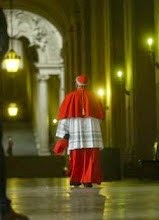
Thursday, October 09, 2008

Heading Home?

Having garnered controversy with statements supporting the prohibition of receiving Communion in the hand and rapping bishops for their "disobedience" to Pope Benedict on the enhanced permission to celebrate the 1962 Missal, the pontiff has reportedly signed-off on Archbishop Malcolm Ranjith's transfer home to Sri Lanka to lead his native archdiocese of Colombo.

Currently the #2 official at the Congregation for Divine Worship and the Discipline of the Sacraments, unnamed Vatican sources indicated the 60 year-old prelate's move to Robert Mickens of The Tablet, who reports from Rome that "the Pope has 'already signed' the transfer" in this weekend's edition. Mickens' sources did not provide a time-frame for an official announcement.

Long an ally of Joseph Ratzinger, Ranjith's second stint as a Curial official began in December 2005, when the newly-elected B16 named him secretary of the dicastery overseeing the liturgy 20 months after the Sri Lankan was exiled from the Propaganda Fide to the apostolic nunciature in Indonesia after reported difficulties with his superior at the missionary office, the then-prefect Cardinal Crescenzio Sepe, now the archbishop of Naples.

In the CDW post, Ranjith's utterances have made waves cheered by liturgical traditionalists. Last January, penning the preface to a Kazakhi bishop's book on worship, the archbishop said it was possibly "high time... to abandon" the post-Conciliar practice on the reception of Communion standing and in the hand -- an option which, he wrote, "was only accepted after its illegitimate introduction in some countries." Shortly thereafter, the Pope began administering the Eucharist solely on the tongue to kneeling communicants.

Along the same lines, in an interview with an Italian outlet late last year, Ranjith said that prelates opposed to Summorum Pontificum -- Benedict's "liberation" of the pre-Conciliar liturgy -- were allowing themselves to be "used as instruments of the devil," taking them to task for "disobedience... and even rebellion" wrought by attempts to rein in the motu proprio on the newly-dubbed "extraordinary rite."

Earlier this year, the archbishop was said to have voiced a desire to head home, ostensibly given the resistance his interventions had attracted.

In the subcontinental capital -- where he served as an auxiliary from 1991 to 1995 -- Ranjith would succeed Archbishop Oswald Gomis, who reached the retirement age of 75 last December. Home to 700,000 Catholics and founded in 1834 (when the then-British colony was still known as Ceylon), the Colombo church has had one cardinal in its history: the native-born Thomas Benjamin Cooray, who was elevated in 1965.

An Oblate of Mary Immaculate, Cooray retired in 1976 and died in 1988.

Meanwhile, the Italian and Spanish presses have both tipped the Spanish primate Cardinal Antonio Cañizares Llovera of Toledo -- a former CDF staffer dubbed the "Ratzingerino" -- to take the helm at Divine Worship later this fall; the dicastery's current prefect, Cardinal Francis Arinze, turns 76 next month.

-30-

Saturday, April 26, 2008

Musical Chairs

Thursday night, the music-loving Pope attended a concert in the Vatican's Paul VI Hall held to mark his 81st birthday and third anniversary of election.

Hosted by the Italian President Giorgio Napolitano with a program including works of Brahms and Beethoven, B16 was joined by his brother, Msgr Georg Ratzinger, who flew into Rome on Benedict's return from the States.

In keeping with his brother's usual post-travel practice, the Papstbruder -- a former director of the Regensburg cathedral choir -- was to join the pontiff during his recharge at Castel Gandolfo, the papal retreat outside Rome. However, the Castel jaunt had to be scrapped due to the funeral of Cardinal Alfonso Lopez Trujillo, the church's "family czar," who died on Saturday; the Pope presided at Lopez Trujillo's burial liturgy in St Peter's on Wednesday, which was celebrated by the Cardinal-Dean Angelo Sodano.

The death of the Colombian cardinal -- one of the Vatican's lead commanders in the culture wars -- opens just another crucial spot in the Curial ranks, several of which are in for another wave of reshuffling in the short-term future. Of these, though, the vacancy at the Pontifical Council for the Family (the first time a dicastery head has died in office since the saintly Vietnamese Cardinal Francois Xavier Nguyen Van Thuan passed in 2002) is of special note as Lopez Trujillo had been the Holy See's lone prominent voice from a key section of the Catholic world: Spanish-speaking Latin America.

Two other curial chiefs -- the Brazilian prefect of Clergy Cardinal Claudio Hummes and the president of the Council for Health Care Workers Cardinal Javier Lozano Barragan -- might likewise hail from south of the border, but neither could command the visibility that naturally fell to the Roman official whose purview included leading the charge against abortion and gay marriage.

Already, so it's said, the region is being looked to for Lopez Trujillo's successor... and not just because the next World Meeting of Families is scheduled for early next year in Mexico City, quite possibly with Benedict in attendance.

* * *

Beyond the Family, the retirement age of 75 has the Pope in need of new lead-hands at the church's central offices for Worship, Causes of Saints, Justice and Peace and Migrants and Itinerants. (To date, Benedict has named new heads for four of the curia's nine congregations, and five of its eleven pontifical councils.)

Already well-floated in the Italian press, the most current scenario for the top opening has the Vatican liturgy chief Cardinal Francis Arinze being succeeded by the former Cardinal Ratzinger's deputy at the Congregation for the Doctrine of the Faith, Archbishop Angelo Amato. Arinze marked his 75th in November.

A Salesian confrere of his predecessor in the CDF post (the "Vice-Pope" Cardinal Tarcisio Bertone) and ghost-author of its controversial 2000 decree Dominus Iesus, prior tippings had Amato in line for the Congregations for Catholic Education or Causes of Saints (particularly the latter after an Easter Sunday lead article in L'Osservatore Romano on the witness of the martyrs). The Pope's high regard for his former deputy is no secret, and a prefect's job (with its ex officio red hat) has been seen as long in the planning for him. What's more, the foreseen move would defuse one of the more tense tandems in the Curia's top ranks; longstanding reports have indicated a level of friction between Amato and his current boss, Cardinal William Levada, with some even musing that the former "Holy Office" is effectively governed by a triumvirate that's seen the California cardinal outnumbered by the two Salesians.

To succeed Amato, the current buzz points to Bishop Rino Fisichella, the Rome auxiliary dubbed the "chaplain to Parliament." Long a fixture of the Urb's media and policy circles, Fisichella and Levada have long enjoyed good ties. Another key post in play is that of the Vicariate of Rome -- the day-to-day operator of the Pope's diocese -- and the long-expected move of Cardinal Agostino Vallini, currently the church's "chief justice" as prefect of the Supreme Tribunal of the Apostolic Signatura, is still perceived as a go. In succession to the all-powerful Cardinal Camillo Ruini (arguably Italy's most influential political player of recent decades) Vallini's selling-point for the post is said to be his reluctance for a high public profile, a trait which would strengthen the hand of Bertone, who's made little secret of his intent to be the church's lead in relations between the Vatican and the Italian state.

Adding to the drama, reports just prior to the Pope's arrival in Washington noted that the controversial #2 at Divine Worship, Sri Lankan Archbishop Malcolm Ranjith, had been overheard voicing a desire to skip town. A former Vatican diplomat exiled from the Curia once before, Ranjith, 60, was restored to Rome by B16 shortly after his election and has long been thought the prefect-in-waiting of the dicastery that oversees the Latin church's liturgical rites.

Sharing the Pope's affinity for what's now called the "extraordinary rite" -- the pre-Conciliar Missal of Bl John XXIII -- Ranjith made waves in the aftermath of Summorum Pontificum by chastising the disobedience of bishops over the decree permitting wider celebration of the Tridentine Mass, stoking even further resistance when he advocated a reconsideration of the reception of communion in the hand. (A posture recently banned in Peru's capital by Cardinal Juan Luis Cipriani of Lima.)

It's been noted that Sri Lanka's largest local church -- the 700,000-member archdiocese of Colombo -- is in need of a new head; Archbishop Oswald Gomis reached the retirement age in December. Ranjith was an auxiliary of the capital see from 1991 to 1995.

So that's the snapshot... for all the rest, stay tuned.

PHOTOS: AFP/Getty(1); Reuters(2)


-30-

Monday, November 29, 2010

Of Homecomings... and Hat Parades

With Consistory Week now in the books, the newest far-flung members of the College of Cardinals have returned home. Yet even if the galero hasn't been conferred during the elevation rites since 1965, that didn't keep Sri Lanka from rolling out a record-sized one as the second Roman "prince" in its history, Colombo's Cardinal Malcolm Ranjith, arrived back on Saturday.

Led by the overwhelmingly-Buddhist country's prime minister, much of the island's political, cultural and pan-religious establishment turned out to greet Ranjith as his flight touched down in the capital. As native dancers performed and monks of other faiths prayed, thousands thronged Colombo's streets -- many decorated to celebrate the occasion -- as the new cardinal was paraded through on his way to a thanksgiving stop at the country's patronal shrine of Our Lady of Lanka, where the new cardinal prayed at the tomb of the first Sri Lankan raised into the papal "Senate," Thomas Benjamin Cooray.

An Oblate of Mary Immaculate who served at the helm of the Colombo church from 1947-76, Cooray was created a cardinal in the 1965 intake -- the last to receive the time-honored ceremonial "red hat" that still surmounts the rank's coat of arms... and, apparently, his successor's homecoming float.

Cooray built the massive basilica, which was dedicated in 1974. He died in 1988, and just last month, Ranjith opened the cause for his predecessor's beatification.

Spread across eleven dioceses, Catholics comprise just under 10% of Sri Lanka's 20 million residents.

* * *
Speaking of cardinals and their hats, it appears no one noticed the latest switch-up to come from the Office of Papal Liturgical Celebrations, which rolled out another "development of tradition" at last weekend's festivities.

Since time immemorial, the mitre worn by members of the College of Cardinals in the Pope's presence (and for concelebrations in general) has been the traditional all-white, but with a quietly distinctive twist: in deference to the rank, cardinals have donned the "damasked mitre" of white-on-white silk, with red tassels on the back.

One of the few pieces of insignia to survive the Conciliar reforms completely intact, even more than its look, the mitra damasco (shown en masse at left) was conspicuous by its size -- such was the headgear's height that, in many cases, the gap between its front and back peaks (usually "open" on a mitre) proved close to nonexistent, which, at least for some cardinals, was said to have made its use a painful experience.

Seemingly in response to the complaints, the damasco was tweaked into a more manageable form at the 2001 consistory -- same style, but significantly smaller (above) -- and was immediately adopted by practically the entire College. Now, however, in the spirit of the "Papal Pallium," the papal MC Msgr Guido Marini and his team have apparently moved to make another innovation, debuting a complete revamp of the red-hats' liturgical headdress:

And, well, time will tell how it catches on, both in Rome and on the road.

* * *
Lastly, it took a while, but English translations have finally emerged of B16's powerful twin homilies at last weekend's ceremonies... so, here, snips from the preach at the Consistory itself:
No one is master in the Church but all are called, all are sent out, all are reached and guided by divine grace. And this is also our security! Only by listening anew to the word of Jesus who asks, “come, follow me”, only by returning to our original vocation, is it possible to understand our own presence and mission in the Church as authentic disciples.

The request of James and John and the indignation of the other “ten” Apostles raised a central question to which Jesus chose to answer: who is great, who is “first” for God? First of all Jesus looks at behaviour which “those who are supposed to rule over the Gentiles” risk assuming: to “lord it over them”.

Jesus points out to the disciples a completely different conduct. “But it shall not be so among you”. His community follows another rule, another logic, another model: “Whoever would be great among you must be your servant, and whoever would be first among you must be slave of all”.

The criterion of greatness and primacy according to God is not domination but service; diaconia is the fundamental law of the disciple and of the Christian community, and lets us glimpse something about “the lordship of God”.

And Jesus also indicates the reference point: the Son of man who came to serve. In other words he sums up his mission in the category of service, not meant in a generic sense but in the concrete sense of the Cross, of the total gift of life as a “ransom”, as redemption for many, and he points it out as a condition of the “sequela”.

It is a message that applies for the Apostles, for the whole Church, and especially for those who have leadership roles in the People of God. It is not the logic of domination, of power according to human criteria but rather the logic of bending down to wash feet, the logic of service, the logic of the Cross that is the root of all exercise of authority.

The Church in every period is committed to conforming to this logic and to testifying to it to make the true “lordship of God” shine out, that of love.

Venerable Brothers appointed to the cardinalitial dignity, the mission to which God calls you today and which qualifies you for an even more responsible ecclesial service, requires an ever greater willingness to adopt the style of the Son of God who came among us as one who serves (cf. Lk 22:25-27).

It is a question of following him in his humble and total gift of himself to the Church, his Bride, on the Cross. It is on this wood that the the grain of wheat — which the Father let fall into the earth of the world — dies, in order to become a ripe fruit.

This is why it is necessary to be even more deeply and firmly rooted in Christ. The intimate relationship with him that transforms life increasingly in such a way that it is possible to say with St Paul, “it is no longer I who live, but Christ who lives in me” (Gal 2:20), constitutes the primary requirement if our service is to be serene and joyful and to bear the fruit that the Lord expects of us.
...and Sunday's Mass of the Rings:
In today's Gospel we see that everyone asks Jesus to come down from the Cross. They mock him, but this is also a way of excusing themselves from blame as if to say: it is not our fault that you are hanging on the Cross; it is solely your fault because if you really were the Son of God, the King of the Jews, you would not stay there but would save yourself by coming down from that infamous scaffold.

Therefore, if you remain there it means that you are wrong and we are right. The tragedy that is played out beneath the Cross of Jesus is a universal tragedy; it concerns all people before God who reveals himself for what he is, namely, Love.

In the crucified Jesus the divinity is disfigured, stripped of all visible glory and yet is present and real. Faith alone can recognize it: the faith of Mary, who places in her heart too this last scene in the mosaic of her Son's life. She does not yet see the whole, but continues to trust in God, repeating once again with the same abandonment: “Behold, the handmaid of the Lord” (cf. Lk 1:38).

Then there is the faith of the Good Thief: a faith barely outlined but sufficient to assure him salvation: “Today you will be with me in Paradise” . This “with me” is crucial. Yes, it is this that saves him. Of course, the good thief is on the cross like Jesus, but above all he is on the Cross with Jesus. And, unlike the other evildoer and all those who taunt him, he does not ask Jesus to come done from the Cross nor to make him come down. Instead he says: “remember me when you come into your kingdom”.

The Good Thief sees Jesus on the Cross, disfigured and unrecognizable and yet he entrusts himself to him as to a king, indeed as to the King. The good thief believes what was written on the tablet over Jesus' head: “The King of the Jews”. He believed and entrusted himself. For this reason he was already, immediately, in the “today” of God, in Paradise, because Paradise is this: being with Jesus, being with God.

So here, dear Brothers, is the first and fundamental message that the word of God clearly tells us today: to me, the Successor of Peter, and to you, Cardinals.

It calls us to be with Jesus, like Mary, and not to ask him to come down from the Cross but rather to stay there with him. And by reason of our ministry we must do this not only for ourselves but for the whole Church, for the whole People of God.
Speaking of texts, while yesterday afternoon saw Cardinal Donald Wuerl's Mass of Thanksgiving in Washington on his return to the capital, his first message on these shores has yet to emerge.

Then again, the DC cardinal's "real" homecoming is still two weeks off; on 12 December, the 11th bishop of Pittsburgh will return to his hometown for a celebration in the Steel City's St Paul's Cathedral.

Luckily, however, Wuerl's American counterpoint in this class is nowhere near as bashful, so the full, footnoted text of Cardinal Raymond Burke's Thanksgiving sermon on his elevation lit up the wires almost within minutes of its delivery last Monday in the chapel of the Pontifical North American College.

Among other points, the now scarlet-clad "chief justice" mused that "the cardinal has a particular bond with the virgin martyrs," adding for good measure the story of St John Fisher, who received the red hat behind bars amid his refusal to assent to Henry VIII's Act of Supremacy -- or, as Burke called it, the earthly ruler's "angry rebellion against the law of Our Lord."

In light of the new cardinal's prior statements on the domestic state of affairs -- among them, that American society "is abandoning its Judeo-Christian foundations, the fundamental obedience to God’s law which safeguards the common good, and is embracing a totalitarianism which masks itself as the 'hope,' the “future,” of our nation"...

...suffice it to say, complete the sentence.

PHOTOS: Archdiocese of Colombo(1,2); AP(4,5); Reuters(6)


-30-

Tuesday, May 27, 2008

On Worship

In a change from the norm, the Pope distributed the Eucharist at Thursday's Corpus Christi Mass to kneeling communicants.

The Vatican's chief liturgist, however, says that the tradition-as-chic move was more a nod to the feast than a new fixture of papal worship:
In a brief e-mail to Catholic News Service May 23, Msgr. Guido Marini, master of papal liturgical ceremonies, said the decision "was a solution adopted for (the feast of) Corpus Domini," but as for the future, "we'll see."

Archbishop Albert Malcolm Ranjith Patabendige Don, secretary of the Congregation for Divine Worship and the Sacraments, told CNS "there is no discussion" in the Vatican about insisting that those who receive Communion from the pope do so kneeling or that they receive it on the tongue rather than in their hands.

In addition, he said, "there are no new norms coming" that would change the Vatican's 1969 decision that local bishops could allow their faithful to receive the Eucharist in their hands while standing.

"But the gesture of the Holy Father" at the May 22 Mass "is to be appreciated. It brings out in a better way the fact that we adore the Lord whom we receive" in the Eucharist, Archbishop Ranjith said.

"It was a special occasion" because the feast focuses on Jesus truly present in the Eucharist, he said. "I hope this practice spreads."

In a preface to a January book about the beauty of receiving the Eucharist on the tongue while kneeling, Archbishop Ranjith had said he thought it was time for the Catholic Church to reconsider its decision to allow the faithful to receive Communion in the hand.

Passionist Father Ciro Benedettini, assistant director of the Vatican press office, said he did not think the May 22 Mass marked a permanent change; "according to current norms the faithful may receive in the hand while standing," he said.

However, he said, the practice chosen for the special feast day was another example of what Msgr. Marini has said would be the practice at papal Masses, "alternating the old and new to indicate continuity with the past."

In his homily at the Mass, Pope Benedict spoke about the importance of "kneeling before the Lord, adoration that begins at the Mass itself and accompanies the entire (Corpus Christi) procession" through the streets of Rome.

"To adore the body of Christ means to believe that there, in that piece of bread, there really is Christ who gives meaning to our lives," the pope said in his homily.
One thing the Holy See does want to change on a more stable basis -- and not just for the Pope's Masses -- is what it views as an excess of concelebrants at large celebrations.

The issue first came up in the plans for last month's papal visit to the States, when Vatican officials unsuccessfully attempted to extend the Papal Chapel's practice of concelebration by invitation only to B16's three public liturgies on these shores. Now, a development first reported in the Italian weekly Panorama says that the Pope has entrusted the matter to the Congregation for Divine Worship and the Discipline of the Sacraments, with an eye to an instruction that would limit concelebration to "precise circumstances" and forbid the practice, now common, of vested clergy concelebrating from outside the sanctuary.

In Rome, all clergy present concelebrate at but one Mass all year: the Holy Thursday Chrism Mass. The rest of the time, the privilege is reserved either to the cardinals in attendance or other small groups of key prelates contingent on the event in question.

Of course, in the field, a new policy would mean that keeping the clergy in one place for larger Masses would require use of choir dress -- i.e. cassock and surplice -- by all non-concelebrating clerics.

Suffice it to say, as having those on-hand isn't a given for many, if not most, priests, such a move would surely herald a new springtime... for the vesture houses.

PHOTO: Reuters


-30-

Tuesday, November 06, 2007

Getting Up to Speed

Crazy days, but thanks a million for the prayers... and more on that in a second.

Just in case anyone's been missing a quick summary, you're in for a treat:
  • Yesterday, Msgr Guido Marini took the Pope's side for his first liturgy at B16's chief master of ceremonies. The debut of the Genovese cleric, a former private secretary to Cardinals Dionigi Tettamanzi and Tarcisio Bertone during their reigns on St Siro's chair, is but the most prominent indicator of the continuing rounds of the Curia's "musical chairs." Rome's top Worship Czar, Cardinal Francis Arinze, reached the retirement age of 75 on All Saints' Day, and expectations are that it might not be long before Sri Lankan Archbishop Malcolm Ranjith -- the current #2 at the Congregation for Divine Worship and the Discipline of the Sacraments -- gets the nod to succeed the Nigerian cardinal. Arinze's sound-byte-friendly statements have made him a favorite of the global press, but not the "extraordinary rite" folk; a leader of the Curial charge that opposed what became Summorum Pontificum, one top Tridentine hand once accused the prefect of "attacking the Mass." ("The Mass" meant "Old Mass," of course.) But in Ranjith -- a favorite of Benedict's whom the Pope restored to the Curia after a 2001 power play saw him banished from the Urb -- the papal leanings on the liturgy would gain another ally in a key post. And it'd mark another first, with two heads of Roman congregations hailing not only from Asia, but South Asia at that. 
  • Speaking of Ranjith, the CDW lieutenant has, to use a friend's term, "gone on a rampage" of late, using the Italian news-outlet Petrus to encourage bishops to "set aside all pride and prejudice" in implementing the wider permission for the 1962 Missal and, according to CWNews, employing another recent speech to observe that prelates opposed to the new norms were being "used as instruments of the devil." And speaking of MC Marinis, with his successor now firmly in place, the former papal ceremoniere Archbishop Piero Marini -- now president of the Pontifical Commission for International Eucharistic Congresses -- is primed to spread his wings on his own in the weeks to come, with an English-language treatise on the liturgical reform now on the shelves, and a spate of appearances set to take flight. 
  • Keeping with the Main Office personnel, appearances are that the longstanding (and just as confounding) buzz linking the "Grand Inquisitor" Cardinal William Levada to the archbishopric of New York has become The Rumor That Won't Go Away... which means one of two things: 1. there could be something to it... or 2. (and, more likely,) that Someone (or, again, more likely, several Someones) are keeping it afloat out there, but to no small degree. While both at home and abroad, Team Levada has furiously downplayed the talk as an attempt to undermine the Pope's choice to succeed Himself as prefect of the Congregation for the Doctrine of the Faith, questions about the scenario haven't stopped coming in at a steady clip, even from traditionally-reliable (and just as customarily-cautious) quarters. As previously noted, stranger things have usually happened -- but not if this one actually came to pass. (Still, don't hold your breath on it.) Actually atop the Pope's HR plate, though, are key openings for the top job at the Congregation for the Causes of Saints and the #2 post at the Congregation for Catholic Education. Given the consistent priority the Holy See places on the academy -- a concern only upped exponentially in this pontificate -- the latter appointment has garnered no small amount of attention. Reportedly, however, the job -- vacated by summer's appointment of Archbishop Michael Miller CSB as coadjutor of Vancouver -- has already been declined... more than once. Suffice it to say, the state of things across the Tiber has B16 and Bertone headhunting for a few good men... on second thought, more than just a few sounds more like it.
  • Speaking of New York, Archbishop Timothy Dolan of Milwaukee -- whose own name hasn't lacked for mention in the Gotham Stakes -- will swing through the Big Apple this weekend for an appearance at the annual mega-watt weekend meeting of the Order of Malta's US branch. Alongside a Saturday Mass at the Waldorf-Astoria for the American association's Knights and Dames, the former NAC rector is slated to give a talk focusing on "The Priesthood and the Future of the Church in the United States." Given the profile and place of the gathering, some have already mused that this is "the introduction," and others might be tempted to quote the lyrics of an old song, the one that begins "Sign, sign, everywhere a sign." Feel free to do either, but just keep in mind that it's still early... and, as always, stay tuned.
  • Keeping close to home, the mega-series chronicling a year with Bishop Thomas Tobin continued Sunday in the Providence Journal with two more parts. The project sounded impressive at its outset, but in its precision, fairness and detail of context, Wayne Miller's package has been a gift. (Full disclosure: this author was involved in the prep for the series as an informal consultant on the fine-tuning... and to have lent a hand on something like this is one of the reasons I love my job.)
  • Hard to believe, but it's already been six months since the aforementioned scribe found himself in one of the US church's hidden hotspots: Madison, Wisconsin. To say that the place blew me away on multiple levels doesn't scratch the surface; as with so many others, the MadCity experience lives with me and keeps me encouraged everyday. You see, in the heart of what's been termed the "People's Republic" for its prominence as a bastion of hard-core secularity, quite a vibrant community is emerging -- one that's young, alive, awake, open and warm in spirit, and large both in number and heart. And the fruits are considerable: in recent years, the number of seminarians in the diocese of 280,000 has spiked to 30, on a beautiful spring Friday (the first of the year there) just as many twenty-somethings were holding the fort in downtown's lone adoration chapel, and the campus ministry at the University of Wisconsin -- where weekend Mass attendance goes long into the thousands -- has spilled over into the two downtown parishes, which have experienced a concurrent uptick in energy and responded with an outreach and engagement of the top-flight kind. Presiding over it all is Bishop Robert Morlino, who recently sat for an extended interview (transcript) with one of the city's mainstream broadsheets. After four years of driving over iced lakes in Montana as bishop of Helena, the Scranton-born onetime Jesuit who began his teaching years on Philly's Hawk Hill landed on the Madison Isthmus in 2003; asked why he thought he was sent to a town known for its tough crowd, the bishop mused that it might've come about "because the Lord has given me the grace not to be afraid." A moral theologian by training and accomplished chef in his spare time, Morlino's fearlessness extends to the heart of the public square; when his ability to mix it up "quite often" was noted, he shot back with "Oh no, it's been a while.... Have I been in a controversy the last six months?" (He hasn't.) "[T]he culture is not conducive so much to the flourishing of an institution whose engine — the church's engine — is driven by obedience," he said later. "The engine that drove Christ was obedience to the Father, and the engine that drives the Catholic Church is obedience to Christ. Churches are an obedience-driven communion. So when you're in a culture that's not so warmed up to obedience, then you have your problems. But you just embrace those problems and go on with joy. And that's what I do." Among other things joyously on-deck for the strong-speaking bishop and his ecclesiastical boomtown: a "worthy" new St Raphael Cathedral to replace the 19th-century structure destroyed in a 2005 fire, and a '62 Mass to be celebrated by Morlino on Laetare Sunday.
  • And, on a final note, it might be T -6 days 'til the US bishops ratify Cardinal Francis George's ascent to their top post in Baltimore, but two other major conferences of the global church have already elected new heads in recent weeks: the Canadian bishops tapped Archbishop James Weisberger of Winnipeg as their new president at last month's annual plenary in Cornwall and, yesterday at Lourdes, the French episcopate chose Cardinal-designate Andre Vingt-Trois of Paris to lead them for the next triennium; the Parisian prelate succeeds Cardinal Jean-Pierre Ricard of Bordeaux. The (American Catholic) world might be awaiting next Monday's address of the nuncio to Washington Archbishop Pietro Sambi with bated breath, but in the meantime, the Cornwall remarks of B16's representative to Canada Archbishop Luigi Ventura are well worth a read (and maybe the "extra credit" types might like to review Sambi's '06 talk). Among the common agenda items for the conferences (US included) this fall has been the election of delegates to the next Synod of Bishops, scheduled for next October in Rome. Its theme: "The Word of God in the Life and Mission of the Church."
Whew.

-30-

Thursday, April 30, 2009

Tornando a Colombo

Early word from Rome on this last day of April forecasts a significant, long-tipped move in the liturgy world: Il Giornale's Andrea Tornielli reports that, possibly come Saturday, the Pope will transfer the #2 of the Congregation for Divine Worship Archbishop Malcolm Ranjith back to his native Sri Lanka as archbishop of Colombo.

First aired last October in the pages of The Tablet, the move for the B16 favorite would place the 60 year-old prelate (right) at the forefront of the crucial Asian church and possibly, Tornielli writes, in line for the cardinal's red hat, an honor given to just one previous Sri Lankan over Catholicism's centuries of history in the war-torn island-nation.

An auxiliary in the 700,000-member Colombo church before stints as a diocesan bishop, Vatican official and papal diplomat, Ranjith's become a flashpoint in church circles over his staunch support for the 1962 Missal and traditional practices such as receiving the Eucharist kneeling and on the tongue, all elements of Benedict XVI's liturgical program. While the archbishop was restored to the Curia months after his patron's election to Peter's chair as lieutenant to the then-CDW prefect Cardinal Francis Arinze, the dynamic atop the global church's liturgy office has shifted even more decisively in Benedict's favor since the arrival late last year of its new head Cardinal Antonio Cañizares, a longstanding collaborator of the Pope's whose closeness to Benedict once earned him the nickname "Ratzingerino," the "Little Ratzinger."

With the Congregation overseeing the approvals for the revised translation of the Missale Romanum in English, Tornielli notes that Ranjith's successor at Divine Worship is "with all probability" likely to be "an Anglophone prelate." If the Colombo appointment proceeds as reported, the Curialist would succeed Archbishop Oswald Gomis, who reached the retirement age of 75 in December 2007.

-30-

Tuesday, June 16, 2009

"Culto DiNoia" Comes to Pass

As foreseen for the better part of a year, this morning the Pope transferred Archbishop Malcolm Ranjith back to his native Sri Lanka to lead the 700,000-member archdiocese of Colombo, the island-nation's most prominent local church.

With Ranjith now exiled from the Curia a second time, replacing the controversial prelate as second-in-command at the Congregation for Divine Worship and the Discipline of the Sacraments is (as likewise expected) the trusted aide to Joseph Ratzinger, onetime top theologian to the US bishops and professor at DC's Dominican House of Studies: namely, the New York-born Gus di Noia OP.

The first American in four decades to be given a lead role in overseeing the global church's liturgical life, the wire reports that the archbishop-elect will be ordained to the episcopacy on 11 July -- the day after his 66th birthday -- in Washington's Basilica of the National Shrine of the Immaculate Conception.

As top Curial officials are traditionally ordained bishops at the Vatican or elsewhere in Rome, the choice of venue is fairly unique. Despite the lag-time until the post's sacramental element is conferred, however, the new secretary's transition to Culto Divino and its work (new English missal included) begins immediately.

-30-

Sunday, October 12, 2008

Tornielli: Bring On the Bux

First reported in the current edition of The Tablet and noted on these pages, the buzz surrounding the "already signed" transfer of the CDW #2 Archbishop Malcolm Ranjith to his home see of Colombo spiked in the Italian press earlier today with a mention from Il Giornale's Andrea Tornielli, who wrote on his blog that, "destined" for the Sri Lankan post, Ranjith "also seems to be departing" the Congregation for Divine Worship and the Discipline of the Sacraments alongside its over-75 prefect, Cardinal Francis Arinze.

Echoing another part of the longstanding talk, Tornielli likewise notes the likelihood that the Spanish primate Cardinal Antonio Cañizares Llovera will be named to the liturgy dicastery's top slot "before Christmas or at the beginning of the new year."

Implied in the post is the rising star on the Vatican scene of Fr Nicola Bux, a professor of liturgy at the Theological Faculty of Puglia and consultor to the Congregations for the Doctrine of the Faith, Causes of Saints and, as of last month, the Office for Papal Liturgical Celebrations. A key player behind 2005's Synod on the Eucharist, Bux's new book on The Reform of Benedict XVI was reviewed by the Milanese scribe in today's print edition of the paper.

Well-juiced in this pontificate's inner circle, Tornielli's served as an imminent warning siren for several major moves, among them the Pope's winter revision of the 1962 Missal's controversial Good Friday prayer for the Jews, last year's transfer of Archbishop Piero Marini from the chief MC's post and the appointment of Gian Maria Vian as editor of L'Osservatore Romano.

-30-

Thursday, December 04, 2008

A Vox Farewell

In what's almost certain to be his final meeting with the A-list group overseeing English-language liturgical translations, Cardinal Francis Arinze (front center) sat for a photo with the Vox Clara Committee at its final sit-down of the year earlier this week in Rome.

As previously indicated, Arinze -- who turned 76 last month -- is widely expected to retire in short order, to be replaced by the Spanish primate Cardinal Antonio Cañizares Llovera of Toledo at the helm of the Congregation for Divine Worship and the Discipline of the Sacraments, where the buzz likewise continues surrounding the likely transfer of the dicastery's #2, Archbishop Malcolm Ranjith (rear center), back to his native Sri Lanka and his home-see of Colombo.

Notably absent from this week's gathering at Culto Central was one of the committee's vice-chairs, Cardinal Oswald Gracias of Mumbai, whose city continues its initial stages of grief and recovery following last week's terror attacks.

Below is the traditional end-of-Vox communique; read closely for the (gibbet-free) newsworthy bits:
VOX CLARA COMMITTEE
PRESS RELEASE
December 3, 2008


The Vox Clara Committee met for the sixteenth time from December 1 - December 3, 2008 in the offices of the Congregation for Divine Worship and the Discipline of the Sacraments in Rome. This Committee of senior Bishops from Episcopal Conferences throughout the English-speaking world was formed by the Congregation on July 19, 2001 in order to provide advice to the Holy See concerning English-language liturgical books and to strengthen effective cooperation with the Conferences of Bishops in this regard.

The Vox Clara Committee is chaired by Cardinal George Pell, Sydney (Australia). The participants in the meeting were Archbishop Oscar Lipscomb, Mobile (USA), who serves as First Vice-Chairman; Cardinal Justin Rigali, Philadelphia (USA), who serves as Treasurer; Cardinal Francis George, O.M.I., Chicago (USA); Archbishop Alfred Hughes, New Orleans (USA); Archbishop Terrence Prendergast, S.J., Ottawa (Canada); Archbishop Peter Kwasi Sarpong, Kumasi (Ghana); Archbishop Kelvin Felix (Dominica) and Bishop Philip Boyce, O.C.D., Raphoe (Ireland). Also members of the Committee, though not present at the meeting, are Cardinal Cormac Murphy-O’Connor, Westminster (England), who serves as Secretary and Cardinal Oswald Gracias, Bombay (India), who serves as Second Vice-Chairman.

The members were assisted in their work by the following Advisors: Abbot Cuthbert Johnson, O.S.B. (England), Monsignor Gerard McKay (Rome), Reverend Dennis McManus (USA), Reverend Jeremy Driscoll, O.S.B. (USA), and Monsignor James P. Moroney (USA), Executive Secretary. The support and assistance of officials of the Congregation was once again gratefully noted.

The meeting was primarily devoted to a careful review of the ICEL Gray book for the Proper of Seasons, as recently approved by several of the English-speaking Conferences of Bishops. The members were gratified by the high quality of amendments offered by the Conferences and frequently noted their capacity to improve significantly the precision and proclaimability of the texts. The indispensible role played by the Conferences of Bishops both at the stages of consultation and final amendment and approval has borne great fruit.

With this meeting, the Vox Clara Committee has completed its recommendations to the Congregation concerning the Proper of Seasons, the largest and most challenging of the segments of the Roman Missal. With eight further Gray Books pending consideration by the Conferences of Bishops, the members noted the pastoral imperative of completing this project as expeditiously as possible. Methods by which the Congregation could support the Conferences in these important last stages of their work were explored, along with ways in which a rapid confirmation of the entire Missal could be assured once all the segments have been approved.

In its meeting with Cardinal Francis Arinze, Prefect of the Congregation for Divine Worship and the Discipline of the Sacraments and Archbishop Albert Malcolm Ranjith, Secretary of the Congregation, the members thanked the superiors of the Congregation for the recent confirmation of the Order of Mass, the first of the segments of the Roman Missal to be approved. In expressing his gratitude for the work of each of the Conferences of Bishops, the Prefect noted, in particular, the helpfulness of the amendments received from the United States Conference of Catholic Bishops. While thanking the members and advisors for their continuing advice to the Congregation, the Cardinal expressed his hopes for an expeditious completion of the work.

The members of the Committee concluded by renewing their commitment to a completion of the Roman Missal in the near future.

The Committee will meet again in August 2009 in Rome.
PHOTO: Vox Clara Committee

-30-

Friday, June 05, 2009

Culto DiNoia?

On his California tour in 1998, Cardinal Joseph Ratzinger spent a few minutes conversing with the then-director of doctrine for the US bishops, Fr Joseph Augustine Di Noia.

Three years later, the Bronx-born Dominican received a sudden call with the news that Ratzinger wanted the American at his left hand in the #3 post of the Congregation for the Doctrine of the Faith.

Even as Pope, B16 is said to have maintained a close bond with his trusted Undersecretary at the Holy Office. Now, it's being reported that the pontiff has tapped the friar known as "Gus" to serve in one of the Curia's most sensitive assignments... and for a Dominican whose election as the order's East Coast provincial was once "cassated" by the order's then (über-progressive) master-general, suffice it to say, it's quite the reversal.

Earlier today, Il Giornale's Andrea Tornielli -- the lead "court scribe" of the moment -- wrote that the USCCB vet would be named Secretary of the Congregation for Divine Worship and the Discipline of the Sacraments. In the #2 post at the dicastery overseeing the liturgy -- carrying with it the rank of archbishop -- DiNoia would succeed the controversial Malcolm Ranjith, understood to be "on the runway" for his native Sri Lanka as archbishop of Colombo.

With word of Ranjith's second "exile" from the Curia in circulation for the better part of the last year, the appointment of another Anglophone to Culto Divino has been seen as a necessity given both the congregation's management of the nearly-completed retranslation of the Roman Missal in English, and the lack of fluency in the language on the part of CDW's newly-arrived prefect, Cardinal Antonio Cañizares Llovera. Given the latter's history at the CDF, a DiNoia arrival in the second slot would secure the Latin church's "worship office" in doctrinal hands, reflecting the "lex orandi est lex credendi" ("the law of prayer is the law of belief") concept that underpins Benedict's thought on the liturgy.

In testimony to the Dominican's wide regard, a friend of the reported nominee has already chimed in on the reported nod, and quite happily so... just from a launch-pad one wouldn't necessarily expect:

Father DiNoia is one of the smartest people I have ever met. Even when we disagree, which was not infrequent, his arguments and his depth of learning made such disagreements a learning experience for me. He inhales literature and has always read the most recent journals of ideas, not just of theology but of politics and literature. I remember by mother once spending an entire brunch discussing novels with the good father while my Dad and I discussed the Red Sox. He is unfailingly gracious.

DiNoia’s selection for a post dealing with an issue that is near and dear to the Holy Father’s heart makes sense. The two have collaborated closely in the past. They know each others’ minds. It is not every day that you encounter news from Rome that is thrilling, but this is thrilling.

Among other top Curial posts slated to shift over the coming weeks are the presidencies of the Pontifical Councils for Christian Unity and Justice and Peace, where Cardinals Walter Kasper and Renato Martino have both long passed the retirement age of 75.

-30-

Tuesday, October 05, 2010

The Benedictine Majority

And so, folks, it's time....

Or is it?

Some might've already seen its earlier leak via Page Three, but here below -- formatted for A1... and with some bonus "Director's Cut" feed -- is the final installment of this scribe's very own "Ring Cycle": the Q&A delved into last week for Michael Sean Winters at the National Catholic Reporter's Distinctly Catholic, this one's focus on a rapidly-changing College of Cardinals in what could be the run-up to the third consistory of B16's pontificate.

Again, to be clear, that's could be -- while reports have circulated since May of a 20 November date for the elevation of new members into the "Pope's Senate," said timetable has not sufficiently been confirmed for the house's customary comfort level; as of this writing, a conspicuous lack of chatter amid what would usually be the final approach to a papal announcement of the next intake bears particular note. (Keep in mind, too, that the prospective slate of cardinals-designate has likewise appeared to evolve since the initial warning sirens and, of course, could continue to do so -- not just until Announcement Day... but, at least in theory, all the way to Consistory Morning itself.)

While the winds of "when" could well make a turnabout over the coming days -- and if they do, as ever, you'll know quick -- a concerted push is understood to have been made from some quarters for a later date. By early April, the Pope will have at least eight additional openings in hand (25 in all) to return the current contingent of 103 cardinal-electors to its full complement of 120, to say nothing of the logistical nightmare that the Christ the King weekend scenario would augur for Stateside pilgrims; not only would the now-customary Consistory Eve consultation between the pontiff and his cardinals begin all of 15 hours following the close of the US bishops' Fall Plenary in Baltimore, but the festivities' end would either see the American delegations heading home amid the costly chaos of Thanksgiving Eve (traditionally the nation's busiest air-travel day of the year), or pilgrims stranded in Rome for the holiday. That said, the take below applies regardless of when Red Dawn deigns to break.

To sum things up editorially, the (one, two, three) four long-frame analyses you've seen here over the last week represent the most intense writing cycle this scribe's undertaken over these last six years -- some 12,000 words in all, the final product crammed with more facts, stories and all-around institutional memory than you'll probably find anywhere in open circulation on this beat.

If anything, that's a perk of the medium -- these pages' ability to be frank, faithful, fair and fluent on this most daunting of subjects is, admittedly, unique; to do this kind of stuff anywhere else would involve a trade-off, whether of nuance and depth on the mainstream-news side... or, on the other, the freedom born of a distance from the institutional or ideological constraints that dominate the "official" ecclesial realm, especially in these polarized days.

Over 20 million hits later, the perch has yielded its dividends in many ways... that is, except in the one place it hasn't: a solvent budget. (And just to be clear, this last week's pieces, while commissioned by an outlet, were produced gratis -- as ever, simply for love of the game... and, candidly, to remind oneself that the A-game remains intact.)

Put simply: per usual, but even moreso now given the distinct possibility of double-whammy road stories just ahead, the fate of this work lies in its readership's hands. As things stand, just the usual bills have served to suck up the shop's traditional shoestring resources, and the short-term outlook doesn't just rule out traveling to cover the stuff, but being able to cover the stuff at all....

As ever, whether Quittin' Time is just around the corner rests in the ineffable design of Providence. Either way, God is good, the ride's been tremendous, and if the day's indeed close at hand, as swan songs go, this would be pretty tough to top.

But let's cut to the fun part. The Final Question is... "According to some reports, Pope Benedict is preparing to name new cardinals, possibly as soon as next month. What can we expect in the College’s next class?"

And here, your narrator's stab at it:

* * *
I’d normally be reluctant to compare people to bulls... but there’s something about that scarlet that really drives folks wild -- and not just in the church. Indeed, a friend once mused that if Martians ever descended, not knowing our languages, customs, anything about us, even they’d be able to quickly tell the difference between a bishop and a cardinal because of how everybody just seems to charge toward anyone wearing the rank’s distinctive color, and what it represents.

Thanks to that, consistory time -- or, as my readers have come to know it, “Red Dawn” -- has a particular magic to it, and one I’m especially fond of. To cite just one example, when Texas got its first cardinal at the last intake in late 2007, the H-Town horde that wildly stormed Rome for the week provided the Eternal City’s first mass-taste of Catholicism in the American South, and the group’s typically-Texan buoyancy served to considerably brighten the impressions of many Vatican folk on the state of the US church after the scandals. (OK, to cite another example -- because I can't resist -- thanks to the coverage that surrounded it, it's because of a consistory that I'm here, doing what I'm doing... so I literally owe my life to one.)

On his return, Dan DiNardo was suddenly thrust into the top rank of the city’s -- and the Lone Star State’s -- civic leadership as no Catholic cleric had ever been. No less than an Evangelical dubbed it the "Second Coming," and above all, I remember hearing that, out of nowhere, at least some local parishes found themselves deluged with calls from people who’d become curious about the church thanks to the wall-to-wall media coverage and were looking to learn even more. As good times go, especially these days, you can’t really ask for more than that.

In its broadest sense, though, the week of celebrations highlights the universality and spirit of the faith at its best -- Vietnamese, Mexicans and Kenyans dancing in St Peter’s Square, Italians kicking (and Spaniards pushing) their way through the crowds to the customary horde of receptions, Americans finding a fresh sense of faith and perspective at absorbing a living history far more extensive than anything we have... all in all, one big happy family -- even if the period inevitably leads one to consider what the mainstream press have come to term the PDE: that is, the “papal death event.”

As of this writing, Benedict XVI has 17 open seats in the college that’ll elect his successor, with two more cardinals reaching the age of 80 -- and, ergo, becoming ineligible to enter a hypothetical conclave -- by 14 November. So that makes nineteen slots to return to the maximum 120 (a number set by Paul VI in 1975).

Already, in the red hats he doled out in March 2006 and November 2007, the pontiff has named thirty -- that is, at least a quarter -- of his successor’s eventual electorate, so restoring the “papal senate” to its voting maximum would give Papa Ratzinger 42% of “his” cardinals in the electoral college, the remainder named by John Paul II.

But here’s where it really gets interesting. Between now and the end of 2012, at least an additional 23 seats will open up just on account of electors “aging out.” The result: within just seven years of his own election, B16 will have an unfettered hand to choose not just a majority of the voting college, but a contingent just shy of the two-thirds necessary to elect the Roman pontiff. What’s more, while John Paul II -- who repeatedly broke with Paul’s 120 limit, once ballooning it as high as 135 -- tended to name his cardinals significantly older, especially toward the end of his reign, as of today Benedict’s additions to the scarlet tide have an average age of just over 68 -- a figure bound to fall considerably once the new class takes its seats.

Lastly, this rapid turnover of the college presents the specter of a scenario that could end up being a rather pointed last word on John Paul’s legacy: the distinct -- and, with time, ever-growing -- possibility that one of Karol Wojtyla’s chosen cardinals will never don the papal white. (A month after becoming archbishop of Munich, Joseph Ratzinger was elevated by Paul VI at his last consistory in 1977 -- only one other Montini creation voted in the 2005 conclave.)

All this is of especially crucial import for the Stateside church: of the cardinals turning 80 within the next two years, no less than six -- almost half of the 13 electors the US started 2010 with -- are ours, four of them either becoming ineligible over the next year or already so rendered since January. For American Catholicism, a glut of openings of this sort is without any precedent. And just as he has with his appointments of bishops, Benedict is playing a conspicuous game of long-ball -- of the two residential prelates he’s already elevated on these shores, Boston’s Sean O’Malley is 66, DiNardo all of 61; upon their elevations, each became the youngest cardinal named on these shores since LA’s Roger Mahony received the scarlet biretta at 55 in 1991.

While we’re at it, one would be wise to recall the relative youth of those who the pontiff’s placed in the pipeline to fill those rapidly-opening seats -- Mahony’s successor-in-waiting, Archbishop José Gomez, is 58; New York’s Archbishop Timothy Dolan is 60, and the coming go-round’s most bankable American pick, the Vatican’s “chief justice” Archbishop Raymond Burke, is 62. In other words, they won’t just be around to elect Benedict’s successor, but maybe even his successor’s successor, to say nothing of the impact they’ll respectively have over nearly two decades among the nation’s topmost church leadership.

At the same time, the pontiff’s already begun undertaking another kind of domestic shake-up: shifting the distribution of the US’ red hats -- a strategy intended both to more accurately reflect the drastically-altered demographic spread of the nation’s 68 million Catholics, and to reward the “growth and dynamism” of the shift's new leading outposts.

Before DiNardo’s elevation, the last time an American city saw its first cardinal came in 1967, when Washington -- still freshly severed from the Premier See of Baltimore -- celebrated the elevation of Archbishop Patrick O’Boyle. Prior to that, you’d have to go back to 1953, when -- the conferral of the red hat (left) still taking its medieval form -- the New York-born archbishop of Los Angeles, James McIntyre, became the nation’s first Roman prince to reign west of Chicago.

While the gameplan began in Texas, the coming churn is, in time, practically certain to make more red-hat history in the South -- most likely with the Harley-riding, cigar-chomping, hyper-competent and ever-colorful native son now heading the 1.3 million-member Miami church, Archbishop Thomas Wenski, or Atlanta (now home to a million Catholics) and Archbishop Wilton Gregory, the much-acclaimed USCCB president in the opening throes of the sex-abuse crisis, and a figure said to enjoy the pontiff’s particular high regard from those turbulent days. And maybe even both. As a bonus, just as Gomez’s certain red hat will mark the rise of the States' first Hispanic cardinal, elevating Gregory -- an especially beloved figure among the progressive crowd -- would see no less a watershed moment: an African-American prince of the church.

While we’re at it, it’s worth adding that, between Wenski’s blasting of "xenophobic politics" and handy summary of Catholic social teaching -- “No man is a problem” -- and Gomez’s bilingual Installation Day message that “no one is a stranger for [God] and no one is an alien for any of us,” thanks to Benedict, the migrant to these shores, irrespective of legal status, hasn’t had such faithful, forceful and high-ranking friends enter the US' top rank since Mahony, whose commitment to migrants has famously been a hallmark of his nearly half-century of priesthood.

In a press conference on his appointment, the pontiff’s Miami pick -- who likewise held a Mass of Reparation over Notre Dame's choice of President Obama as its 2009 commencement speaker and, even before his installation, urged Florida Gov. Charlie Crist to sign a (subsequently vetoed) bill that would’ve mandated ultrasounds for women considering an abortion -- memorably compared the illegality of undocumented immigration to getting “a parking ticket.” Additionally, last week saw history in the South Florida church as Wenski's top aide in Orlando, Sister of St Joseph Elizabeth Worley, took office as Miami's Chancellor and Chief Operating Officer, making the archdiocese the largest Stateside see by far to have a woman in its lead administrative post. (While the even larger churches of Los Angeles and Rockville Centre also have female chancellors, Worley alone holds the distinction of serving as de facto "moderator of the curia" -- a title that, per the canons, can only be formally given to a priest.)

All that said, let’s take a look beyond these shores and toward the class whose ascent is, so they say, soon ahead.

Above all else, the next consistory will almost certainly bring something I’ve been chomping at the bit about for some time: the day when TC makes TC -- that is, at long last, the entrance of Toronto's Archbishop Thomas Collins into The College.

To be sure, the red hat has literally hung over the head of Canada's largest and most diverse local church since early 2007; the galero of TO's first cardinal, James McGuigan, is suspended from the rafters of St Michael's Cathedral, directly above the archbishop's chair. Still, it couldn't find a better head to land on. In a nutshell, Collins is one of the most prayerful, unpretentious, generous, happy and holy prelates I’ve ever been blessed to know... and, truth be told, I’ve known him since I was a kid. That he’s gone on to lead the True North's mega-fold -- its Catholic population quickly approaching 2 million -- never ceases to be astonishing, simply because he’s remained his priceless, earthy, clear and charitable self throughout. (Case in point: you’re almost as likely to find him alone, queued up for a coffee and Timbits on a run to one of downtown TO’s numerous Tim Hortons’ stands -- “St Timothy’s,” to the archbishop -- as in the sanctuary of St Michael’s.) When I simply mentioned the coming inevitable to Collins on a Sunday evening we spent catching up over the summer -- the beginning of a week in Toronto when, among other talks, he asked me to speak with his priests on the value of integrating technology into their ministries -- his face turned even more scarlet than the biretta heading his way, less out of anticipation than a seeming sense of dread.

Recently, though, the signs of Benedict's approving eye have begun to tick up: a January appointment to his first Curial membership (a nod most cardinals only get post-elevation); the May commission to serve alongside Dolan, O'Malley, Ottawa's Jesuit Archbishop Terry Prendergast and other top-shelf Anglophones in leading the high-stakes Apostolic Visitation of the Irish church, and in late 2009, Rome's provision of two auxiliaries for the burgeoning TO church, one of them the archbishop's hand-picked top administrator: 43 year-old Vincent Nguyen, a refugee from Vietnam and engineer by training who became not only Canada's youngest bishop, but its first from an ethnic minority.

A Scripture scholar, longtime seminary formator, cat lover and committed technophile, the “hard-charging” 63 year-old prelate is a refreshing antidote to the frequent griping over the alleged “anti-Catholicism” of media one tends to hear from senior prelates, especially whenever a scandal’s afoot. As the global press bore down on the Vatican over the European revelations in the run-up Holy Week, Collins issued a markedly different message than the chorus of American bishops who slammed what they saw as a battering of the church, telling his Chrism Mass crowd in the cathedral that, if anything, “we should be grateful for the attention which the media devotes to the sins of Catholic clergy, even if constant repetition may give the false impression that Catholic clergy are particularly sinful.

As opposed to scandal-mongering, he added, “that attention is a profound tribute to the priesthood” as “people instinctively expect holiness in a Catholic priest, and are especially appalled when he does evil.”

While the natives were declaring war on The New York Times -- and the paper ferociously blasted right back -- the Grey Lady’s op-ed columnist Ross Douthat saw fit to highlight Collins as a “bishop who gets it.”

Especially these days, high praise, indeed.

* * *
Across the Pond, meanwhile, another global star of the next class presents itself in the person of Joseph Ratzinger’s hand-picked successor in Bavaria’s top post: the archbishop of Munich and Freising, 57 year-old Reinhard Marx.

As the abuse crisis’ most recent turn erupted in Germany earlier this year -- its impact said to have taken a particular toll on the pope -- Marx quietly slipped the scene in early April to make his first major US tour, stopping in New York and Chicago after delivering a well-received turn at Notre Dame, where he devoted the annual Vatican lecture to “The Social Message of the Church in the Context of Contemporary Challenges.”

A trained sociologist, media magnet and long the German bishops’ lead hand on issues of work and the economy, in late 2008 the motorbike-loving, “larger-than-life” Munich prelate -- said to have been part of his predecessor’s drafting committee for what would become B16‘s social teaching manifesto, Caritas in Veritate -- published a book-length retort to Karl Marx’s Das Kapital, today’s Marx subtitling his rebuttal “A Plea for Man.”

The country that, with the US, underwrites the Vatican budget more than any other, not since 2001 has the head of a German diocese been elevated to the Pope’s senate. Beyond his age, Marx’s mind, savvy, provocateur's taste -- and Benedict’s clear über-favor -- make him an ever-rising figure beyond the bounds of the pontiff’s cherished homeland, with the red promising just to speed up the ascent.

* * *
And lastly, the coming consistory will reportedly see B16 go a ways toward remedying one of his early pontificate’s glaring oversights -- the number of cardinal-electors given to the church’s ever-booming contingents in Africa and Asia.

Between the two continents (now home to a combined 270 million Catholics, over a quarter of the world total), the pope bestowed only a combined five red hats in his first two editions of the biglietto -- the document that literally comprises a new batch’s “ticket” to the College -- and this time around could see the figure double.

So the early line has maintained, among several other potential cardinals from the developing church are the archbishops of Tokyo, Bangkok, Yaoundé and Kampala, a first-ever Myanmarese in Rangon’s Salesian Archbishop Charles Maung Bo, and the head of Africa’s largest diocese -- Archbishop Laurent Monsengwo Pasinya of Kinshasa, named by Benedict to lead the 4 million-member fold in 2008, while the 70 year-old prelate was serving as an international co-president of Pax Christi. Even for these, however, one figure particularly stands out, for reasons that speak to both sides of the global north’s ecclesial divide.

Widely anticipated to be among the cardinals-designate is the first Roman prince Sri Lanka could claim in almost half a century: the 62 year-old archbishop of Colombo, Malcolm Ranjith.

More astute readers are probably well familiar with the name; after his first tour of Roman duty -- a four-year stint at the Vatican office overseeing the missions that saw him exiled after reported clashes with one of the “sacred palaces’” quintessential old-guard players, Cardinal Crescenzio Sepe (himself banished by Benedict to Naples in 2006) -- within months of his election the pope restored Ranjith to the Holy See, naming him #2 of the global church’s top liturgy office, the Congregation for Divine Worship and the Discipline of the Sacraments.

During his time between Vatican tours, Ranjith served as nuncio to Indonesia -- the world’s largest Muslim country -- giving him a useful immersion in Islamic society. Once back at the Home Office, meanwhile, the archbishop likely stirred up more flack among the Curial establishment thanks to his staunch support for Summorum Pontificum, Benedict’s landmark 2007 “liberation” of the 1962 Missal. Either way, the pontiff’s dispatching Ranjith back home saw the native son re-immerse himself in peace and justice work; as a young auxiliary in the capital, the prodigal prelate served as a government-tapped mediator between the factions in Sri Lanka’s decades-long civil war, and on his return, one local wag went so far as to recall him as “an outrageous supporter of cease-fire.”

On the wider scene of what’s become Catholicism’s global frontier, however, no Asian prelate -- perhaps no African, either -- enjoys Benedict’s favor and closeness more, so for those keeping score at home, remember Colombo... as a “secret weapon” in Papa Ratzi’s arsenal.

* * *
Back home, meanwhile, the two American archbishops most likely to see red at the new intake are the aforementioned, ever-controversial Burke -- whose pointed jabs at President Obama have reportedly seen at least one diplomatic complaint made by the administration -- and the efficient, ever-meticulous theologian archbishop of the nation’s capital, Washington’s Donald Wuerl, himself a Curial veteran from the decade (1969-79) he served as priest-secretary to Cardinal John Wright, during which time he's said to have essentially "run" the Congregation for the Clergy.

Since taking up the appointments given them by Benedict, each has received additional marks of Roman favor -- the DC prelate as the Pope's first host during B16's 2008 visit to the East Coast (most likely to be this pontificate's lone trip to these shores) and, just last month, his selection by the CDF as its Stateside delegate for Anglicanorum coetibus, while the "chief justice" has been gifted with memberships of several key dicasteries, most notably becoming the fifth American to sit on the all-powerful Congregation for Bishops.

In the collective, however, as dynamic duos go, the two more than hold their own; on his arrival as archbishop of St Louis in early 2004, the Wisconsin-born master canonist sparked an enduring national tempest when he famously told an interviewer that he “would have to admonish” the eventual Democratic nominee, Senator John Kerry, “not to present himself for Communion” given Kerry’s pro-choice stance on abortion.

In response, Wuerl (above) -- then bishop of his native Pittsburgh -- led the pushback, writing in a lengthy essay that while “one may well understand the national implications on the part of any diocesan bishop who would rightfully wish to make declarations” on a politico’s fitness to receive the Eucharist in light of public stances that skirt church teaching, the broad “ramifications” of an ordinary's decision to deny Communion demanded a more collegial response. Months later, in his first major American appointment, Benedict named Wuerl to Washington on his own initiative, turning aside the recommendation of the Congregation for Bishops.

After Burke’s 2008 transfer to Rome, the spat flared again early last year as, in a video interview with the prominent anti-abortion activist Randall Terry, the newly-installed prefect of the Apostolic Signatura said that church law “puts the burden upon the minister of Holy Communion” to deny the host to “someone who in any way contributes in an active way to the murder of innocent defenseless infants in the womb.”

“The Canon is completely clear,” Burke said. “It is not subject in my judgment to any other interpretations.”

Within 24 hours -- after Terry released the video at a Washington press conference with a call for Wuerl's removal -- the archbishop issued a statement apologizing for the “confusion and hurt” his remarks caused, adding that he was speaking in a personal capacity and, above all, did not realize that the interview “would be used as part of a campaign of severe criticism of certain fellow bishops.”

Even so, on the eve of Burke's keynote at a Washington prayer breakfast six weeks later, Wuerl responded in an unusually high-profile forum, telling PoliticsDaily’s Melinda Henneberger that “I stand with the great majority of American bishops and bishops around the world in saying this canon was never intended to be used this way,” adding for good measure that he had “yet to see where the canonical approach has changed anyone's heart.''

The Communion Wars provided but the latest stage for a colorful history, one which goes back some two decades. Provided they both make the biglietto, however, Elevation Day will inevitably unite the two for a priceless moment.

Once the Pope places the red hat on the heads of his picks, each new cardinal wends his way around the ranks of the College to exchange the sign of peace with his confreres.

When Wuerl reaches Burke, just remember to take in the scene... and see it as yet another example of every Consistory Week’s great lesson -- that the church is far bigger than any one of us.

-30-