Wednesday, July 06, 2011

Not Quite a Love Parade: For Pope's Berlin Pick, "The Lion's Den"

Resolving the second of three cardinalatial sees up for grabs this spring across the globe, on Saturday the Pope named a protege of his closest homeland ally as archbishop of Berlin two months before touching down in the German capital for a state visit.

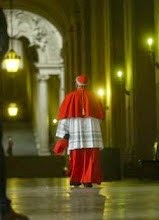
An auxiliary of Cologne since 2003, the 54 year-old archbishop-elect, Rainer Maria Woelki (right), was revealed as Der Deutschepapst's choice two days after the prelate he succeeds, Cardinal Georg Sterzinsky, died at 75 after a long illness.

Having held the post since just prior to the 1990 reunification of Europe's largest country, Sterzinsky retired for health reasons in February, a month after reaching the canonical age-limit.

Though the freshly-deceased cardinal was a close aide to his own predecessor in the capital, Woelki is arguably cut even more in the image of their common mentor: Cologne's extremely influential Cardinal Joachim Meisner, who was transferred from Berlin to what's said to be Europe's wealthiest archdiocese in 1988. The new archbishop served for seven years as priest-secretary to Meisner -- the German hierarchy's leading conservative -- going from that post to the rectorship of the Cologne seminary before his appointment as an auxiliary.

Given his extraordinarily youthful age and the lack of a surviving predecessor with Conclave rights, Woelki stands poised to become the youngest member of the College of Cardinals at the next consistory; likewise a countryman of Joseph Ratzinger, the current holder of that distinction, Munich's Cardinal Reinhard Marx, turns 58 in September.

Despite an eight-decade tradition of its leaders holding a seat in the "Papal Senate," it was only in the wake of reunification that the Berlin church -- now home to some 400,000 Catholics in a city of 3.4 million -- was made an archdiocese.

In the meanwhile, Woelki's arrival in one of Europe's most progressive capitals has reportedly made for a Reichstag-sized stir given his close ties to Meisner and the move's apparent clash with the city's prevailing cultural trend. According to a Reuters brief, the standard press conference on the appointment -- usually a fairly ho-hum affair in Europe -- had to be moved to a larger venue after the initial coverage of the move portrayed the choice as "reactionary" and "backwards minded," particularly with regard to the hot-button topic of homosexuality, and amplified by an alarmist conflation of the prelate's student days at Rome's Pontifical University of the Holy Cross with membership in Opus Dei, which owns the school.

When the time for the meetup came, Woelki denied any ties to the personal prelature outside his doctorate in theology from its Roman house, and pledged his "respect and esteem for all people independent of heritage, skin color and individual nature."

"We will meet with each other... I am open to all without reservations," the archbishop said, adding that "The church is not a moral institution that goes around pointing its finger at people... [but] a community of seekers and believers [which] would like to help people find their happiness in life."

While one paper concluded that, if nothing else, "you can talk with the man of God," another outlet's headline cited Woelki's line as "I have nothing against gays, but...."

With Woelki set to be installed in the prominently-domed St Hedwig's Cathedral (above) over the weeks just prior to the Pope's 22 September arrival for a four-day trek, the sex-talk is a particularly delicate one in the local context as the incoming archbishop now shares the state visit's final planning and hosting duties with the city's openly gay Mayor, a Social Democrat.

The Berlin jaunt will mark B16's second official tour of a European capital with an openly gay city-chief, the pontiff having been welcomed on his 2008 trek to Paris by Mayor Bertrand Delanoe, a Catholic who was elected to his second six-year term in the months leading up to that PopeTrip.

The French tour headlined by the Pope's prominent embrace of the concept of "positive laicité" (read: secularism) advanced by the country's thrice-married Catholic President Nicolas Sarkozy, the thought is likely to be reprised in Benedict's message in Europe's second-largest city. Keeping with much of this pontificate's narrative, however, the talks might again be drowned out by controversies and gaffes.

Among others already to surface, the German Pope's invitation to address the Bundestag -- the dominant house of his homeland's Federal parliament -- has garnered criticism from the body's Green delegation (which holds nearly 70 of its seats) and activist groups. And elsewhere, albeit in response to a bigger-than-expected demand for tickets, the selection of the Berlin stadium built by the Third Reich for the 1936 Olympics to host the visit's main Mass has stoked the predictable storm given B16's forced boyhood conscription into the Hitler Youth.

-30-

Thursday, February 23, 2012

Old Church, New World

As new media moments from last weekend's Consistory go, this one's hard to beat: during a lull in Saturday's "courtesy visits" to the new red-hats, the freshly-elevated archbishop of Berlin, Cardinal Rainer Maria Woelki, took to checking a soccer score on his iPhone.

According to a caption on the capital church's Facebook page -- thanks to Georg for the shot -- the Cologne native was keeping an eye on his hometown side's match against Nuremberg.

Its jerseys featuring a silhouette of the city's famous cathedral, FC Köln lost 2-1.

A protege of the Nordrhein's Cardinal Joachim Meisner -- the closest top German cleric to Pope Benedict, and himself a onetime occupant of the Berlin chair -- Woelki was named archbishop of the relatively small Berlin fold in July, just prior to the German pontiff's September state visit to his homeland.

All of 55, with his elevation, the Opus Dei-trained theologian and former seminary rector is now the youngest member of the College of Cardinals, replacing another German -- Joseph Ratzinger's 58 year-old successor in Munich, the motorbiking sociologist Cardinal Reinhard Marx -- as the junior prelate of the papal "Senate." (On a related note, just turned 62, New York's new Cardinal Timothy Dolan is the seventh youngest of the now-214 member "club," and Galveston-Houston's Cardinal Daniel DiNardo, 63 in May, is tenth.)

Der Deutschepapst already having tapped the young clerics to fill half his native turf's four traditional cardinalatial sees, Germany's other two prime ecclesial posts are likewise soon to turn over: head of the Mainz church since 1983, the longtime head of the country's bishops Cardinal Karl Lehmann turns 76 this spring, and Meisner -- who's led one of global Catholicism's wealthiest dioceses since 1989 -- is now 78.

-30-

Friday, January 06, 2012

Biglietto, 2012

Here, in the Vatican's traditional precedence order, Pope Benedict's slate of cardinals-designate to be elevated on 18 February:
  • Fernando Filoni, prefect of the Congregation for the Evangelization of Peoples;
  • Manuel Monteiro de Castro, Major Penitentiary of the Roman Church;
  • Santos Abril y Castelló, archpriest of St Mary Major;
  • Antonio Maria Veglió, president of the Pontifical Council for Migrants and Refugees;
  • Giuseppe Bertello, president of the Government of the Vatican City-State;
  • Francesco Coccopalmerio, president of the Pontifical Council for Legislative Texts
  • Joao Braz de Aviz, prefect of the Congregation for Religious;
  • Edwin Frederick O'Brien, grand master of the Equestrian Order of the Holy Sepulchre;
  • Domenico Calcagno, president of the Administration of the Patrimony of the Apostolic See;
  • Giuseppe Versaldi, president of the Prefecture for the Economic Affairs of the Holy See;
  • George Alencherry, Major-Archbishop of Erkugnalam-Angamaly of the Syro-Malybars;
  • Thomas Christopher Collins, archbishop of Toronto;
  • Dominik Duka OP, archbishop of Prague;
  • Willem Jacobus Eijk, archbishop of Utrecht;
  • Giuseppe Betori, archbishop of Florence;
  • Timothy Michael Dolan, archbishop of New York;
  • Rainer Maria Woelki, archbishop of Berlin;
  • John Tong Hon, bishop of Hong Kong

...and likewise, the designates older than 80 -- and, ergo, unable to enter a conclave --who are given the red hat as an "honorary" gesture:

  • Lucien Muresan, major archbishop of Fagaras and Alba Julia of the Romanians;
  • Fr Julien Ries, Belgian historian/anthropologist of religion;
  • Prosper Grech OSA, Maltese Biblical scholar;
  • Karl Josef Becker SJ
-30-

Monday, June 29, 2015

"Teach Prayer By Praying, Proclaim Faith By Believing, Give Witness By Living!" – To New Archbishops, Pope's Rules of the Road

On this foundational feast of the church of Rome, the Pope again commemorated Saints Peter and Paul by giving the pallium to the 46 new metropolitan archbishops named over the last year... yet in a change from the ritual devised by St John Paul II in 1984, the group weren't vested with the lambswool band signifying their new jurisdiction by Francis, but will instead have it placed over their shoulders in Cathedral Masses at home over the coming months.

A significantly larger class than usual, this year's crop included two cardinals – the German Rainer Maria Woelki, returned from Berlin to his native Cologne (by most accounts, the Catholic world's richest diocese), and the former Worship chief Antonio Cañizares Llovera, now in Valencia – alongside Francis' marquee US appointee to date, Archbishop Blase Cupich of Chicago, who only met Papa Bergoglio for the first time in a private audience on Friday.

Among others, the group included Archbishops Eamon Martin of Armagh (the new Irish primate), Anthony Fisher OP of Sydney, John Wester of Santa Fe, Charles Scicluna of Malta (the former lead CDF prosecutor on sex-abuse), and the pontiff's pick for the Spanish capital, Carlos Osoro Sierra of Madrid.


Its roots dating to Christian antiquity and given by the Popes as a "bond of love and incentive to courage" symbolizing the particular link each archbishop enjoys with the Roman pontiff, Francis' decision to return to the pallium's actual presentation within the local church restores the tradition which extended until 1984, when John Paul chose to gather the new metropolitans in Rome to confer it himself.

Cupich will receive his pallium in a 23 August Mass in Chicago's Holy Name Cathedral, while Wester's conferral date in Santa Fe's Cathedral-Basilica of St Francis has yet to emerge. In both cases, the rite will be performed by the Nuncio to Washington, Archbishop Carlo Maria Viganò.

Traditionally accompanied by large pilgrimages from the archbishops' new flocks, the pallium events signal the end of the Vatican's working year before the Curia's summer exodus, the week usually accompanied by a host of wrap-up meetings and releases as the church's Home Office heads into hiatus until early September. As appointments go, the last batches decided over these days are customarily announced on or before July 15th.

Back to the main event, here below, for those who missed it overnight, on-demand video of the morning liturgy...


...and the Vatican's English translation of the Pope's homily at it (emphases original):

The reading, taken from the Acts of the Apostles, speaks to us of the first Christian community besieged by persecution. A community harshly persecuted by Herod who “laid violent hands upon some who belonged to the Church… proceeded to arrest Peter also… and when he had seized him he put him in prison” (12:1-4).

However, I do not wish to dwell on these atrocious, inhuman and incomprehensible persecutions, sadly still present in many parts of the world today, often under the silent gaze of all. I would like instead to pay homage today to the courage of the Apostles and that of the first Christian community. This courage carried forward the work of evangelisation, free of fear of death and martyrdom, within the social context of a pagan empire; their Christian life is for us, the Christians of today, a powerful call to prayer, to faith and to witness.

A call to prayer: the first community was a Church at prayer: “Peter was kept in prison; but earnest prayer for him was made to God by the Church” (Acts 12:5). And if we think of Rome, the catacombs were not places to escape to from persecution but rather, they were places of prayer, for sanctifying the Lord’s day and for raising up, from the heart of the earth, adoration to God who never forgets his sons and daughters.

The community of Peter and Paul teaches us that the Church at prayer is a Church on her feet, strong, moving forward! Indeed, a Christian who prays is a Christian who is protected, guarded and sustained, and above all, who is never alone.

The first reading continues: “Sentries before the door were guarding the prison; and behold, an angel of the Lord appeared, and a light shone in the cell; and he struck Peter on the side… And the chains fell off his hands” (12:6-7).

Let us think about how many times the Lord has heard our prayer and sent us an angel? An angel who unexpectedly comes to pull us out of a difficult situation? Who comes to snatch us from the hands of death and from the evil one; who points out the wrong path; who rekindles in us the flame of hope; who gives us tender comfort; who consoles our broken hearts; who awakens us from our slumber to the world; or who simply tells us, “You are not alone”.

How many angels he places on our path, and yet when we are overwhelmed by fear, unbelief or even euphoria, we leave them outside the door, just as happened to Peter when he knocked on the door of the house and the “maid named Rhoda came to answer. Recognizing Peter’s voice, in her joy she did not open the door” (12:13-14).

No Christian community can go forward without being supported by persistent prayer! Prayer is the encounter with God, with God who never lets us down; with God who is faithful to his word; with God who does not abandon his children. Jesus asked himself: “And will not God vindicate his elect, who cry to him day and night?” (Lk 18:7). In prayer, believers express their faith and their trust, and God reveals his closeness, also by giving us the angels, his messengers.

A call to faith: in the second reading Saint Paul writes to Timothy: “But the Lord stood by me and gave me strength to proclaim the word fully… So I was rescued from the lion’s mouth. The Lord will rescue me from every evil and save me for his heavenly Kingdom” (2 Tim 4:17-18). God does not take his children out of the world or away from evil but he does grant them strength to prevail. Only the one who believes can truly say: “The Lord is my shepherd, there is nothing I shall want” (Ps 23:1).

How many forces in the course of history have tried, and still do, to destroy the Church, from without as well as within, but they themselves are destroyed and the Church remains alive and fruitful! She remains inexplicably solid, so that, as Saint Paul says, she may acclaim: “To him be glory for ever and ever” (2 Tim 4:18).

Everything passes, only God remains. Indeed, kingdoms, peoples, cultures, nations, ideologies, powers have passed, but the Church, founded on Christ, notwithstanding the many storms and our many sins, remains ever faithful to the deposit of faith shown in service; for the Church does not belong to Popes, bishops, priests, nor the lay faithful; the Church in every moment belongs solely to Christ. Only the one who lives in Christ promotes and defends the Church by holiness of life, after the example of Peter and Paul.

In the name of Christ, believers have raised the dead; they have healed the sick; they have loved their persecutors; they have shown how there is no power capable of defeating the one who has the power of faith!

A call to witness: Peter and Paul, like all the Apostles of Christ who in their earthly life sowed the seeds of the Church by their blood, drank the Lord’s cup, and became friends of God.

Paul writes in a moving way to Timothy: “My son, I am already on the point of being sacrificed; the time of my departure has come. I have fought the good fight, I have finished the race, I have kept the faith. From now on there is laid up for me the crown of righteousness, which the Lord, the righteous judge, will award to me on that Day, and not only to me but also to all who have loved his appearing” (2 Tim 4: 6-8).

A Church or a Christian who does not give witness is sterile; like a dead person who thinks they are alive; like a dried up tree that produces no fruit; an empty well that offers no water! The Church has overcome evil thanks to the courageous, concrete and humble witness of her children. She has conquered evil thanks to proclaiming with conviction: “You are the Christ, the Son of the living God” (cf. Mt 16:13-18).

Dear Archbishops who today receive the Pallium, it is a sign which represents the sheep that the shepherd carries on his shoulders as Christ the Good Shepherd does, and it is therefore a symbol of your pastoral mission. The Pallium is “a liturgical sign of communion that unites the See of Peter and his Successor to the Metropolitans, and through them to the other Bishops of the world” (Benedict XVI, Angelus of 29 June 2005).

Today, by these Palliums, I wish to entrust you with this call to prayer, to faith and to witness.

The Church wants you to be men of prayer, masters of prayer; that you may teach the people entrusted to your care that liberation from all forms of imprisonment is uniquely God’s work and the fruit of prayer; that God sends his angel at the opportune time in order to save us from the many forms of slavery and countless chains of worldliness. For those most in need, may you also be angels and messengers of charity!

The Church desires you to be men of faith, masters of faith, who can teach the faithful to not be frightened of the many Herods who inflict on them persecution with every kind of cross. No Herod is able to banish the light of hope, of faith, or of charity in the one who believes in Christ!

The Church wants you to be men of witness. Saint Francis used to tell his brothers: “Preach the Gospel always, and if necessary, use words!” (cf. Franciscan sources, 43). There is no witness without a coherent lifestyle! Today there is no great need for masters, but for courageous witnesses, who are convinced and convincing; witnesses who are not ashamed of the Name of Christ and of His Cross; not before the roaring lions, nor before the powers of this world. And this follows the example of Peter and Paul and so many other witnesses along the course of the Church’s history, witnesses who, yet belonging to different Christian confessions, have contributed to demonstrating and bringing growth to the one Body of Christ. I am pleased to emphasize this, and am always pleased to do so, in the presence of the Delegation of the Ecumenical Patriarchate of Constantinople, sent by my beloved brother Bartholomew I.

This is not so straightforward: because the most effective and authentic witness is one that does not contradict, by behaviour and lifestyle, what is preached with the word and taught to others!

Teach prayer by praying, announce the faith by believing; offer witness by living!
-30-

Thursday, June 28, 2012

Pallium Eve

Even if all remains quiet for now, one of the Catholic imagination's more unique rituals continues as this Friday dawns in Rome.

Every year on the vigil of Saints Peter and Paul, the year's freshly-woven batch of the pallium -- the symbol worn by metropolitan archbishops within their provinces to signify "the fullness of the episcopal office" -- are placed in the gilt casket shown above, to spend this night in the tomb of the First Apostle. From there, come morning, the Pope will confer the lambswool bands of ancient origin on 43 prelates named to archdioceses across the globe over the last year, giving it as "a bond of love, and an incentive to courage."

While newly-named metropolitans have made the trek to the Vatican to receive their pallia from the pontiff since 1984, this year's rite -- beginning at 9am Rome time (3am Eastern; livestream... and worship aid) -- will be unique in two aspects.

For starters, a new change to the ceremonial has moved the distribution of the garment to before the Mass, as opposed to its prior place following the homily. And in a gesture that's both an ecumenical landmark and a treat for a music-loving Pope on the 61st anniversary of his ordination to the priesthood, the choir of London's Westminster Abbey -- which blew the Vatican delegation away during Benedict's State Visit to the UK in September 2010 -- will join the usual Sistine Singers to sing at the liturgy.

As this year's recipients go, the 44 archbishops include two prelates already made cardinals -- the youngest member of the Papal "Senate," Berlin's Rainer Maria Woelki, and the Mexican Francisco Robles Ortega, who gets his second pallium after his transfer from Monterey to Guadalajara, the country's second-largest diocese, last year.

Other high-profile figures among the global group include the new patriarch of Venice Francesco Moraglia, Archbishops Chito Tagle of Manila, Christian Lepine of Montreal, Andrew Yeom of Seoul, Mark Coleridge of Brisbane, and Paul-Andre Durocher of Gatineau, the vice-president of the Canadian bishops. Per usual, the world's largest Catholic country -- Brazil -- leads the pack with seven new metropolitans in tomorrow's class.

The US delegation, meanwhile, is led by the figure who's taken on American Catholicism's most daunting episcopal assignment in the last half-century (and the recently-named host of the church's 2015 World Meeting of Families), Philadelphia's Archbishop Charles Chaput OFM Cap. -- receiving his second pallium 15 years after his first, for Denver -- joined by his successor in the Rockies, the native son Samuel Aquila, who'll be installed on 18 July; the "quarterback" of the USCCB's religious freedom push, William Lori of Baltimore; and, in a rarity for an Eastern metropolitan, William Skurla, the Ruthenian archeparch of Pittsburgh.

The Peter and Paul Mass traditionally marks the end of the Vatican's working year; much like his Curia, the Pope is scheduled to leave Rome next week until late September, in his case to spend the summer hiatus at the papal villa at Castel Gandolfo.

-30-

Thursday, September 22, 2011

"I Have Come To Speak About God"

ADDRESS OF POPE BENEDICT XVI
STATE WELCOMING CEREMONY
BELLEVUE CASTLE
BERLIN
22 SEPTEMBER 2011


Mr President of the Federal Republic,
Ladies and Gentlemen,
Dear Friends,

I am honoured by the kind welcome which you have given to me here in Bellevue Castle. I am particularly grateful to you, President Wulff, for inviting me to make this official visit, which marks the third time I have come as Pope to the Federal Republic of Germany. I thank you most heartily for your cordial words of welcome. I am likewise grateful to the representatives of the Federal Government, the Bundestag, the Bundesrat, and the City of Berlin for their presence, which signifies their respect for the Pope as the Successor of the Apostle Peter. Last but not not least, I thank the three Bishops who are my hosts, Archbishop Woelki of Berlin, Bishop Wanke of Erfurt and Archbishop Zollitsch of Freiburg, and all those at the various ecclesial and civil levels who helped in preparing this visit to my native land and contributed to its happy outcome.

Even though this journey is an official visit which will reinforce the good relations existing between the Federal Republic of Germany and the Holy See, I have not come here primarily to pursue particular political or economic goals, as other statesmen rightly do, but rather to meet people and to speak about God.

We are witnessing a growing indifference to religion in society, which considers the issue of truth as something of an obstacle in its decision-making, and instead gives priority to utilitarian considerations.

All the same, a binding basis for our coexistence is needed; otherwise people live in a purely individualistic way. Religion is one of these foundations for a successful social life. “Just as religion has need of freedom, so also freedom has need of religion.” These words of the great bishop and social reformer Wilhelm von Ketteler, the second centenary of whose birth is being celebrated this year, remain timely.

Freedom requires a primordial link to a higher instance. The fact that there are values which are not absolutely open to manipulation is the true guarantee of our freedom. The man who feels a duty to truth and goodness will immediately agree with this: freedom develops only in responsibility to a greater good. Such a good exists only for all of us together; therefore I must always be concerned for my neighbours.

Freedom cannot be lived in the absence of relationships. In human coexistence, freedom is impossible without solidarity. What I do at the expense of others is not freedom but a culpable way of acting which is harmful to others and also to myself. I can truly develop as a free person only by using my powers also for the welfare of others. This holds true not only in private matters but also for society as a whole. In accordance with the principle of subsidiarity, society must give sufficient space for smaller structures to develop and, at the same time, must support them so that one day they will stand on their own.

Here in Bellevue Castle, named for its splendid view of the banks of the Spree and situated close to the Victory Column, the Bundestag and the Brandenburg Gate, we are in the very heart of Berlin, the capital of the Federal Republic of Germany. This castle, with its dramatic history – like many buildings of this city – is a testimony to the history of Germany. A clear look at the past, even at its dark pages, enables us to learn from it and to receive an impetus for the present. The Federal Republic of Germany has become what it is today thanks to the power of freedom shaped by responsibility before God and before one another. It needs this dynamism, which engages every human sector in order to continue developing now. It needs this in a world which requires a profound cultural renewal and the rediscovery of fundamental values upon which to build a better future (Caritas in Veritate, 21).

I trust that my meetings throughout this visit – here in Berlin, in Erfurt, in Eichsfeld and in Freiburg – can make a small contribution in this regard. In these days may God grant all of us his blessing.

* * *
[Photo Caption: to mark this weekend's Papal State Visit, the leading German daily Bild placed the shown 18-story copy of its front-page from 20 April 2005 -- the day following Pope Benedict's election -- on its Berlin headquarters.

[To mark the first election of a German pontiff in nearly a millennium, Bild's cover translates in English as "We are the Pope!"]

PHOTO: Reuters

-30-

Wednesday, March 06, 2013

On Castel Stroll, Paparazzi Snap Papa Ratzi

Lest anyone thought being Pope made for the world's most mysterious – and therefore attention-grabbing – public role, there's apparently something that commands even more fascination: the first post-papacy in 700 years.

Six days since leaving Peter's chair to attain his long-sought "release," as never once happened during his seven years as Pope, Italian paparazzi images published today captured a bundled-up B16 walking in the gardens at Castel Gandolfo with his secretary, Archbishop Georg Gänswein, who'll soon have to return to Rome to fulfill his "day job" as prefect of the Papal Household.

Two photos of the now Pope-emeritus were run in the Italian celebrity magazine Chi.

The morning after the resignation, the Vatican spokesman Fr Federico Lombardi related that Papa Ratzinger was moved and appreciative on seeing the Italian TV reports about his departure in the hours after the sede vacante took effect. The Jesuit portavoce added that Benedict slept well, had breakfast and was looking forward to resuming his longtime practice of playing the piano in the evenings.

No further update from the Holy See has since emerged. Still, much as it wouldn't be any surprise if the Vatican sought to protest the invasion of the retired pontiff's space, the Pope's line at his closing audience a week ago just echoes back again...
"Always, he who assumes the Petrine ministry no longer has any privacy. He belongs always and totally to everyone, to the whole Church. His life is, so to speak, totally deprived of the private sphere.... The 'always' is also a 'forever' – there is no returning to private life. My decision to forgo the exercise of active ministry does not revoke this. I do not return to private life, to a life of travel, meetings, receptions, conferences and so on. I do not abandon the cross, but remain in a new way near to the Crucified Lord."
On a side-note, it's sweet to see that the quilted mountain-jacket and ballcap – first used by Benedict on the first summer break after his 2005 election (left, amid the Alps) – have been kept around and returned to use.

Elsewhere, though, much as howls have come from some segments of the Establishment over both the ex-Pope's future living arrangements behind the city-state's walls amid claims of an "undue influence" the situation could have on his successor, and especially Gänswein's impending dual role as B16's lead minder while holding the post that will organize the next Pope's daily agenda, it bears reminding that the last Pope has followed tradition in leaving his successor several openings to give the secretary a golden "out." 

As things stand, two key posts in German Catholicism – the influential bishopric of Mainz and the metropolitan seat at Cologne, thought to be the richest diocese in the world – both have cardinal-heads who remain in office well past the retirement age of 75; in the latter case, Benedict's closest ally at home, the conservative Cardinal Joachim Meisner, turns 80 on Christmas. Come August, meanwhile, Gänswein's native archdiocese of Freiburg opens up as Archbishop Robert Zollitsch – the president of the German bench – will be required to submit his own "walking papers."

Of course, the scenario clearly echoes that of early 2005, when John Paul II could've filled the archbishopric of Krakow – Poland's second see, and the one he held until becoming Pope – but left the replacement of his own successor, Cardinal Franciszek Macharski, then nearly 78, to the next pontiff. 

For what it's worth, it didn't take being in Rome to figure out – even before John Paul died – that Stanislaw Dziwisz, Karol Wojtyla's omnipresent ombra of four decades, would end up in the post. 

Within six weeks of Benedict's election, it happened.


As Pope, Der Deutschpapst was keenly intent on stacking the German church's top rank with 50-something appointees, naming the sociologist-biker Reinhard Marx (above), then 52, to his former seat in Munich in 2007 and the iPhone-toting Cologne auxiliary Rainer Maria Woelki to Berlin at 54 in 2011, quickly elevating both into this Conclave's electorate.

And in the next pontificate – whoever the cardinals' choice might fall upon – don't be surprised one bit when the Vatican's "George Clooney," now 56, completes the circle.

PHOTOS: Chi(1); CatholicPressPhoto(2); AP(3)

-30-

Monday, July 02, 2012

At the "Holy Office," It's Müller Time -- Pope Taps Der Regensburger as "Grand Inquisitor"

Anticipated for months, it's finally official -- at Roman Noon this Monday, the Pope named Bishop Gerhard Ludwig Müller of Regensburg as prefect of the Congregation for the Doctrine of the Faith, accepting the retirement of Cardinal William Levada a year after the highest-ranking American in Vatican history reached the canonical age of 75.

With the appointment of the 64 year-old theologian -- the editor of the still-in-production "Complete Works" of Joseph Ratzinger -- Germans now occupy two of the Vatican's top three posts: a level of dominance that, until now, has been enjoyed only by Italians.

Made an archbishop on the move, by seniority Müller will be the first cardinal created by Benedict at his next consistory, which could come in Spring 2013, barring one exception: namely, should the pontiff appoint a new Secretary of State before then who hasn't already received the red hat.

Early last month, the most definitive sign of the impending appointment came when the Pope appointed Müller as a member of the Congregation for Catholic Education and the Pontifical Council for Christian Unity -- a combination that, among the Curia's senior members, has been held only by Levada. As early as January, however, German reports noted that the bishop had been taking refresher courses in Italian.

Once the "supreme" dicastery of the Roman Curia, the roots of the modern-day CDF date to 1542, when Pope Paul III established it as the Sacred Congregation of the Universal Inquisition. In the post-Vatican II reforms of Paul VI, the "Holy Office" was given its current name, with a rebooted mandate to encourage and promote theological study beyond its traditional function as the global church's lead guardian of orthodoxy.

A priest of Mainz, the new prefect spent most of his priesthood as a theology professor in Munich before his appointment to Regensburg in 1992. He has served as a member of the congregation since 2002.

Given common perceptions of the current pontificate, it's worth noting that Müller's appointment to lead the CDF survived an attempted subterfuge by some conservatives in Roman circles, who -- among other things -- sought to play up a longstanding friendship the new "Grand Inqusitor" has kept with a leading architect of liberation theology, the Peruvian Dominican Gustavo Gutierrez.

While, for most, any mention of the Bavarian city is likely to evoke one of the most controversial addresses of Benedict's seven-year reign, the 1.2 million-member Regensburg church is the closest thing the Pope has to a "home" diocese. The now-pontiff's last professorship before becoming archbishop of Munich and Freising in 1977 was there, and his elder brother, Msgr Georg Ratzinger, directed its cathedral choir (the Domspatzen) from 1964 to 1994. A short drive away in the suburb of Pentling, meanwhile, is the small house off a cul-de-sac that Joseph Ratzinger built in the 1970s for himself and his brother with an eye to their retirement. (As Pope, Benedict was able to return there for a fleeting few minutes during his 2006 "homecoming" trip. In an undated photo, Muller is shown above with the Pope's brother at the Pentling house.)

Named by Benedict to succeed the Pope in the job he held for 23 years within days of his 2005 election, the LA-born Levada -- then the archbishop of San Francisco -- previously worked as a staffer at CDF from 1976-82. As the cardinal's tenure as prefect neared its close, the work of the congregation sparked twin firestorms in the American church and media as, citing "serious doctrinal problems," in late April the office imposed a wide-ranging oversight on the nation's leading umbrella-group of nuns, the Leadership Conference of Women Religious, then issued a high-profile warning in early June on a 2006 book on sexual ethics written by another sister, the retired Yale professor Margaret Farley RSM, a former president of the Catholic Theological Society of America.

Among CDF's relatively new areas of jurisdiction are several matters of sizable import to the church in the English-speaking world, above all deciding final outcomes to the worldwide church's clergy sex-abuse cases (a task entrusted to Ratzinger in 2001 after a Curial turf-fight), and the implementation of Anglicanorum coetibus, the Pope's 2009 initiative allowing for Anglican groups to enter the Catholic church as collective units, with their own liturgy and governing structures. In the space of just over a year, the latter development has arguably made for the Western church's largest boon of married priests in the millennium since mandatory celibacy became universal policy.

As a result of today's appointment, given that the congregation's top three officials will now be a German, a Spaniard (the secretary, Archbishop Luis Ladaria SJ) and an Italian (the Milanese undersecretary Msgr Damiano Marzotto Caotorta), what effect the new dynamic will have on the Anglophone-centric issues is a key point to watch over the coming months. With Levada's departure, CDF's top English-speaking principal becomes the office's highly-regarded lead "prosecutor" on abuse cases, the Maltese promotor of justice Msgr Charles Scicluna.

With his ascent, the new prefect now likewise becomes president of the Pontifical Commission Ecclesia Dei, making him -- at least officially -- the prime overseer of the Vatican's doctrine-centric reconciliation effort with the Society of St Pius X.

As previously noted, however, the bulk of the heavy lifting on the top Benedictine priority will largely fall to the newly-named vice president of the office, the Bronx-born Archbishop J. Augustine DiNoia OP, a former #3 at CDF.

At the same time, in a telling sign of the Müller appointment's likely reception in at least some traditionalist circles, while performing a priestly ordination over the weekend in the Regensburg diocese, one of the four SSPX bishops, the Spaniard Alfonso de Galarreta, reportedly "complained" about the Pope's choice for the post, citing a widely-trafficked assertion among opponents to the appointment that, in one of his theological works, Müller had denied the dogma of the Virgin Birth.

As head of the Holy Office, by custom Müller will also serve as president of the International Theological Commission and the Pontifical Biblical Commission.

Beyond its Roman significance, with Germany already home to the Catholic world's two youngest cardinals -- Berlin's Rainer Maria Woelki, 55, and Munich's Reinhard Marx, 58 -- today's appointment further signals Benedict's determination to firmly establish a new generation of leadership in his homeland which will endure long past his pontificate's end. Two further opportunities toward that end aren't far ahead on the horizon as the German church's lead conservative and progressive figures of the last two decades -- respectively Cologne's Cardinal Joachim Meisner and Mainz's Cardinal Karl Lehmann -- are both well past the retirement age. (Notably, the latter prelate was Müller's doktorvater, overseeing his dissertation on Dietrich Bonhöffer, the Protestant theologian hanged by the Nazis.)

Speaking of retirement, while the new prefect-emeritus has long been understood as keen to return to the West Coast, Levada will remain a member of several key Curial offices until his 80th birthday in June 2016.

For many years, the cardinal has owned a condo in his hometown of Long Beach, sharing the getaway with his closest friend of nearly 60 years and successor in San Francisco, Archbishop George Niederauer, whose own transition from office is likewise expected in short order.

Referring to the nearing end of their ministries in his homily at the San Fran Mass marking Niederauer's golden jubilee of priesthood in late April, Levada quoted the poet Robert Browning: "Grow old along with me! The best is yet to be, the last of life, for which the first was made. Our times are in his hand who saith, 'A whole I planned, youth shows but half; Trust God: See all, nor be afraid!'"

Having ordained this year's class of priests and transitional deacons just yesterday in his now-former charge, the incoming prefect will take up residence in Rome in time for the Curia's mid-September return from the traditional summer recess. Müller was scheduled to hold a press conference on his appointment as the announcement was made in Rome.

-30-