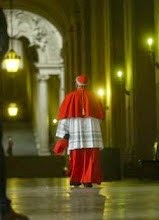
Friday, January 20, 2006

Happy Kasper Week

Benedict XVI had in his fellow German Cardinal Walter Kasper, president of the Pontifical Council for Christian Unity, yesterday afternoon for a private chit-chat.

It's an appropriate time, given the Week of Prayer for Christian Unity (that goal'll be accomplished much sooner than Catholic unity, for which we'd need an annual month of prayer) which is an annual highlight of his dicastery's work, and the Pope's presence at the Week's conclusion on 25 January: the annual prayer service with Orthodox and Protestant representatives at St. Paul's Outside the Walls, which is where the Vatican prefers to be ecumenical.

But earlier in the week, "Kasper the Friendly Cardinal" got his game face on at a mega-ecumenical confab in the English city of Durham (whose Anglican bishop, NT Wright, is well-known to most of you). Members of the A-team of the global Catholic press (Cindy Wooden of CNS and a delegation from The Tablet) were in attendance.

According to Wooden, Kasper said some interesting things:
While many of the doctrinal differences that divided Christians for centuries are close to being resolved, different approaches to modern ethical questions are making Christian unity appear as distant as ever, said Cardinal Walter Kasper.

"I am very sad we are not able to speak with one voice on these issues to a world that needs to hear," the cardinal said Jan. 13 at an international ecumenical conference at Ushaw College, a Catholic seminary in Durham....

Cardinal Kasper told conference participants that believing Christians cannot give up hope for Christian unity because church division is "a sin before God and a scandal before the world."
Ooh, he said "scandal." I thought liberals didn't know that word even existed.

Even more interesting was this portion of the remarks:
Differences among Catholics, Orthodox, Anglicans and Protestants over issues such as homosexual activity, abortion, euthanasia and other moral questions "are not on the top of the hierarchy of truths" -- like the belief in Jesus as savior is -- "but they are very emotional and, therefore, very divisive," the cardinal said.

Just five or six years ago, he said, Catholic bishops and leaders of some other churches seemed ready to explore concrete steps their communities could take toward organizational unity.

Since then, however, it has become clear that "both the ecumenical mood and the ecumenical situation worldwide have changed so radically as to virtually run counter to the ecumenical movement toward unity," he said.

In Europe and North America, he said, "the changed situation is evident in a new polarization and fragmentation exemplified by divergent and even conflicting verdicts on ethical problems."
So everything that we keep hearing screamed about as dogma and "the most important things in the life of the church" every day has just been clarified -- by a cardinal of the church who's not a self-anointed anything, no less -- as being on the tier of mere "ethical problems," "not on the top of the hierarchy of truths" should not obstruct the greater good of unity, so long as the participants don't get all self-righteous and make themselves impediments to it.

Hmmmmm.... Either he's right or... he's right. And this works for intra-church spatting, too.

And for those who think that Christian Unity means just making everybody else Catholic, the cardinal's telling you to think again:
"Ecumenical unity is not to be thought of along the lines of the fusion of worldwide megacorporations," he said. Rather, Christians are called by God to be united in their faith in Jesus, in the sacraments, in the proclamation of the Gospel and in striving for holiness, he said.

By committing themselves to holiness and to unity in the fundamental truths of Christianity, he said, Christians will come closer to full unity than they ever could hope to do by planning corporate mergers.

"The fact that the unity of the church is grounded in its participation in the holy does indeed have real consequences for the concrete form of the church," he said.
"Fundamental truths of Christianity" seem to equal serene faith in Jesus, consistent love for neighbor, and a commitment to peace for all.

As I always say, just as they'll know that we are Christians by our love (by our love, by our love), so they'll know that they are Catholics by their anger....

Let's hope it doesn't have to be that way.

-30-

Friday, November 23, 2007

The Cardinals' "Come-to-Benedict"

In the final count, the daylong meeting of the cardinals drew 143 red-hats, and reds-to-be.

Writing on the resurrected NewsHub, CNS' John Thavis blogs the flavor from the New Synod Hall:
A pool of journalists watched as cardinals entered the Synod Hall building one by one. Some came by foot, some were chauffeured and one — 75-year-old Dutch Cardinal Adrianus Simonis — rode a bicycle to the meeting hall.

Cardinal-designate John P. Foley stepped out of his car and began chatting with reporters on the other side of the press pen. Within seconds he looked up, a bit surprised, to see a cluster of fuzzy boom mikes overhead. “I guess my every word is being recorded,” he remarked....

Near the building’s entrance, a vehicle dropped off Cardinal Bernard Law, the former archbishop of Boston, who went directly inside. Cardinal Angelo Scola of Venice, energetic as always, jumped out of his car before it even stopped moving and began conferring with fellow Italians in the parking lot.

Those who walked were sometimes intercepted. Down near St. Peter’s Square, Portuguese Cardinal Jose Saraiva Martins, head of the Vatican’s saintmaking office, was sidelined by a stamp collector who asked him to autograph a recent commemorative series.

Inside the atrium of the hall, each cardinal was handed a red folder, which presumably contained a program and the text of the day’s main address on ecumenism by Cardinal Walter Kasper.

Old friends and colleagues greeted each other: Cardinal William J. Levada, the Vatican’s doctrinal chief and the former archbishop of San Francisco, conversed with Cardinal Roger Mahony of Los Angeles. [Friends for a half-century, the two were seminary classmates.]

Polish Cardinal Stanislaw Dziwisz of Krakow was warmly welcomed by everyone in his path. I asked Cardinal Dziwisz how it felt to come back to the Vatican, where he had spent more than 26 years as secretary to Pope John Paul II. He paused a moment and said, “So many memories,” and then moved into the Synod Hall.
The morning's topic, of course, was a discussion on ecumenical and interreligious dialogue, with facilitating duties falling to the president of the Pontifical Council for Christian Unity, Cardinal Walter Kasper, who subsequently briefed the press:
On relations with Anglicans, Kasper said the 77-million member Anglican Communion was in "a very difficult situation" with the challenges by traditionalists -- many from the Third World -- against liberal bishops in western countries.

The Anglican Communion is in internal crisis over the ordination of women and openly homosexual bishops.

"We hope they make a decision very soon. They cannot postpone all this crisis. There must be a decision made. But it is not in our hands."

Relations with Protestant Churches were getting more difficult because of "an inner fragmentation" among them, Kasper said. "Some of them have turned to liberal (positions) and there are now new ethical problems dividing them," he said.

He said that evangelical churches were spreading quickly and noted there were now 400 million Pentecostals around the world.

These two conservative Christian movements have been spreading especially rapidly in Latin America, often wooing away the faithful from the Catholic Church there.

"We must not ask first what is wrong with the Pentecostals but ask what is wrong with our pastoral work and come to a spiritual renewal," he said.
PHOTO 1: L'Osservatore Romano
PHOTO 2: AP/Plinio Lepri


-30-

Friday, February 21, 2014

Throw "Casuistry" To the Wind – For Family Talks, Francis Wants "Theology While Kneeling"

A couple weeks from now will mark a year since the walls of the Synod Hall shook – at least, figuratively – as Cardinal Jorge Bergoglio unleashed his assessment of a "self-referential, sick" church, and many among a stunned pre-Conclave General Congregation punctuated the take with a sudden ovation.

If the Argentine hadn't lit the fuse – with time to spare on his allotted five minutes, to boot – chances are he wouldn't have become Pope. And now, in the same place, the narrative arc of a year that rocked the Catholic world has reached its home stretch.

Any final outcomes, however, remain a good while off.

For the first time as Rome's 266th Bishop, Francis convoked the city's historic clergy – the College of Cardinals – yesterday, opening his first addition to the body with the creation of 19 new members tomorrow morning. Now numbering 218 prelates with the new intake, while some 185 red-hats were initially expected to be on-hand, the first day's turnout was considerably lighter, with only 150 said to be in the room.

In any event, the shape of the day marked a new threshold for the prime function of the papal "Senate" – advising the Pope. As John Paul II had only consulted broadly with the college on a handful of occasions over his 27-year reign, Benedict XVI responded by introducing a "day of prayer and reflection" to preface each of his four major Consistories.

Prepared by the professor-Pope in the style of a seminar, Ratzinger's sense of programming tended to be too packed by long addresses from hand-picked prelates on topics ranging from the retirement age of bishops, clergy sex-abuse and Anglicanorum coetibus to the New Evangelization to allow for any kind of profound interaction. Now, in his turn at the format, Francis has signaled his premium on hearing the "mind of the body" instead by extending the session to two days, while culling back its agenda to just one item: the pastoral challenges facing the family – Papa Bergoglio's marquee issue-item for 2014, set to culminate at October's Extraordinary Synod on the same topic.


At the same time, what the Pope's "script" lacked in a heavy roster, it more than made up for with his choice of messenger. Yet again, no small amount of shockwaves made the rounds on the announcement that the retired Christian Unity Czar, German Cardinal Walter Kasper, would be the keynote speaker at yesterday's opening session. For all the warmth that's marked the unprecedented dynamic of "two Popes" coexisting behind the walls, the move signaled yet another theological turn from the mind of Ratzinger toward a greater openness to the thought of his rivals.

A onetime assistant to Hans Küng, Kasper memorably clashed with the future B16 over the primacy of the universal or local church and, before his 1998 arrival in Rome, over the very issue that's become the flashpoint of Francis' call to reflection on family life: the standing of civilly remarried Catholics, particularly on their reception of the sacraments.

Specifically citing the "adamant refusal" of the Eucharist posed by the latter scenario, Kasper wrote in 2001 that "no bishop should be silent or stand idly by when he finds himself [facing] such a situation."

Within days of his election, the new Pope began showcasing the German iconoclast as – to quote Mickens – "the theologian of his pontificate." At his first Angelus, Francis conspicuously plugged Kasper's recent opus on mercy, hailing him as an "on the ball" thinker. Even before the election, meanwhile, the cardinal – who, having turned 80 days after B16's resignation, was able to vote in the Conclave by the skin of his teeth – said the next Pope "need[ed] to realize the perception of the Second Vatican Council; we have not accomplished this task... to fully realize collegiality."

Kasper went on to call for "a modest Church, not self-referential, perhaps not poor, but modest and humble as well."

In other words, the whole ship he asked for suddenly docked along the banks of the Tiber.

According to the summaries provided by the VatiSpox Fr Federico Lombardi and some participants, Kasper's lengthy reflection yesterday returned to the tension between the application of mercy and the non-negotiable truths of divine revelation. While the cardinal did treat the question of the civilly remarried among other practical pastoral concerns, the keynoter said in the run-up to his turn at the podium that he wasn't looking to push a position so much as lay out the principles at hand. He did, however, probe the possibility of a return to the once-widespread concept (subsequently clamped down upon by Rome) of dealing with civil remarriage as a matter of the "internal forum" – that is, in the context of Confession as opposed to the "external forum" of a tribunal.

While the text of Kasper's talk wasn't released by the Holy See, Francis' brief introductory remarks were published shortly after delivery:

Dear brothers,

I extend a warm greeting to you all and, with you, I thank the Lord who has given us these days of meeting and working together. We welcome especially our brothers who will be created Cardinals on Saturday and we accompany them with our prayers and fraternal affection. I wish to thank also Cardinal Sodano for his words.

During these days, we will reflect in particular on the family, which is the fundamental cell of society. From the beginning the Creator blessed man and woman so that they might be fruitful and multiply, and so the family then is an image of the Triune God in the world.

Our reflections must keep before us the beauty of the family and marriage, the greatness of this human reality which is so simple and yet so rich, consisting of joys and hopes, of struggles and sufferings, as is the whole of life. We will seek to deepen the theology of the family and discern the pastoral practices which our present situation requires. May we do so thoughtfully and without falling into "casuistry", because this would inevitably diminish the quality of our work. Today, the family is looked down upon and mistreated. We are called to acknowledge how beautiful, true and good it is to start a family, to be a family today; and how indispensable the family is for the life of the world and for the future of humanity. We are called to make known God’s magnificent plan for the family and to help spouses joyfully experience this plan in their lives, as we accompany them amidst so many difficulties with a pastoral care that is sound, courageous and full of love.

On behalf of everyone, I thank Cardinal Walter Kasper for his valuable contribution which he will offer us with his introduction.

Thank you all, and have a productive day!
As is his habit, Francis defined his reference to "casuistry" alongside lobbing it into the seats of the Synod Hall. At his morning Mass before today's second session, the Pope recalled the Gospel accounts of "all those who approached Jesus to present him with cases such as: is it lawful to to pay taxes to Caesar?" or the case of the widow, "poor thing, who according to the law had to marry the seven brothers of her husband in order to have a child.

As the two evince, "casuistry is precisely the place to which all those people go who believe they have faith," but instead reflexively rattle off precepts, Francis said. "When we find a Christian [who asks] if it is licit to do this and if the church could do that... [either] they do not have faith, or it is too weak."

The Pope went on to contrast these with figures from the Gospels "who do not know doctrine but have great faith."

"Theoretically, we can say the Creed, even without faith, and there are many people who do so," Francis went on, pointedly adding that "even demons" do.

"Demons know well what is said in the Creed," he added, "and know that it is the Truth."

The other danger alongside "casuistry," he warned, is "ideology": "Christians who think of faith, but as a system of ideas, ideologues: even in the time of Jesus, there were people like this. The Apostle John tells them that they are the antichrist, the ideologues of faith, whatever sign they may be.... [T]hose who fall into casuistry or those that fall into the trap of ideologies are Christians who know the doctrine, but without faith, like demons."

Despite the clarified understanding of the term, again, any firm resolutions remain a significant amount of time away. Following the close of the 14 hours of talks with the cardinals, on Monday the action shifts to the 15-member Synod Council – a global A-list of cardinals and other senior bishops – and its final preparations for the working document of the October gathering.

In keeping with his unique custom since taking office, the Pope is likely to be on hand for most, if not all, of the two-day deliberations down the street. Only once the fruit of its labors – the text of the instrumentum laboris – emerges sometime around Easter can any authoritative sense be had of what is and isn't "on the table" come October.

Along the way, earlier today Francis' choices to lead the autumn meeting emerged. Keeping with the Synod's protocols, the sessions will be conducted by a trio of Presidents-delegate: Cardinals André Vingt-Trois of Paris, the "golden child" Luis Antonio Tagle of Manila, and the Brazilian Raymundo Damasceno Assis of Aparecida, a former president of the CELAM and close Bergoglio ally, who's believed to have been a key mover in the last Conclave.

Though the freshly-tapped trio will handle the mechanics of the floor, last October already brought the appointments of the most significant figures in laying the groundwork for the discussions: the Hungarian primate, Cardinal Peter Erdö of Budapest, widely seen as a "conservative," as the 2014 Synod's Relator-General, and Bruno Forte – the Italian theologian-bishop hailed by progressives – as the meeting's Secretary.

All that said, the next round in the Synod Hall isn't the last stage of the effort. With this fall's two-week gathering set to be dominated in its makeup by the presidents of the episcopal conferences from around the globe, the "endgame" isn't slated until October 2015, when an Ordinary Synod (a larger meeting, including non-ordained representatives) will meet to mark the 50th anniversary of the close of Vatican II.

Opening today's second session with his red hats, meanwhile, Francis thanked Kasper again for his keynote, terming it "profound theology, serene theology," which he said reflected the "sensus ecclesiae... that love for Mother Church, right there" contained in the teaching of no less than Bergoglio's own spiritual father: the Jesuit founder Ignatius of Loyola.

"This is called doing theology while kneeling," the Pope said of his chosen keynoter... and so it seems, it's likewise his wish for the long, arduous discernment he's pushed into motion.

-30-

Wednesday, June 30, 2010

"Unity" Eve

Apparently, the appointment will be formally announced tomorrow... but already, reaction's beginning to emerge on B16's expected choice of Bishop Kurt Koch of Basel -- until last year, president of the Swiss bishops -- as the Vatican's next chief ecumenist at the helm of the Pontifical Council for Promoting Christian Unity and, indeed, the lead hand on the global church's relations with the Jewish community.

Shown above (right) with the Pope during the latter's 2008 pilgrimage to the Holy Land, the 60 year-old prelate will bring a contrast of style from his soon-to-be predecessor, the colorful Cardinal Walter Kasper, who won high marks among the dialogue partners, yet famously tussled with the now-pontiff shortly after his arrival in Rome over the primacy of the universal church versus that of the local churches.

A native of the diocese he's led since 1996 -- and a longtime member of the dicastery he's tipped to head -- Italian reports have already circulated quotes from Koch saying, in essence, that accusations of B16's desire to "retreat" from the legacy of the Second Vatican Council are the result of "ignorance, or a willful intention of some theologians who would know better, but loudly say otherwise" (an alleged reference to interventions on the issue made by Fr Hans Kung).

Benedict, the nominee added, "absolutely doesn't want to go 'backward,' but wants instead to bring the church into the deep... pressing forward even today for a new 'reformation' of the church from within, and thus to restore its authentic form, already realized in the Council."

Already, a welcome statement for the new Unity Czar's come from the head of the Geneva-based World Council of Churches, Dr Olav Fyske Tveit:
"We rejoice at the appointment of Bishop Kurt Koch as president of the Pontifical Council for Promoting Christian Unity", said Tveit commenting the news in Moscow. "We welcome his appointment and look forward to working with him for the visible unity of the church", he added.

Tveit said that "Bishop Koch is well known for his openness and deep ecumenical commitment. His book 'That all may be one; Ecumenical perspectives' is an excellent summary of the present state of ecumenical dialogue and relations".

"We see in Bishop Koch a reliable partner for all those involved in the ecumenical movement and trust he will continue Cardinal Walter Kasper's emphasis on spiritual ecumenism", Tveit said.

"Bishop Koch has been given a very important responsibility as the call for all Christians to be one comes from Jesus Christ himself", Tveit said. "I wish him much joy in fulfilling this calling, and that God may give him strength."
-30-

Tuesday, February 19, 2008

Kasper on Ravenna: Authority + Synodality = Unity

Last fall's East-West dialogue at Ravenna was a watershed event in Catholic-Orthodox relations, according to the Vatican's top ecumenist.

But while the Constantinople-Moscow-Athens side opened itself to a discussion on authority, the president of the Pontifical Council for Promoting Christian Unity Cardinal Walter Kasper noted that the Roman end would need to do the same on the question of "synodality" -- or, as it's better known in Catholic circles, "collegiality":
"We started the dialogue between the Catholic Church and the Orthodox Churches as a whole in 1980. The first phase of the dialogue between the 1980s and 90s sought to reaffirm what we have in common: the Eucharist and the other sacraments, episcopacy and priesthood," Cardinal Kasper explained. "Now, we are discussing the canonical and theological consequences; for the first time, we approach the questions: What is the Church? Where is the Church? What are the structures of the Church?

"We came to the concept that the Church is realized on three levels: the local level, that is, the diocese with the bishop; the regional level, that is, the metropolitan or patriarchate; and the universal level. And on every level we have a tension between authority -- bishop, patriarch, and the ‘protos,' Greek for primate, that is, ‘the first of the bishops' -- and the principle of synodality, synodal structures."

Cardinal Kasper explained that at each level, there is a tension between authority and synodality, "which is essential to the nature of the Church -- "ecclesiologically constitutive" -- and that is already an important point on which to have agreement."

But the real breakthrough, he said, was that "the Orthodox agreed to speak about the universal level -- because before there were some who denied that there could even be institutional structures on the universal level. The second point is that we agreed that at the universal level there is a primate. It was clear that there is only one candidate for this post, that is the Bishop of Rome, because according to the old order -- ‘taxis' in Greek -- of the Church of the first millennium the see of Rome is the first among them.

"Many problems remain to be resolved, but we have laid a foundation upon which we can build."

Cardinal Kasper clarified that the foundation reached is a challenge also for the Catholic Church.

"Whereas the Orthodox must clarify more deeply the question of ‘primacy, 'protos,' on the universal level, we Catholics have to reflect more clearly on the problem of synodality and conciliarity, especially on the universal level," he said.

The prelate continued: "The Ravenna document is only a first step and a basic statement. It quotes the Letter of Ignatius of Antioch to the Romans -- around 100 A.D. -- stating that the community of Rome presides in love. Other early statements concur. When in the first millennium local churches were in difficulty or in distress, they often appealed to Rome. Rome was an instance of appeal, and had therefore already in the first millennium an important role to play.

"The Ravenna document mentions this, but when we in Ravenna spoke in detail about it, it became obvious that there are often different interpretations of the same facts.

"These differences existed partly already in the first millennium. For instance, the doctrine of primacy was much more developed in the West than in the East. Therefore, it is necessary to study the first millennium in detail, in order to come to a common understanding of the Fathers, both the Western and the Eastern ones. I hope we will find a common view of the first millennium."

The pontifical council president clarified that a common view does not mean "a totally unified view."

"There can still be a difference in understanding," he affirmed. "For we have to distinguish between differences that are complementary and those that are contradictory.

Complementarity existed already in the first millennium. So we have to look if we can transform our contradictions into new, fruitful complementary positions."

Cardinal Kasper said the atmosphere in Ravenna was "so positive" that he is hoping to reach such a point of agreement with the Orthodox.

"We will not arrive at uniformity, that is not the goal, but we can come to a common view, a common basic understanding; and within this common basic understanding there can be different accents and different emphases. This does not necessarily prevent Church unity. But we must overcome the contradictions of the first millennium."

The president of the pontifical council clarified that a consensus on the first millennium is not enough.

"When we have finalized the discussion about the first millennium, then we have to go to the second millennium," he said.
...and so it goes.

(SVILUPPO: Not so fast, says the Moscow Patriarchate....)

Speaking of synodal structures in the Western church, the newly-elected chair of the German bishops, Archbishop Robert Zollitsch of Freiburg, has already set off rumblings with comments made in his first interview since taking the post:
[Zollitch's] peers have frowned at his suggestion that clerical celibacy is not "theologically necessary."

In an interview with German newsmagazine Der Spiegel... Zollitsch said that celibacy and the unmarried lives of priests were a "gift," but not essential.

Furthermore, he said it would be a "revolution" if the celibacy tradition within the Catholic Church were dissolved.

This week's publication of the interview prompted a swift response from Regensburg's bishop, Gerhard-Ludwig Müller.

"All of the specifics of being a priest and the corresponding rules of celibacy could not be expanded upon, as a theological context would require, in a quick interview," he said in a press release.

"The Second Vatican Council made clear in Article 16 -- "Decree on the Ministry and Life of Priests" -- what the decisive requirements are," Müller added. "That is and will remain the policy of the Catholic Church."...

Germany's Süddeutsche Zeitung daily pointed out in its Tuesday edition that such a refutation of Zollitsch's stance reflects the displeasure it caused among the more conservative bishops in the German Bishops' Conference, an assembly of the bishops and archbishops of all the German dioceses.

Yet the majority of bishops within the conference voted for Zollitsch last week as the new head of the German Catholic Church.

The archbishop of Freiburg is not only known for his more liberal views on celibacy, he has also professed his support for day-care nurseries for children (as opposed to the more traditional view that mothers should stay at home).

He has also said that if the German government can draw up legal guidelines for gay and lesbian relationships and marriages, he can do the same -- a view strongly opposed by Pope Benedict XVI.
-30-

Wednesday, May 07, 2008

"Ut Unum Sint!"

This morning's General Audience saw more than one "Santità" present as the head of the Armenian Apostolic church, Catholicos Karekin II, sat in for Papa Ratzi's Wednesday gathering.

Greeting the "supreme patriarch" of the worldwide fold of 6 million, Benedict XVI noted the nation's history of "severe persecutions"; "Armenia’s many martyrs are a sign of the power of the Holy Spirit working in times of darkness, and a pledge of hope for Christians everywhere," the Pope said. Between 1.5 and 2 million Armenians were killed in the Ottoman-led genocide in the years around World War I.

In his catechesis, the pontiff melded the twin themes of ecumenism and Sunday's celebration of Pentecost, praying that the Holy Spirit might "advance" the Christian family along the path to unity.

In the Easter season, Benedict said, "the Holy Spirit appears as the force for the forgiveness of sins, the renewal of our hearts and our lives; and so he renews the earth and creates unity where there was division.

"On the feast of Pentecost," he added, "the Holy Spirit reveals himself in other signs: the rushing wind, the tongues of fire, and the Apostles speaking in every language. This is a sign that the division of Babel, fruit of the pride that divides man, is superseded in the Spirit who is love and whose gift is unity amid diversity. From the first moment of its existence the church speaks in every language -- thanks to the strength of the Holy Spirit and the tongues of fire -- thus it lives in all cultures, it doesn't destroy their various gifts, their many charisms, but takes them all into a great and new unity of reconciliation: unity and multiformity."

At the end of the audience, Benedict voiced his "cry of pain and help" for the people of Myanmar following Cyclone Nargis, which struck the country last weekend. "I invite everyone to open their hearts with mercy and generosity," the pontiff said, "that there might be relief to the suffering caused by such an immense tragedy."

According to Catholic Relief Services' current estimates, the CAT-3 storm's toll has left at least 20,000 dead, 40,000 missing, 100,000 homeless, with "tens of thousands" of homes destroyed; calling the situation "increasingly horrendous," the charge d'affaires of the US embassy in the capital, Yangon, said earlier today that the actual death toll could be as high as 100,000.

* * *

In other Vatican briefs, while all was gracious at Monday's meeting between B16 and the archbishop of Canterbury Dr Rowan Williams, one leading papal surrogate has called the Anglican Communion to a moment of decision.

In comments to the UK's Catholic Herald, Rome's top ecumenist Cardinal Walter Kasper expressed his hope that this summer's Lambeth Conference would serve as the moment when the fractured global body of 70 million would "clarify its identity."

"Ultimately, it is a question of the identity of the Anglican Church," Kasper told the paper. "Where does it belong?

"Does it belong more to the churches of the first millennium -- Catholic and Orthodox -- or does it belong more to the Protestant churches of the 16th century? At the moment it is somewhere in between, but it must clarify its identity now and that will not be possible without certain difficult decisions."

For its part, the president of the Pontifical Council for Promoting Christian Unity said the Holy See hoped "that certain fundamental questions will be clarified at the [Lambeth] conference so that dialogue will be possible.

"We shall work and pray that it is possible, but I think that it is not sustainable to keep pushing decision-making back because it only extends the crisis."

At Williams' invitation, Kasper will speak at the decennial summit of Anglican bishops. However, in an unusual move intended to underscore its support, the Vatican's top hand in attendance will be the "Red Pope" Cardinal Ivan Dias, the Curia's top official on the missionary world.

And lastly, just two weeks after Italian President Giorgio Napolitano threw the Pope a concert to mark his 81st birthday and third anniversary on Peter's chair, B16 will return to the Paul VI Hall tonight for another, even more politically charged performance as the China Philharmonic plays for the pontiff.

While both Rome and Beijing are seeking to downplay the event's profile -- no diplomatic invitations have been issued -- the evening of Mozart's Requiem and traditional Chinese songs indicates a heightened commitment to what diplomatese calls "reciprocal contacts."

As the orchestra criss-crosses Europe in the run-up to the Summer Olympics in Beijing, conductor Long Yu even went so far as to compare the concert to the early '70s China-US ping-pong matches that paved the way for Richard Nixon's eventual visit.

Long might just be onto something. Statesiders might have a thing for sports... but the Pope's weakness for Mozart is far from a state secret.

Benedict will close the concert with an address.

PHOTO: Reuters


-30-

Friday, June 09, 2006

"Our Friends' Problems...."

The Tablet editorial on the (seemingly) impending ordination of women bishops in the Church of England, and Cardinal Walter Kasper's reponse:
It must have occurred to many Church of England bishops listening to his address at Lambeth Palace that while talking explicitly about the likely impact of women bishops on Anglican-Catholic relations, Cardinal Kasper could equally well have been addressing the split in the international Anglican Communion over homosexual bishops. That linkage may deepen the theological argument when the House of Bishops presents its views to the General Synod. At risk of over-simplification, what Cardinal Kasper is saying to the Church of England about women bishops is precisely what the Church of England and the majority of churches in the Anglican Communion have been saying to the American branch of Anglicanism, the Episcopalian Church, about gay bishops.

They have been saying that the office of bishop stands not just for unity within a diocese, but above all for unity between dioceses and provinces, as a focus and sign of the koinonia or communio which is at the heart of the Church. Hence the American decision to ordain a practising homosexual bishop whose ministry is rejected by a large majority of other Anglican bishops worldwide shattered the Anglican communio and hence threatened to break up the Anglican Communion. Similarly a Church of England decision to ordain women bishops will change the nature of the relationship between Anglicanism and Roman Catholicism for the worse, permanently and profoundly. The partial communio that has been drawing them towards convergence and unity will end.
Difficult words for a difficult moment.

-30-

Monday, October 24, 2005

Kasper: Not So Fast

The president of the Pontifical Council for Christian Unity has something to say to everyone who thinks a consultative Synod closed the question of optional celibacy

"I can't imagine that the debate on [married priests] is closed. This is a reality and we have to at least reflect on how to respond," said Cardinal Walter Kasper, head of the Vatican's department for Christian unity.

One point of discussion in the synod that ended on Sunday was the plight of millions of Catholics who have divorced and remarried outside the Church without an annulment.

Since the Church still recognises their first marriage, they are banned from receiving communion because they are considered to be living in sin. Synod documents voted by a majority of the more than 250 bishops present reaffirmed the existing policy.

But Kasper said the debate was not closed and suggested it would be up to Pope Benedict to make a final decision based on debate, including the minority opinion, during the synod.

Hmmmmmm....

-30-

Friday, November 16, 2007

The Red Hat Pre-Game Show

November Meeting usually takes on a feeling akin to the Fall Classic. This year, however, something on the horizon gave it more of an air of anticipation.

That "something," of course, is next week's consistory -- the first year-end creation of new cardinals since the class of 1994, whose elevations likewise took place over Thanksgiving Weekend.

The traditional cycle of festivities in Rome begins on Turkey Day, when the red hats-to-be join the rest of the college for two days of meetings with Pope Benedict... and CNS has a preview:
The ceremony to create the cardinals takes only an hour or so, but the celebratory and consultative events that surround it last four days.

The working part comes first, when the pope meets Nov. 23 with the College of Cardinals -- including the cardinals-to-be -- in a closed-door assembly. The main topic for the morning session is ecumenism, while the afternoon is open to "free interventions" on other matters.

On Nov. 24 the pope holds the consistory proper, a Liturgy of the Word, during which he pronounces a formula that officially creates the new cardinals.

Then, as each cardinal kneels before him, the pope hands him a scarlet biretta -- the "red hat" -- whose color signifies a cardinal's willingness to shed his blood for the faith. It's a moment that always prompts applause from pilgrim cheering sections.

In the afternoon, the Vatican hosts receptions for the new cardinals in an "open house" event that attracts thousands of well-wishers. For some, it's a rare chance not only to greet the cardinals but also to see rooms of the Apostolic Palace that are normally off-limits.

On Nov. 25, the pope concelebrates a morning Mass with the new cardinals, presenting each of them with a gold ring, a sign of their special bond with the church of Rome.

The consistory and the ring Mass are scheduled for St. Peter's Square, mainly because of the huge crowds expected. Rain and cold could force the events inside, but that's a worst-case scenario that liturgical planners hope they don't have to face.

On Nov. 26, the pope holds an audience with the new cardinals, their relatives and the pilgrims who have accompanied them. It's a less-formal event and gives the visitors a real chance to voice support for their favorite sons....

Although most of the attention will focus on the public events, the consultative session with cardinals is an important part of the program. Pope Benedict, continuing a tradition of his predecessor, convened the cardinals at his first consistory in 2006 to get their input on issues that included dialogue with Islam and outreach to Catholic traditionalists.

This time, the focus is on ecumenism.

"I am very happy and I am very grateful that the Holy Father has chosen this theme," Cardinal Walter Kasper, the Vatican's chief ecumenist, told Vatican Radio.

The cardinal said the session would include a report on the state of ecumenism, followed by a general discussion among the cardinals. The results of a recent Catholic-Orthodox meeting will be taken up, but the discussion will be much wider, covering relations with Oriental churches, Protestant churches and Pentecostal movements, he said.

Cardinal Kasper said the opportunity to examine ecumenical themes with all the world's cardinals was particularly important because "ecumenism is a mandate from Our Lord. It is not an option, it is an obligation for the church."
Once the new intake is formally created, the college will return to its maximum quota of 120 electors. While Benedict XVI was prepared to increase the traditional voting number by one to accommodate his new appointees, the death last week of Japanese Cardinal Stephen Fumio Hamao, the former president of the Pontifical Council for the Pastoral Care of Migrants and Itinerants, moots the intended derogation from Paul VI's now-traditional limit, set in 1975.

* * *

Besides sharing a home-state, both of the American cardinals-designate -- Philadelphia's John Foley, the pro-Grand Master of the Order of the Holy Sepulchre, and Galveston-Houston's Daniel DiNardo -- have strong ties to the Society of Jesus.

DiNardo began his studies for the priesthood at Pittsburgh's now-defunct Bishop's Latin School, and Foley's a double Jesuit product, having attended Philly's St Joseph's Prep High School and the university of the same name on Hawk Hill. (What's more, before entering formation for his home diocese, Foley spent a period as a Jesuit novice.)

In an editorial written by America's Fr Denis Lenihan -- himself a Philly Jesuit -- the society's US magazine celebrates the choices:
The recognition of John Foley and his enormous contributions to the world of the Catholic media is a matter of special gratification to the editors of America. To have a knowledgeable former working editor in the College of Cardinals means that a man who fully understands the challenges of communications is now in an even more prominent position to share his wisdom and experience. The elevation of Daniel DiNardo is equally gratifying to his former teachers and to the people he served in Pennsylvania, Iowa and now Texas. All commentators have taken note of Texas as representative of the rich and vibrant Catholic tradition in the American southwest. Daniel DiNardo, with his Roman experience, brings a vision of the whole church to his people and will in turn speak of them to the universal church. We offer these men and their new colleagues all congratulations and our prayers.
The Jesuit editorial, however, neglected to mention that the Society actually has one of its own among the new class: Spanish Cardinal-designate Urbano Navarrete.

A former rector of the Pontifical Gregorian University and top consultant to the 1983 revision of the Code of Canon Law, the 87 year-old Jesuit will not be ordained to the episcopacy, in keeping with the Society's tradition for its "honorary" cardinals over 80 who've been elevated in tribute to their lifelong service.

In other things America, the mag's current edition features an interview with the departing Father-General of the Jesuits, Peter-Hans Kolvenbach. The General Congregation to elect Kolvenbach's successor as head of the church's largest religious community begins in Rome on 6 January.

* * *

The US honorees are each bringing several groups to mark the big day. Cardinal-designate Foley has no less than four separate pilgrimages heading over to honor him: the mass delegation from Philadelphia, an international representation from the Equestrian Order of the Holy Sepulchre, a couple score representing the Catholic press in the States, and an ecumenical delegation of about 20 of his classmates from the Columbia School of Journalism Class of '66.

It was no secret that the main Foley pilgrimage had been arranged long before the papal announcement. As further evidence of this, the group was able to snap up the coveted Consistory Week lodgings of the DeiMollini and the Visconti Palace.

Two groups of pilgrims to cheer on Cardinal-designate DiNardo will likewise be in the mix -- a planeload and more from Houston, and another from his hometown of Pittsburgh, most of whom are coming from the suburban parish he founded: Sts John and Paul in Marshall Township. 

All told, the revelers for the Cardinal of the South will total upwards of 700. First among 'em, Houston TV caught up earlier this week with DiNardo's sister, Peg, who recently moved with her husband to her twin's archdiocese.

* * *

Lastly, the dean of the College of Cardinals, the retired Secretary of State Angelo Sodano, reaches the mandatory retirement age of 80 on Consistory Eve.

Though he stepped down as the Vatican's "prime minister" in September 2006, the birthday will trigger Sodano's ineligibility as a papal elector and his departure from the membership of multiple dicasteries, including the Congregations for Bishops and the Doctrine of the Faith, and the board of cardinals that oversees the Institute for the Works of Religion -- or, as it's more commonly known, the "Vatican Bank."

The cardinal-dean met with the Pope earlier this week. While the subject matter of the meeting remains unclear, quick-moving word indicates that festivities to mark the milestone will begin on Monday in Washington, as a Cleveland-born Dominican from Sodano's clan gets the nod to become Father-General of a different (read: "four-star") sort.

Just to clarify: if you're thinking Dominican as in "House of Studies," think again.

* * *

PHOTO: AP

-30-

Sunday, November 15, 2015

"Life Is Bigger Than Explanations" – To Rome's Lutherans, Pope Talks Conscience on Communion

Before anything else, greetings from Baltimore and the eve of this 97th November Plenary of the Stateside bishops, the public sessions beginning just after 10am Eastern Monday due to early regional meetings.

Even if the halls here are already full of conversation, yet again this Sunday's sudden top-line comes from Rome, where the Pope visited the city's Evangelical Lutheran church for an ecumenical dialogue. (Indeed, with an eye to the coming 500th anniversary of the German Reformation in 2017, today's event follows quickly on the heels of Declaration on the Way, a major joint statement from the USCCB and Evangelical Lutheran Church of America rolled out earlier this month as a roadmap for the path forward.)

Among the handful chosen to take part in today's Q&A, Francis heard from a member of the mostly German-Swiss congregation who, speaking of her marriage to a Catholic, addressed "the hurt we've felt together due to [their] difference of faith" and asked about their ability "to finally participate together in Communion."

In an answer that's almost certain to resonate broadly across the ecumenical scene (and elsewhere, quite possibly show his hand on his intended course following last month's Synod on the Family), the pontiff – clearly wrestling with the plea – pointedly appealed less to the standard prohibition of the Eucharist for Protestant communities than to the woman's discernment in conscience.

As if to reinforce the point, in a move clearly decided in advance, Francis publicly presented the pastor with a chalice which appeared identical to the ones the Pope gave the archbishops of Washington, New York and Philadelphia during his late September US trip.

On another context front, meanwhile, having employed Q&A as a favorite format with no shortage of groups over time, Papa Bergoglio is customarily appraised of the questions to be put to him in advance – and given the situation here, it'd be practically impossible to believe that Francis didn't anticipate the topic coming up.

All that said, as Cardinal Walter Kasper looked on between the current Ecumenism Czar Cardinal Kurt Koch and the Papal Vicar for Rome, Cardinal Agostino Vallini, below is the fullvideo of the exchange on intercommunion, and an English translation of the Pope's reply, which the congregation greeted with warm smiles and an ovation:


The question on sharing the Lord’s Supper isn’t easy for me to respond to, above all in front of a theologian like Cardinal Kasper – I’m scared!

I think of how the Lord told us when he gave us this mandatum to “do this in memory of me,” and when we share the Lord’s Supper, we recall and we imitate the same as the Lord. And there will be the Lord’s Supper in the final banquet in the new Jerusalem – it’ll be there! But that will be the last one… in the meantime, I ask myself and don’t know how to respond – what you’re asking me, I ask myself the question. To share the Lord’s banquet: is it the goal of the path or is it the viaticum [etym. “to accompany you on the journey”] for walking together? I leave that question to the theologians and those who understand.

It’s true that in a certain sense, to share means that there aren’t differences between us, that we have the same doctrine – underscoring that word, a difficult word to understand. But I ask myself: but don’t we have the same Baptism? If we have the same Baptism, shouldn’t we be walking together? And you’re a witness of a likewise profound journey, a journey of marriage: itself a journey of family and human love and of a shared faith, no? We have the same Baptism.

When you feel yourself a sinner – and I’m much more of a sinner – when your husband feels he’s sinned, you go forward to the Lord and ask forgiveness; your husband does the same and also goes to the priest and asks absolution, [thus] I’m healed and kept alive in my Baptism. When you pray together, that Baptism grows, becomes stronger. When you teach your kids who is Jesus? Why did Jesus come? What did Jesus do for us?, you’re doing the same thing, whether in the Lutheran language or the Catholic one, but it’s the same.

The question [Pope draws question mark with his finger].... The supper? There are questions that only if one is sincere with oneself and the little theological light one has, must be responded to on one’s own. See for yourself. This is my body. This is my blood. Do it in remembrance of me – this is a viaticum that helps us to journey on.

I had a great friendship with an Anglican bishop, 48 years old, married with two children, and he had this concern: a Catholic wife, Catholic children, and he a bishop. He accompanied his wife and children to Mass on Sundays and then went to worship with his community. It was a step of participating in the Lord’s Supper. Then he passed on, the Lord called him, a just man.

I can only respond to your question with a question: what can I do with my husband that the Lord’s Supper might accompany me on my path? It’s a problem that each must answer [for themselves], but a pastor-friend once told me that “We believe that the Lord is present there, he is present” – you believe that the Lord is present. And what's the difference? There are explanations, interpretations, but life is bigger than explanations and interpretations. Always refer back to your baptism – one faith, one baptism, one Lord: this Paul tells us; and then consequences come later.


I would never dare to give permission to do this, because it’s not my own competence. One baptism, one Lord, one faith. Talk to the Lord and then go forward. [Pauses] And I wouldn't dare – I don’t dare say anything more.
SVILUPPO: In a Sunday afternoon email to its collaborators obtained by Whispers, the US-based Evangelical Lutheran Church of America announced that – at a Chicago meeting of its governing council today – the group "voted unanimously, and with warm enthusiasm, to accept the Statement of [32] Agreements" in its joint Declaration on the Way with the nation's Catholic bishops, and that "receiving the agreements recognizes that there are no longer church-dividing issues with respect to these Statements."

-30-

Wednesday, March 05, 2008

On Primacy

At today's General Audience, B16 dwelt on one of his predecessors -- St Leo the Great:
The Roman primacy in the Church is "necessary", today as in the past it is "at the service of truth and charity" and "serves communion" in the one Church of Christ. Benedict XVI made the remarks during the illustration of the figure of St Leo the Great, to whom he dedicated today's address for the general audience, to again assert the purpose of Petrine primacy and to recall its existence since the time of the undivided Church....

[Leo's] pontificate began in 440, "undoubtedly one of the most important [pontificates] in the history of the Church", in "very difficult" times. The repeated assaults of the barbarian invasions, the weakening of the authority of the empire, and a grave social crisis, in the words of the pope, "had forced" the bishop of Rome to take on a role in the civil sphere as well, which increased the prestige of the Roman see. Benedict XVI recalled the best-known episode in the life of Leo the Great, when in 452 he went to Mantua and convinced Attila, leader of the Huns, not to continue with his invasion. "It was a memorable sign of the peacemaking activity conducted by the pontiff". But he did not have similar success with his attempt, in the spring of 455, to prevent the invasion and sacking of Rome on the part of the Vandals. "The gesture of the pope, who went unarmed to meet the invader, at least prevented Rome from being burned" and allowed the basilicas of St Peter, St Paul, and St John to be spared, "in which part of the terrorised population took refuge".

He was "a theologian and pastor, at the service of communion and a tireless promoter of Roman primacy, showing himself an authentic heir of the apostle Peter, and the Eastern bishops also showed in their awareness of this". So it was in 451, when the Council of Chalcedon addressed the "Christological controversy", affirming the union in the one person of Christ, without confusion and without separation, of his two natures as true God and true man. The principle was affirmed by Leo in an important doctrinal text that was read at Chalcedon and "welcomed with significant acclamation".

The primacy of the pope is, therefore, a "primacy of communion", "at the service of truth and charity" and "also at the service of communion among the different Churches". Citing Leo, the pope finally repeated: "what was communicated to all the apostles was entrusted to only one of them".
As noted below, today is the 75th birthday of the Vatican's chief ecumenist Cardinal Walter Kasper... whose recent musings on authority and synodality could be compared and contrasted with today's catechesis.

At an availability yesterday in Rome, the German prelate expressed his belief that Benedict would keep him on as president of the Pontifical Council for Promoting Christian Unity and the Holy See's top liaison with Judaism.

Kasper also announced that a "delegation from Jerusalem" would come to the Vatican later this month in light of the continuing controversy over the 1962 Missal's recently revised prayer for the conversion of the Jewish people. Underscoring the importance of the session, the Secretary of State Cardinal Tarcisio Bertone SDB will lead the Vatican group at the discussion.

And following a first bilateral meeting yesterday, it was announced this morning that the founding seminar of a Vatican-backed "Catholic-Muslim Forum" will take place in early November in Rome.

Slated to take "Love of God, Love of Neighbor" as its focus, a statement from the Pontifical Council for Interreligious Dialogue said that the Pope will meet with the summit.

PHOTO: Reuters


-30-

Monday, June 28, 2010

Go Back Into the World: B16 Announces "New Evangelization" Council

At tonight's first Vespers for tomorrow's solemnity of Saints Peter and Paul -- the patrons of Rome -- Pope Benedict went public with one of the Vatican's worst-kept secrets of recent months, formally announcing the creation of a Pontifical Council for the New Evangelization, the first Curial dicastery to be established from scratch in over a quarter-century.

While the pontiff didn't disclose the identity of his choice to lead the new Council, the lead Italian vaticanista Andrea Tornielli of Il Giornale -- who forecast the office's creation in late April -- previously tipped Archbishop Rino Fisichella, currently head of the Pontifical Academy for Life (and the de facto "chaplain" to Italy's political class), for the post. The office's genesis came from two prominent exponents of the "new movement" closest to Benedict, Comunione e Liberazione; the late CL founder Msgr Luigi Giussani proffered the idea to John Paul II as far back as the early 1980s, and the thought was recently revived to Benedict by the movement's highest-profile ally after the Pope, the patriarch of Venice Cardinal Angelo Scola.

In keeping with tradition, tonight's vigil was held at Rome's Basilica of St Paul's Outside the Walls... for the rest, a Vatican Radio brief relays a summary of B16's announcement:
Pope Benedict chose the Church the first great Christian missionary – St. Paul – to announce a new Pontifical Council dedicated to the evangelization of secularized Christian nations.

The Pope was celebrating the Vespers of the Vigil of the Solemnity of Sts. Peter and Paul in the Papal Basilica of St. Paul Outside the Walls. During his homily, he spoke of how his predecessor, Pope John Paul II, had urgently proclaimed a new evangelization, aimed at countries which had long before received the Gospel.

Pope Benedict said he received this legacy upon his own election to the Chair of Peter, and noted the challenges of the present time are mostly spiritual.

He said he wanted to give the new Pontifical Council the task of promoting a renewed evangelization in countries with deep Christian roots which are now experiencing a sense of the “eclipse of God”, and becoming increasingly secularized.

He said this situation presents a challenge in finding the appropriate means in which to revive the perennial truth of the Gospel of Christ.
Of course, the presidency of the new council only adds to an already significant docket of Curial posts that stand to be filled over the coming weeks and months, including the top posts of the Congregations for Bishops, Clergy and Religious along with the presidency of the Pontifical Council for Promoting Christian Unity, where Cardinal Walter Kasper -- the eldest dicastery-head -- confirmed that his retirement was near at a weekend press-conference.

Kasper reached the traditional retirement age of 75 in March 2008.

Especially given the record of heightened Jewish-Catholic tensions over the course of the current pontificate, it's worth recalling that the holder of the Christian Unity portfolio additionally plays the Vatican's lead role on relations with Jews.

PHOTOS: AP

-30-

Monday, May 05, 2008

Peter and Augustine

For the second time in the last 18 months -- and only the sixth time since 1960 -- the Pope received the archbishop of Canterbury earlier today as Rowan Williams had a 20-minute sit-down with B16:
[The duo] discussed Christian-Muslim relations, inter-faith dialogue and the Pope's impression of his visit to the United States last month.

He described the visit, the second official meeting between the Pope and the spiritual leader of the world's 77 million Anglicans, as "warm and friendly".

In March Cardinal Jean-Louis Tauran, the Vatican's top man for relations with Islam, criticized Williams as mistaken and "naive" for suggesting that it was unavoidable that some aspects of Sharia, Islamic law, would be adopted in Britain.

Williams's remarks, in a speech in February, sparked a storm in Britain and beyond and became part of a broader debate on how to integrate Britain's 1.8 million Muslims....

Relations between the Catholic and Anglican Churches have been strained over the past decade over the issue of women priests and homosexual bishops in the Anglican Church, which both leaders have acknowledged as obstacles to unity.
Unlike the present tandem's first Vatican summit on Thanksgiving Day 2006, today's visit took on a much quieter tone. No statement has yet been issued by the Holy See, and Pope and Primate didn't join in formal, public prayer this time.

Within his own communion, Williams faces the specter of this July's Lambeth Conference -- the decennial meeting of global Anglicanism's bishops -- which is expected to see fierce disputes over the blessing of same-sex couples and the consecration of Gene Robinson, the openly gay bishop of New Hampshire, who has gone uninvited to the conference in the archbishop's hope of tamping down on the tensions.

In an interview with Vatican Radio broadcast earlier today, the primate said he hoped to update Benedict on the Lambeth plans, and "touch base with him about China." On Wednesday, Williams will preside at a service installing the new head of Rome's Anglican Centre, Dr David Richardson, whose role includes standing as the church of England's formal representative to the Holy See.

Richardson's installation will be held in the Basilica of S. Maria Sopra Minerva, the Roman church entrusted to the Catholic primate of England and Wales, the archbishop of Westminster Cardinal Cormac Murphy-O'Connor.

SVILUPPO: In a sign of the Vatican's support for Williams amid the "battle for Anglican unity," a key Roman hand will be appearing at Lambeth:
As the Archbishop of Canterbury arrived in Rome yesterday for a private meeting with the Pope, it was announced that Cardinal Ivan Dias, the Indian prefect of the Congregation for the Evangelisation of Peoples, would be among the speakers at this summer's event, which brings Anglican bishops together in London once every 10 years....

Cardinal Walter Kasper, head of the pontifical Council for Promoting Christian Unity, may also attend the Lambeth event....

Rev Keith Pecklers, a professor of liturgy at the Gregorian University in Rome, who has worked with the Anglican Centre in Rome on relations between the two churches, said: "Cardinal Kasper might be expected to attend, given his role, but Cardinal Dias's presence is proof that the Vatican wants to be supportive of Williams.

"The message is 'We're in this together and we are ecumenical partners, even if there are issues on which we disagree quite clearly,' " he added.

The meeting follows criticism by Vatican officials of Williams for suggesting that some aspects of sharia law in Britain were unavoidable.

But despite his conservative views on women priests and homosexuality, Pope Benedict appears determined to bolster Williams's leadership in the name of Anglican unity.
PHOTO: Reuters

-30-

Thursday, September 13, 2007

Daniel, the Friendly Patriarch

It's no secret that among Benedict XVI's top priorities -- both for reasons ad intra and ad extra, and reflecting his personal affinities -- is a better state of relations with the Orthodox world. Ergo, the Eastward-reaching pontiff is likely smiling today at the choice of a top ecumenist to head Orthodoxy's second largest branch.

Forty-four days after the death of Patriarch Teoctist, the synod of the Romanian church elected its second-ranking prelate, Metropolitan Daniel of Moldavia, as its new leader "for a new age" last night in Bucharest. The sixth patriarch of all Romania, 56, won on the second round with 88 votes, trouncing the octogenarian Metropolitan Bartolomeu, a protege of the leadership group that, in decades past, sought coexistence with the nation's authoritarian regimes.

Born Daniel Ciubotea, local reports said that the winner spent "the worst" of the Ceausescu regime in the West, where his ecumenical commitment reportedly took root during his studies at Catholic and Protestant institutions in the US. Last week, Daniel hosted Europe's highest-profile ecumenical gathering in a decade in the Romanian city of Sibiu, where the Catholic delegation was headed by Cardinals Walter Kasper, the Holy See's Christian unity czar, and the Hungarian Peter Erdo, head of the continent's mega-conference of bishops.

Addressing the Sibiu gathering, Kasper took a curious stance in the wake of the Congregation for the Doctrine of the Faith's recent statement on Catholicism's place at the table, saying that Christianity's various branches can air their differences "without being controversial or restrictive."

"Instead of converging at the lowest common denominator," the German cardinal said, "we can enrich each other with the heritage that we have been given." He went on to note that, in releasing the CDF statement the Holy See "did not mean to hurt anyone" and that remaining ecumenical differences "have dimmed the light of Jesus Christ for many people."

Seen as the candidate of the synod's Western-influenced "reformist" arm, Daniel is, like Joseph Ratzinger, an academic theologian with a professorial background in the discipline. He's also acquired a reputation for being media-savvy, having founded a radio station in Moldavia. Already, expectations on the ground are that an "Orthodox TV" network will be rolled out under his patronage.

With close to 20 million members around the world, the Romanian church is Orthodoxy's second-largest branch behind the 85 million communicants of the Moscow patriarchate.

In a post-election press conference moments after the balloting wrapped, Daniel began his media push, offering his wish that the church's activities be made "famous" and pledging "more information" about "every aspect" of its life.

Currently the church's interim head, the incoming patriarch will be formally installed on 30 September.

PHOTO:
AP/Vadim Ghirda


-30-

Friday, May 15, 2009

At Catholic-Jewish Desk, the Torch-Pass Begins

If only Cardinal William Keeler were a decade younger, the 14th archbishop of Baltimore would be the odds-on favorite to fill Cardinal Walter Kasper's shoes as the Vatican's lead point-man both on ecumenism and the church's sometimes-fraught relations with Judaism.

Alas, the 78 year-old cardinal, who retired in summer 2007, is two years older than Kasper, whose age-induced departure from the Pontifical Council for Christian Unity and the Pontifical Commission for Religious Relations with the Jews is likely a good bit nearer now that the Pope's cleared the hurdle of his Holy Land voyage. Even so, the Charm City prelate's used his retirement less to rest on his laurels at 408 N. Charles -- where a modern-style menorah presides from one table in the historic Gibbons Room -- than take his long-standing interfaith work into overdrive... a task from which neither brain surgery nor injuries sustained in a 2006 car accident have kept him.

This week alone, against the backdrop of B16's pilgrimage to the church's birthplace, Keeler presided over a Big Apple meeting of rabbis and senior clerics before being honored by South Jersey's high-profile Catholic-Jewish committee last night at a local synagogue.

Despite his retirement, the cardinal remains co-chair of the national Catholic-Jewish dialogue.

A former president of the US bishops (whose 1992-95 tenure handed him the oft-unsung challenge of dealing with the Clinton administration), Keeler travels even more extensively these days than before -- and usually on his own at that -- on cross-faith duty. Yet even without the Vatican slot, he's had to groom an heir for the work on these shores... and by the looks of it, he's done just that in his close friend, fellow history buff and longtime favorite, now the archbishop of New York.

Indeed, that Keeler recruited Tim Dolan to join the working group in 2004 didn't hurt the latter's odds of landing in the world's largest Jewish community beyond Israel one bit. Though the cardinal was said to have vouched for the then-Milwaukeean to take his place at the helm of the nation's Premier See, the way the stars eventually aligned served instead to confirm the new occupant of 452 Madison as Keeler's heir apparent in the dialogue's top Catholic seat.

Along those lines, both to express "solidarity" with the Pilgrim Pope and reiterate the new arrival's open-door leanings, Tuesday's church-shul meet-up in Gotham saw a joint prayer service take place in the Archbishop's Residence as cameras were let into the place for the first time in nearly a decade.

The rabbis wore their zucchetti... the bishops didn't.

That is, Keeler excepted.

Not even a month into tenth archbishop's tenure, the gathering followed up Dolan's presence at an interfaith seder for Passover sponsored by the Anti-Defamation League and well-received remarks at the city's annual service for Holocaust Remembrance Day.

Sure, he might've ended up well north of Maryland... but clad at the latter event in a simple black cassock, rochet, zucchetto and violet stole -- and in a Lutheran church, to boot -- +New York evoked no less a Baltimorean than James Gibbons himself.

Just a little less patrician-looking, of course.

PHOTOS: Gregory Shemitz/3VPhoto


-30-

Thursday, February 05, 2009

Communication Breakdown, Vatican Edition

When even the Vatican's Media Czar -- the head of the Holy See Press Office, Vatican Radio and CTV -- admits the operation's a mess, you know things are bad:
The Vatican does not have control over its own communications and should improve the way it presents controversial statements, spokesman Rev. Federico Lombardi told a French Catholic newspaper on Thursday.

Lombardi spoke to the daily La Croix after almost two weeks of heated debate over Pope Benedict's decision to lift the excommunications of four ultra-traditionalist bishops, one of whom has denied the Holocaust....

"We didn't control the communications," said Lombardi, whose office originally announced the pope's decision in a simple statement accompanied by the Vatican legal document that readmitted the four back into the Roman Catholic Church.

"I think we still have to create a communications culture inside the Curia, where each dicastery (ministry) communicates by itself, not necessarily thinking of going through the press room or issuing an explanatory note when the issue is complex."

The Holocaust denial by Bishop Richard Williamson, broadcast three days before the Vatican announcement, overshadowed the public discussion of the move. Under heavy criticism, the Vatican demand on Wednesday that he publicly recant.

Lombardi, whose comments were distributed by La Croix before publication on Friday, said the Vatican could have avoided several hectic days if it had issued the order for Williamson to recant along with the announcement of the bans lifting.

"Especially when it's about hot topics, it's better to prepare the explanations," he said.

Lombardi said the Vatican officials who dealt with the Society of Saint Pius X (SSPX), the breakaway group the four bishops lead, focused on the views of the group's leader Bishop Bernard Fellay and not those of Williamson or the others.

"They didn't take the views of the other bishops enough into account," he said. "One thing that's certain is that the pope didn't know. If someone should have known, it was Cardinal (Dario) Castrillon Hoyos."

Castrillon Hoyos heads the Vatican department that deals with traditionalist Catholics.

Lombardi said modern communications made it difficult for the Vatican to issue some statements.

"Certain documents are meant for specialist of canon law, others for theologians, others for all Catholics or all people," he said. "But today, whatever the type of document, it all ends up directly in the public sphere. It gets difficult to manage."

The announcement on lifting the excommunications was negotiated "up to the last minute," the spokesman said, and some points remained a bit confusing.

"The communique accompanying it left too much in doubt, giving rise to different interpretations," he said.
...the Holy See's lead point-man on Catholic-Jewish relations has likewise piped in:
"Up to now people in the Vatican have spoken too little with each other and have not checked where problems might arise," Cardinal Walter Kasper told Vatican Radio's German program Feb. 2.

"There were misunderstandings and management errors in the Curia," he said, in reference to the lifting of the excommunication of British-born Bishop Richard Williamson, who has claimed that reports about the Holocaust were exaggerated and that no Jews died in Nazi gas chambers.

Bishop Williamson was one of four bishops of the traditionalist Society of St. Pius X whose excommunication was lifted by Pope Benedict XVI Jan. 21 -- the same day a Swedish television station aired a November interview with Bishop Williamson in which he repeated his position on the Holocaust.

The papal decree was made public Jan. 24 and Jewish groups expressed shock that the Vatican would lift the excommunication against Bishop Williamson even after his comments had been televised.

Cardinal Kasper said he has been following the unfolding controversy "with great concern."

He said the pope "wanted to open the discussion because he wanted unity inside and outside" the church. But the cardinal said he "would have also liked to see more communication in advance."

"Explaining something after the fact is always much more difficult than if one did it right away," he said.
Meanwhile, B16 & Co. are said to be "horrified" at the post-deexcommunication blowback:

[A]ccording to a German politician who met with Benedict following the papal audience [yesterday], the pope is angry at the tone of German criticism. "The Vatican is horrified by the discussion in Germany," Georg Brunnhuber, a parliamentarian from Chancellor Angela Merkel's Christian Democrats (CDU), told the Financial Times Deutschland. "The impression there is that all of the anti-Catholic resentments hiding under the surface in Germany are now coming to the surface."

The comments from Merkel, in particular, have raised eyebrows both in the Vatican and elsewhere. On Tuesday the German chancellor said Holocaust denial was unacceptable and that Pope Benedict XVI hadn't made a "sufficient clarification" regarding the church's attitude toward Williamson's Holocaust remarks. Some have credited Merkel with spurring Wednesday's demand by the Vatican that Williamson publicly retract his views. Many, though, see her comments as unacceptable interference into an internal church matter....

As frustrated as the pope may be about the continuing debate, at least one Vatican insider thinks Benedict may even consider turning in his resignation. Father Eberhard von Gemmingen, head of the German language staff at Radio Vatican, said the pope "has his back to the wall," in comments to German radio. "As I know the pope," he said, "then it is certainly possible that he has thought to himself: 'At some point I might have to step down so that the papacy is respected.'"

And that last quote is your bombshell of the day.

SVILUPPO:
On further review, strike that bombshell -- the quote from von Gemmingen was taken out of context by the above-cited Der Spiegel, alongside much of the rest of the German press.

Earlier today, Vatican Radio released a clarification providing the context for the cleric-commentator's quote as originally given in an interview with a German radio outlet. In said context, Gemmingen echoed other insiders who've mused over time that, should Benedict XVI be in prolonged failing health, the current pontiff's concept of the papacy would likely be more open to considering the option of resignation than was John Paul II, who saw his suffering as a witness to be borne before the eyes of the world until he was called from this life.

In that light, the RV note said, extending the priest's observation to point toward a possible papal resignation over the Lefevbrist crisis was an "inadmissible" construction.

The Vatican broadcaster underscored that "neither Father Gemmingen nor the German-speaking department of Vatican Radio are involved in any speculation over what the pope would have to do or to allow."

-30-