Sunday, September 16, 2007

Cardinal Says "Degenerate"; Fracas Ensues

At the weekend, Cardinal Joachim Meisner of Cologne -- the leader of the conservative wing of German Catholicism, viewed as the German Pope's closest ally in his native land -- sparked a tempest at the opening of an art museum:
A Roman Catholic cardinal used the term "degenerate" at the opening of an art museum on the ruins of a church, drawing criticism Saturday for employing a phrase strongly linked to the Nazi persecution of artists....

Meisner, the influential Cardinal of Cologne, warned in a sermon at the opening of a museum built on the ruins of Cologne's St. Kolumba church that it was dangerous to allow art to break away from religion.

"Let us not forget that there is an indisputable connection between culture and religion. Where culture is uncoupled from ... the worship of God, religion becomes moribund in rituals and culture degenerates," Meisner said Friday.

In German the phrase "degenerate art," or "Entartete Kunst," carries deep associations with the Nazis' attempts to ban artworks they deemed did not uphold their ideals. In 1937, they staged an exhibit in Munich called "Entartete Kunst," which included 650 artworks confiscated from museums and considered unacceptable, including many by Expressionist artists.

Germany's main Jewish group said the cardinal's remarks went too far.

"Meisner ... is a notorious spiritual firebrand who tries not just to test the boundaries of what is allowed, but to deliberately overstep them," said Stephan Kramer, a leader in Germany's Central Council of Jews said in a statement.

Meisner was one of three German bishops who made controversial comments comparing the separation barrier in the West Bank to the Berlin Wall. He also recently criticized the taste of a leading artist who designed stained glass windows for Cologne Cathedral.

Theodor Lemper, a member of Chancellor Angela Merkel's conservative Christian Democrats and responsible for culture in Cologne, said use of the word "entartete" should be taboo.

"In addition, culture does not grow only out of the worship of God," Lemper was quoted as saying by the Cologne daily Express. "The absolutism preached by Cardinal Meisner is false and inappropriate."
Lest anyone be surprised, Hans Kung jumped into the fray:
[T]heologian Hans Kueng assailed Cardinal Joachim Meisner of Cologne, saying in remarks reported Sunday that the cardinal had used a "primitive" word....

Kueng told the newspaper Welt am Sonntag that Meisner should not use "primitive language" to discuss complex topics.

The Swiss-born retired theologian, who has clashed with church conservatives such as Meisner in the past, also disagreed with the substance of Meisner's views.

"All true art is about the meaning of life, but you can't ban artists from portraying chaos, ugliness and evil," said Kueng, who lives in Tuebingen, Germany.
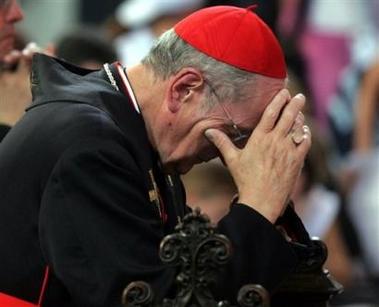
Aside from hosting World Youth Day 2005, the cardinal is best known for spontaneously bursting into tears at emotional moments -- the most famous of which took place in the Sistine Chapel as his friend's election to the papacy became apparent.

Given the red hat in 1983 at the age of 49, Meisner was named to the archbishopric of Cologne -- one of the world's richest local churches, and Germany's largest -- in 1988 after eight years as bishop of Berlin.

Born on Christmas Day, the Lord's 2007th birthday will be the cardinal's 74th.


-30-

Wednesday, July 06, 2011

Not Quite a Love Parade: For Pope's Berlin Pick, "The Lion's Den"

Resolving the second of three cardinalatial sees up for grabs this spring across the globe, on Saturday the Pope named a protege of his closest homeland ally as archbishop of Berlin two months before touching down in the German capital for a state visit.

An auxiliary of Cologne since 2003, the 54 year-old archbishop-elect, Rainer Maria Woelki (right), was revealed as Der Deutschepapst's choice two days after the prelate he succeeds, Cardinal Georg Sterzinsky, died at 75 after a long illness.

Having held the post since just prior to the 1990 reunification of Europe's largest country, Sterzinsky retired for health reasons in February, a month after reaching the canonical age-limit.

Though the freshly-deceased cardinal was a close aide to his own predecessor in the capital, Woelki is arguably cut even more in the image of their common mentor: Cologne's extremely influential Cardinal Joachim Meisner, who was transferred from Berlin to what's said to be Europe's wealthiest archdiocese in 1988. The new archbishop served for seven years as priest-secretary to Meisner -- the German hierarchy's leading conservative -- going from that post to the rectorship of the Cologne seminary before his appointment as an auxiliary.

Given his extraordinarily youthful age and the lack of a surviving predecessor with Conclave rights, Woelki stands poised to become the youngest member of the College of Cardinals at the next consistory; likewise a countryman of Joseph Ratzinger, the current holder of that distinction, Munich's Cardinal Reinhard Marx, turns 58 in September.

Despite an eight-decade tradition of its leaders holding a seat in the "Papal Senate," it was only in the wake of reunification that the Berlin church -- now home to some 400,000 Catholics in a city of 3.4 million -- was made an archdiocese.

In the meanwhile, Woelki's arrival in one of Europe's most progressive capitals has reportedly made for a Reichstag-sized stir given his close ties to Meisner and the move's apparent clash with the city's prevailing cultural trend. According to a Reuters brief, the standard press conference on the appointment -- usually a fairly ho-hum affair in Europe -- had to be moved to a larger venue after the initial coverage of the move portrayed the choice as "reactionary" and "backwards minded," particularly with regard to the hot-button topic of homosexuality, and amplified by an alarmist conflation of the prelate's student days at Rome's Pontifical University of the Holy Cross with membership in Opus Dei, which owns the school.

When the time for the meetup came, Woelki denied any ties to the personal prelature outside his doctorate in theology from its Roman house, and pledged his "respect and esteem for all people independent of heritage, skin color and individual nature."

"We will meet with each other... I am open to all without reservations," the archbishop said, adding that "The church is not a moral institution that goes around pointing its finger at people... [but] a community of seekers and believers [which] would like to help people find their happiness in life."

While one paper concluded that, if nothing else, "you can talk with the man of God," another outlet's headline cited Woelki's line as "I have nothing against gays, but...."

With Woelki set to be installed in the prominently-domed St Hedwig's Cathedral (above) over the weeks just prior to the Pope's 22 September arrival for a four-day trek, the sex-talk is a particularly delicate one in the local context as the incoming archbishop now shares the state visit's final planning and hosting duties with the city's openly gay Mayor, a Social Democrat.

The Berlin jaunt will mark B16's second official tour of a European capital with an openly gay city-chief, the pontiff having been welcomed on his 2008 trek to Paris by Mayor Bertrand Delanoe, a Catholic who was elected to his second six-year term in the months leading up to that PopeTrip.

The French tour headlined by the Pope's prominent embrace of the concept of "positive laicité" (read: secularism) advanced by the country's thrice-married Catholic President Nicolas Sarkozy, the thought is likely to be reprised in Benedict's message in Europe's second-largest city. Keeping with much of this pontificate's narrative, however, the talks might again be drowned out by controversies and gaffes.

Among others already to surface, the German Pope's invitation to address the Bundestag -- the dominant house of his homeland's Federal parliament -- has garnered criticism from the body's Green delegation (which holds nearly 70 of its seats) and activist groups. And elsewhere, albeit in response to a bigger-than-expected demand for tickets, the selection of the Berlin stadium built by the Third Reich for the 1936 Olympics to host the visit's main Mass has stoked the predictable storm given B16's forced boyhood conscription into the Hitler Youth.

-30-

Tuesday, May 30, 2006

His Own Pilgrimage

On the papal visit to Auschwitz on Sunday, the images of Cardinal Joachim Meisner of Cologne in tears struck a chord with many people.

Only later did I learn that, like many survivors of the camps and their descendants who have no burial spot where they could pay tribute to their deceased loved ones, the remains of the cardinal's father are somewhere in Serbia, in a mass grave. And that, from Poland, Meisner was headed to the Balkans to dedicate the restored Archbishop's Residence in the Serbian capital, Belgrade.

As Cologne is one of Europe's -- and the world's -- most fiscally-solvent local churches, it wouldn't be a stretch to believe that the cardinal has supported the small Catholic community there, especially given the personal tie to the place.

Knowing that, after Auschwitz, Meisner would be going to Serbia, "where he would love to pray at the grave of his father," one op noted that it was natural for the cardinal to be "a bit emotional."

Indeed it would be, and indeed it was.


PHOTO: Reuters/Katarina Stoltz


-30-

Friday, December 08, 2006

The Friday Whirl

Again, forgive the slow posting. They say Advent's supposed to be a period of renewal, but with the card-writing, commitments, and trying to slip out and get some shopping done at a relatively low-traffic hour, it's been more than a bit exhausting.

For the curious, the above photo is from the festival of La Purisima ("The Most Pure") -- an annual event held in the Nicaraguan capital, Managua, to mark the Immaculate Conception.

Anyways, here's a potpourri for you, with more on the way:
  • Whither Pittsburgh? Not that anything's afoot just yet, but today's been one of the more-buzzed about days when the appointment of Donald Wuerl's successor could come.... The only problem being, of course, that the Vatican is closed on 8 December, and on the other swirling date of 6 January, Roman Epiphany. While the Steel City's TV stations have been keeping the story going (pieces with video here and here), word is that the case-file has not even approached the final stages. On the ground, many of the diocese's priests got together earlier in the week for an Advent prayer service and dinner, and the mood was said to be "relaxed." In the meantime, diocesan administrator Bishop Paul Bradley is presiding over a bit of a policy shop. Sure, an administrator can undertake no great initiatives under the law, but the auxiliary has been keen to ensure that the new ordinary arrives to find the best and most comprehensive briefings and recommendations possible on the issues facing the diocese, most acutely the shortage of clergy. When the interregnum comes up, the usual response runs something along the lines of "We have a bishop." And while the guys recognize that the appointment could become a political football, a broad consensus seems to indicate that the bishop they have is the bishop they want... and not just on an interim basis.
  • The long, slow sundering of world Anglicanism continues. On Wednesday, the ECUSA bishop of San Diego presided at a farewell service for two of his priests and an estimated 150 to 200 parishioners, who are going on to form a community under alternative oversight. Diocesan officials there say they've lost about 1,000 of their 14,000 members over the recent unpleasantness. Across the grass, however, you know things are really going off the rails when, as one in-house report put it, "relationships between the Global South Primates and their supposed supporters in the secessionist dioceses of the USA are not as harmonious as they might wish the outside world to believe." (Tip to the ever-informative Thinking Anglicans.)
  • Next time those of us who went to see of The Passion of the Christ or own a DVD copy of it go to confession, it might be wise to seek God's forgiveness for... material participation in schism. As his new Apocalypto rolls out, it's come to light that in 2005 Pope Mel I (Gibson) has invested another $8 million into "the tax-exempt entity... designed to run his privately built and owned Holy Family Catholic Church in Malibu." In case anyone's confused, privately built + owned = not a Catholic Church. Fox News reports that the increase in Gibson's endowment to the A.P. Reilly Foundation, the Tridentine church's operating fund named for his late mother, "seems due to profits from 'The Passion of the Christ.'" Oy vey.
  • Speaking of our wall-facing friends and those who love 'em (or not so much), the French episcopate has recently attracted flagons full o' fury from other Old Rite fans livid at the bishops' public statement urging caution on the foreseen universal indult for the Pian Rite. Well, the eveques have tackled a new issue of late, going after France's Muscular Dystrophy Association for funding embryonic stem-cell research, albeit to a relatively small degree. The French MDA's annual telethon -- whose prominence there was likely aided by the national fascination with all things Jerry Lewis -- begins tonight. The NYTimes reports that it all began in October, when one bishop said his diocese could no longer participate in the telethon as “Christians cannot cooperate with evil.” (A statement that quickly disappeared.) In time, Archbishop Andre Vingt-Trois of Paris said that MDA couldn't receive "a blank check," ethically speaking and on Tuesday Cardinal Philippe Barbarin of Lyon that “For us, these embryos are not things, but human beings. And from the depths of our faith, we cannot accept that they are selected, destroyed, the objects of experiments.” The conference, however, issued a statement that no bishops have "called for a boycott of the telethon. Quite the contrary.” Barbarin said that, despite the dispute, “Kids must continue to break their piggy banks for the disabled.”
  • Across the border in the Pope's native land, one of his close confidants has stirred the pot on the question of interreligious interaction. Heretofore famous either for his (joyous) weeping at Ratzinger's election or his archdiocese's hosting of World Youth Day last year, Cardinal Joachim Meisner of Cologne has banned schoolteachers under his jurisdiction from "participating in multi-religious events." Given the cultural currents at play in Germany, the state broadcaster Deutsche Welle says the directive has evoked more than a wee bit of controversy, with one Social Democratic politico calling for the teachers to ignore Meisner, the acknowledged leader of German Catholicism's conservative wing, and one Green party leader who dared the cardinal "to go ahead and throw out the Shrine of the Three Kings" from Cologne Cathedral, as "the Three Magi are believed to have been Persian astrologers." The city's top paper got in on the gang-up in today's editions, saying in an editorial that "Cardinal Meisner deals with Christianity like a landlord who bolts the door as soon as the bell rings -- without first checking who's outside."
  • The continuing reach of blogging in the church never ceases to be, in a word, amazing. Two years ago next week, after a brain fart and with a readership of three, these pages came to life... and something really bizarre happened along the way. Now, the richness of breadth and scope soars even higher as Msgr Mark Langham, the Administrator (Rector) of Westminster Cathedral settles into the click-and-publish life with his contribution, appropriately titled Solomon I Have Surpassed Thee. (Cardinal Vaughan taunting Edward the Confessor, you say?) Especially as the mother church of England and Wales is always a hub of activity on London's religious and cultural scene, not to mention a treasure of art and the living sacred, check it out.
  • And lastly, at a Mass last night in Syracuse, Bishop James Moynihan manned the fountain of honor as the diocese received eleven new monsignors and its first taste of Purple Rain in thirty years (Msgr Prince, intone the hymn...). Coming from a local church where papal honors for the clergy fall just short of the Eucharist on the list of "sources and summits of the Christian life," we celebrate this precious gift of God's love for upstate New York. And Syracuse isn't the only place to resurrect the practice of late; Bishop Finn of Kansas City-St Joseph recently celebrated its first class of honorees since 1968, and last month the diocese of Knoxville was granted the first two monsignori in its history. (How on earth did they survive so long?) In a recent editorial, NCR indicated that it wasn't terribly keen about this resurgence, and it's very true that papal honors can be, and have been, the vehicle for all kinds of excesses. However, as with most things, such lapses/horror stories aren't sufficient justification for chucking the whole notion of ecclesiastical gong-giving. Especially after the last five years in this country, it seems widely the case that those who've stayed and keep selflessly at the work are just chomping at the bit to celebrate something good in the life of the church. Not to mention that some bishops seem to forget that papal honors aren't just the province of the ordained.... Benemerenti, anyone? Sure, some dioceses have instead created and conferred some variation of a "Bishop's Medal" or "Diocesan Cross" -- partly to avoid the tax due to the Holy See when requesting Roman ones, partly to "keep it intimate" -- but just as a rising tide lifts all boats, a little papal recognition for a couple exemplary souls, clerical and lay, could be just the thing to boost morale.
And with that, Happy Weekend!


PHOTO:
AP/Esteban Felix


-30-

Thursday, February 24, 2011

PopeTrip Looming, Berlin Falls Open

In September, the Pope is scheduled to make another visit to his homeland -- a state visit to Germany this time, set to climax with B16's first papal trek to Berlin.

Now, though, the first German pontiff in a thousand years will face an important call: picking his host.

This morning, Benedict accepted the resignation of Berlin's longtime archbishop, Cardinal Georg Sterzinsky, all of a month after the capital prelate reached the retirement age of 75 and without a successor chosen.

Named bishop of Berlin -- then a non-metropolitan church -- in 1990 and a cardinal the following year, Sterzinsky became the city's first archbishop in 1994. The cardinal is said to have been in poor health for some time, hence the quick departure.

While B16 has been uniquely generous in extending his countrymens' time in office past their 75th birthdays -- the Pope's own successor in Munich, Cardinal Frederich Wetter, was kept in post even after turning 80 -- the reality remains that, with three of the country's resident cardinals at or near retirement age, the Berlin opening opens the most significant change of senior leadership the German church has seen in decades.

At the helm of what's often called Europe's wealthiest archdiocese, the German bench's leading conservative -- and its senior prelate closest to the pontiff -- Cardinal Joachim Meisner of Cologne is 77, but expected to remain until after a Eucharistic Congress recently set for 2013 to mark the 1,700th anniversary of its local church. Meanwhile, the country's most prominent progressive voice -- the longtime chair of the German bishops, Cardinal Karl Lehmann of Mainz -- turns 75 in May.

Then bishop of Berlin, Meisner was made a cardinal in 1983, the same year Lehmann was named to Mainz.

In both cases, however, Der Deutschepapst will only have a limited say in who takes the posts. Under the terms of the concordat governing Germany's relations with the Holy See, both sees retain provision for the election of the diocesan bishop by their respective cathedral chapters, with Rome confirming the choice. Still, the groups of clerics are bound to choose from the three-name terna for the post presented by the Vatican.

In his one major appointment at home to date, in late 2007 the Pope named Bishop Reinhard Marx of Trier as archbishop of Munich and Freising -- the post Cardinal Joseph Ratzinger himself held from 1977-81.

Having won plaudits for an especially deft reponse to last year's outbreak of sex-abuse revelations in Germany, Marx (above) was elevated to the college of cardinals at last November's consistory. At 57, the media-savvy sociologist -- a co-drafter of this pontificate's social manifesto Caritas in Veritate -- is the youngest member of the papal "Senate" by close to a year.

Benedict's third visit to Germany as Pope after 2005's World Youth Day in Cologne and the following year's "homecoming" in Bavaria, September's state visit is expected to take the pontiff to Freiburg and Erfurt beyond its leg in Berlin.

PHOTOS: Reuters(2)


-30-

Thursday, February 23, 2012

Old Church, New World

As new media moments from last weekend's Consistory go, this one's hard to beat: during a lull in Saturday's "courtesy visits" to the new red-hats, the freshly-elevated archbishop of Berlin, Cardinal Rainer Maria Woelki, took to checking a soccer score on his iPhone.

According to a caption on the capital church's Facebook page -- thanks to Georg for the shot -- the Cologne native was keeping an eye on his hometown side's match against Nuremberg.

Its jerseys featuring a silhouette of the city's famous cathedral, FC Köln lost 2-1.

A protege of the Nordrhein's Cardinal Joachim Meisner -- the closest top German cleric to Pope Benedict, and himself a onetime occupant of the Berlin chair -- Woelki was named archbishop of the relatively small Berlin fold in July, just prior to the German pontiff's September state visit to his homeland.

All of 55, with his elevation, the Opus Dei-trained theologian and former seminary rector is now the youngest member of the College of Cardinals, replacing another German -- Joseph Ratzinger's 58 year-old successor in Munich, the motorbiking sociologist Cardinal Reinhard Marx -- as the junior prelate of the papal "Senate." (On a related note, just turned 62, New York's new Cardinal Timothy Dolan is the seventh youngest of the now-214 member "club," and Galveston-Houston's Cardinal Daniel DiNardo, 63 in May, is tenth.)

Der Deutschepapst already having tapped the young clerics to fill half his native turf's four traditional cardinalatial sees, Germany's other two prime ecclesial posts are likewise soon to turn over: head of the Mainz church since 1983, the longtime head of the country's bishops Cardinal Karl Lehmann turns 76 this spring, and Meisner -- who's led one of global Catholicism's wealthiest dioceses since 1989 -- is now 78.

-30-

Friday, February 02, 2007

Nunc Dimittis

On this feast of the Presentation, Benedict XVI accepted the resignation of his successor as archbishop of Munich and Freising, Cardinal Frederich Wetter. Indicating that the Bavarian Pope is still considering his choices for the next bearer of Corbinian's Load and the leadership of his native diocese, no successor was named to Wetter, who turns 79 later this month.

Shown here with his predecessor during the papal homecoming in Bavaria last September, the cardinal was named to replace then-Cardinal Ratzinger six months after the native son archbishop left for Rome and the top job at the CDF. He was elevated to the college of cardinals in 1985, and despite holding the metropolitan post of Germany's historical Catholic heartland, has largely taken a back seat on the public stage to Cardinals Joachim Meisner of Cologne, the country's senior churchman, and Karl Lehmann of Mainz, the president of the German episcopal conference.

If the current German leadership were given a similar stay of retirement as that granted Wetter, Benedict's pick to lead Munich and Freising's 1.3 million Catholics could well end up being the lone major personnel move he makes in his homeland. Cardinal Meisner -- a Ratzinger favorite -- turned 73 on Christmas Day, and the other two German cardinals (Lehmann and Georg Sterzinsky of Berlin) both turn 71 in the coming months.

Europe's largest nation, which hasn't received a new cardinal since the red hat was given Lehmann and the late Johannes Joachim Degenhardt of Paderborn in the 2001 mega-crop, could well end up getting two at an impending consistory (expected for June) if the pontiff decides to elevate his Bavarian successor quickly alongside Degenhardt's heir, the 58 year-old Archbishop Hans-Josef Becker.

Also in things German today, the Pope accepted the resignation of Bishop Franz Kamphaus of Limburg. The circumstances for the timing are unknown, but Kamphaus is entering retirement exactly on his 75th birthday.

-30-

Sunday, May 28, 2006

The Shepherd One Beerhaus

So last year, on Memorial Day weekend, the Pope made his first trip outside Rome to the Italian Eucharistic Congress at Bari. And, now, this year, to Poland. Is he trying to crimp our style here in the US or something? Seems like there was a barbeque on the Lot plane heading back.

Don't be fooled, however -- it may look like Hoegaarden or some kind of Hefeweisen, but it's more likely the Pope's beloved Orangina/Fanta....

Given two elements in this shot, it's an easy caption. Four words will suffice: "BAD DAY FOR SSPX."

And, lastly, today's visit to Auschwitz (fulltext of B16's message) marked the third occasion in a year on which Cardinal Joachim Meisner of Cologne has shed public tears.

This isn't a bad thing -- it's actually quite moving, actually, not to mention refreshing, and the cardinal deserves thanks for reminding all of us how nice it is when a prelate doesn't let his emotions be conditioned out of him along the path of ascent.

Four years ago at Dallas, remember well that the US bishops held a "Mass for the Gift of Tears." Suffice it to say, it wasn't a gift God granted them....

Despite the delay, maybe Meisner could lend an assist and serve as the gift-bearer. Yes, it'd be a bit belated... but better (four years) late than never.


PHOTO 1: AP/Czarek Sokolowski
PHOTO 2: AP/Andrew Medichini
PHOTO 3: Reuters/Katarina Stoltz


-30-

Thursday, August 25, 2005

Chanel, Gucci, Prada, Ganswein

If this man has his way, the revolution will be sartorially fabulous. The Guardian takes a good look at Georg -- a piece memorably entitled "Thou Shalt Not Drool":
Over the past four months, the Italian press has also swooned over the 49-year-old German priest, who is known in Italy as Don Georgio. In the grey and elderly world of the Vatican, it is hardly surprising that Gänswein - a keen tennis player and excellent skier who even has a pilot's licence - has become the centre of attention. Last month, the Italian edition of Vanity Fair compared Gänswein to the actor George Clooney, while the magazine Chi opened that he was "as fascinating as Hugh Grant".
The model secretary gives the impression of being of one mind -- and one being -- with his boss.
"I think he is very dangerous," Daniel Deckers, the author of a biography of Germany's leading liberal cardinal, Karl Lehmann, said. "He's part of a small but very powerful group within the Catholic church. He will use his power to push Ratzinger in a certain direction."

Deckers recalls travelling to Rome to meet Gänswein. "He's a good guy. He's very eloquent and can be very charming. But he came right up to me and said: 'Oh, you don't like us.' He referred to himself and Ratzinger as 'us', as if the two of them were an institution."
I wonder if he'd count Josef Clemens as "us." Prob'ly not.

Not to be outdone, something is revealed which has been ringing in my ears for several months:
In the Vatican, Gänswein and Ratzinger dine together, recently entertaining Princess Gloria von Thurn und Taxis, the German socialite, according to reports in the Italian press.
The Romans absolutely love Gloria. Just ask them. Word 'round the campfire -- well, word Gloria was furiously spreading 'round the campfire in Cologne -- has the Pope (and Georg, of course) staying at the TNT compound in Regensburg on the great homecoming tour scheduled to take place in Fall, 2006. If that goes forward, it will bring back some memories for Ratzi: he and Ingrid met at a concert hosted by the TNTs in the summer of 1991....

And best of all is this catty leak:
Gänswein's critics even accuse him of turning the Pope into a fashion victim. This summer, Ratzinger and his secretary went on holiday to the papal residence at Castel Gandolfo, near Rome, as well as to the Italian Alps at Valle D'Aosta. While both men were hiking in the hills, the Pope appeared in public wearing a Nike hat, designer Serengeti sunglasses and a Cartier watch. "This is Gänswein's style. It's his handwriting," one religious affairs writer said. "This is something I don't understand."
Hmmmm... and, for good measure, some Meisner-lieben:
In Germany, the Catholic church is divided more or less between two figures - the liberal-conservative Cardinal Lehmann, the head of the German archbishop's conference, and the ultra-conservative Cardinal Joachim Meisner, the Archbishop of Cologne. Both men were with the Pope last week. But it is no secret as to which Bishop the Vatican favours. "Gänswein is an opponent of Lehmann," one source in the German Catholic church said. "One of Ratzinger's great weaknesses is that his judgment of people isn't always sufficient. He has a small out-reach."
What a piece!

PHOTO: DPA

-30-

Sunday, August 21, 2005

Heroes & Goats: WYD 2005

It's a wrap!

So what if the Americans couldn't eat? Poverty is a virtue -- and Cologne has pulled off the most successful and resonant World Youth Day since Denver opened the modern era of the festivals in 1993. If done right, the celebrations do wonders for the local churches where they've been held, and the fallout of each impacts the lives and work of the churchmen who put them together. If you don't believe that, ask Cardinal Stafford.

Yes, this is a blatant rip from the Philadelphia Weekly, but as the Pope's homecoming tour, the most significant event of his pontificate to date and his first foreign trip comes to a close, this will be the first of (hopefully) many chances to reflect on major events and do some calculus to see who comes out of Cologne better than they went in... and who comes out worse.

HEROES
  • Benedict XVI --Showing the world that rumors of Catholicism's post-Wojtyla demise are greatly unfounded, the late Pope's "first collaborator" also proved that an event constructed for John Paul does not necessarily mean that it has to be The John Paul Show. With his subtle touches of intimacy, communicable depth and serene graciousness all around, Joseph Ratzinger has put his unique stamp on the papacy and marked out a humbler image of the servant of the servants of God. While respecting the exigencies of the modern papacy, B16 has demonstrated that he will do it his way -- and Cologne has been evidence to the doubtful that his way works. Having used the low expectations at his election to his advantage, at this point he can do no wrong. Hell, he even got Trads to attend a Novus Ordo closing liturgy without causing a riot... They might just convert to Catholicism yet.
  • Cardinal Joachim Meisner, archbishop of Cologne -- The most conservative of the German cardinal-archbishops and the closest of them to Ratzinger -- he spoke of his own weeping as the final ballot of the conclave was being counted -- Meisner now has an elevated status in the wider church thanks to the exposure his archdiocese received. Keep an eye on how he uses it.
  • Bishop Josef Clemens, secretary of the Pontifical Council for the Laity -- This latest battle in the War of the Ratzinger Secretaries has yielded a decisive victory for the one who spent two decades at his Prefect's side. As the Vatican point-man dealing with the deep details of every element of the World Youth Day celebration, Clemens knew what his boss would want to keep from the pre-April plans and what to change to better suit B16's temperament, gait and sense of the resonant -- and such is his place in the papal orbit that no one was in a position to challenge his decisions. In a very telling moment at the airport before the Pope got on the plane, Benedict spent about three seconds with each of the gathered prelates who lined the runway to bid him a safe trip. Clemens got about 10 times that. The Pope could've bantered with him forever -- and everyone waiting by the plane knew it. Combined with the Pope's noting Clemens' "able assistance" to Rylko at the close of the morning mass, it was a Ratzi way of saying that a Pope's man doesn't always need to be in the camera frame to be an effective and eminent counsel and presence. His rise is eagerly awaited.
  • Archbishop Piero Marini, master of pontifical liturgical ceremonies -- If there's one thing Marini has taught us over 17 years as the papal MC, it's that uplifting, genuinely holy liturgy is not directly correlated to how much the celebrant looks like he's just performed an armed robbery on the Tower of London. Clean vestments, precise movements, dignified furnishings (like the stunning monstrance at the Vigil) the best of the old, the new and the universal all meant to lift a congregation's attention heavenward as opposed toward what Joseph Ratzinger once called "the golden calf of ourselves" have been his hallmarks -- and the quality is there for the world to see. For all the questions that linger about his future, if this WYD turns out to be his swan song, the apogee period of papal liturgy as public event would be going out on a glorious note.
  • The WYD Bloggers -- Tim Drake, Brandon Evans from The Criterion of Indianapolis and scores of others (they're all linked at Amy's) brought the experience home to everyone who wasn't able to be in Cologne. From the glitches to the smells, sounds, queue-times and every other element of the week, the blogs made this WYD a real world event. My pencil press confreres have some serious catching up to do.
GOATS (Now it gets fun....)
  • Catholics for a Free Choice -- When John Allen calls anyone's antics a "side show," that's the sign that all their credibility is lost.
  • The Seminarians at the Friday encounter -- Watching the Friday evening prayer service, those new to the Liturgy of the Hours might've assumed that screaming, cheering and chanting the Pope's name were approved antiphons for the Psalms. Apparently, the boys weren't taught that just because the Pope's presiding at prayers doesn't mean that they can treat it like it's the Super Bowl or a wrestling match. The lack of restraint and respect for the liturgical act shown by the next generation of priests accomplished what no ressourcement progressive had yet been able to successfully do: they made Annibale Bugnini look as traditional as Ray Burke. That's saying something... When the Pope said that "The role of formators is decisive," what unfolded before his eyes was a reminder of the degree to which that decisiveness must be monitored and properly maintained.
  • EWTN -- The Bearded Marys blew it, even after they admitted that they didn't have much time for laypeople during their coverage. It got to the point where they ditched the Vatican's audio feed for some guy who kept reminding everyone (during that same Friday evening prayer) that this was EWTN's 25th anniversary year. And this has what to do with the Pope, again? Oh, that's right -- nothing. All thanks again to CTV and Radio Vaticana for showing the amateurs how to cover a Pope.
  • Gerhard Schroder -- With three weeks left in a campaign that has him lagging in the polls, the German chancellor (and his fourth wife) might've been hoping for some quality photo-op time to exploit the papacy for electoral purposes a la Bush. He ended up with a pool-shot and a brief, private "Hi, there" -- a courtesy also extended his front-running challenger.
  • Toronto -- Admittedly, WYD 2002 took place under less-than-ideal circumstances -- the major throes of sex abuse disclosures in the States, low attendance and the failing health of JP. There were even whispers at the time that the celebration was a fading fad. Cologne's success at rejuvenating the franchise makes the last meeting look even less memorable than it was before this week.
  • Sydney -- How the hell is Pell going to top Cologne? The Olympic experience with crowd-control and organization helps, for only the second time (the first was Buenos Aires in 1987), World Youth Day has been given to the Southern Hemisphere -- a flight that's easily a full day of travel or more (and just as exorbitant, pricewise) from the American and Western European youth who form the bulk of WYD registrations. The attraction of Mel Gibson's mini-Oberammergau won't be solely sufficient to make this venture float. Let's see what they've got up their sleeve... Pell is known to be a man of surprises.

*************************

Lastly, Allen closes shop in Germany with a last note on Maestro Marini.
This may be a bit of insider baseball, but attentive Vatican-watchers were waiting for the papal liturgies at World Youth Day to see if the somewhat Broadway-esque elements familiar from past editions, associated with Archbishop Piero Marini, the longtime liturgist of John Paul II, would be scrubbed. Given the passion of Benedict XVI for reverent, sober liturgies whose focus is on God rather than the human participants, some expected a more toned-down, "classical" style.

Admittedly, the Saturday night vigil was not a Mass, but it nevertheless featured vespers and a Eucharistic devotional service. It was striking, therefore, that many characteristic Marini touches were still there -- suggesting that at least on this score, and at least for now, Benedict XVI has opted for a philosophy of, "If it ain't broke, don't fix it...."

[I]t's nevertheless one small indication that the sweeping "restoration" some expected from Benedict XVI, especially on liturgical matters, may not be forthcoming in quite the way some had imagined.

Amen. Amen. And amen.

There were some funny little moments these past few days. They're up next....

PHOTO: Wolfgang Radtke/POOL

-30-

Thursday, August 18, 2005

A Quick Cologne Primer

As B16 enters Cologne Cathedral, he is surrounded by two very distinct "rings" of prelates.

Running advance, as usual, is Bishop Renato Boccardo, the number-two man at the Governorato (the body which manages the Vatican City State). A former official at State, Boccardo has been the papal "travel agent" since the retirement of Roberto Tucci in 2001 and was ordained a bishop last year, initially assigned as the secretary of the Pontifical Council for Social Communications.

The Popemobile has two additional seats aside from the Pope's. One is always taken by the secretary (Georg, who is making himself omnipresent today), the other by the bishop of the place being visited (a very happy Cardinal Joachim Meisner).

But in the "inner ring" immediately surrounding him, there are the following individuals:
  • Meisner
  • Sodano
  • Ganswein
  • Boccardo
  • Archbishop Stanislaw Rylko, president of the Pontifical Council for the Laity (the dicastery charged with planning WYD)... As a sidenote, Rylko is a Krakow protege of Pope Wojtyla's who served as Dziwisz's assistant when JP was archbishop of Krakow.
The "second ring" is more a security necessity than a commentary on who's in and who's out. But it's still of interest. There we find:

  • Bishop Josef Clemens, secretary of the Pontifical Council for the Laity (Cardinal Ratzinger's beloved private secretary of 20 years)
  • Archbishop Piero Marini, master-genius of papal liturgical ceremonies
  • Archbishop Leonardo Sandri, sostituto of the Secretariat of State (the papal chief of staff... well, when State's behaving itself)
  • Cardinal Walter Kasper, president of the Pontifical Council for Christian Unity (the point-man for tomorrow's visit to Cologne's Synagogue in his capacity as president of the commission for Religious Relations with the Jews)
  • Cardinal Karl Lehmann, bishop of Mainz and president of the German Bishops' Conference
  • Bishop Franz-Joseph Bode, bishop of Osnabruck and chair of the German Bishops' Commission on Youth
Also in this circle is someone I haven't seen in awhile: the "second secretary," who has apparently been retained from the last pontificate, John Paul's beloved Msgr. Mieczyslaw Mokrzycki.

The Pope has been received in the cathedral to the strains of Anton Bruckner's Ecce Sacerdos Magnus. Interesting pick, and Marini's dictating the pace without betraying any signs of it. The Marini Code is, indeed, a wonder.

UPDATE: Contrary to the previous assumptions, I'm told that Ingrid Stampa is present in the papal entourage. I haven't seen her, but then again the cameras are lucky to have five seconds of good feed each, given the pressing crowd and overpowering security. Like her boss, she's also very good at being inconspicuous.

More soon.

-30-

Wednesday, August 17, 2005

Alois Speaks, Meisner Prays

Frere Alois Leser, the German Catholic nominated by Frere Roger to succeed him, has returned from Cologne and according to a release from Taize, "entered straightaway into his ministry as servant of communion at the heart of the community."

And he's speaking to the press:

Leser told AFP he planned to continue Schutz's work.

"I can smile today but my heart is in pain," he said. "We are grateful for the path Brother Roger opened for us and that we will continue."

He said he had a "heavy heart" returning to Taize. "I came quickly to be here in the heart of the community because the brothers are dispersed around the world but we have need of a home."

At prayers with young followers, he said he gave thanks for all the messages coming in, "and I said that we will trust together in God."

More on the assailant:

A state prosecutor, Jean-Louis Coste, told a press conference the Romanian woman, whom he identified by her first name Luminita, had apparently attacked Schutz "to attract attention but didn't want to kill him."

He said she had tried unsuccessfully to speak with him beforehand, adding that initial psychiatric evaluation did not suggest she should be committed to a mental institution.

A community brother said she had arrived in Taize two days earlier and that followers had noted signs of "psychological problems."


In Cologne, Cardinal Meisner signed a book of condol- ence and led prayers, clad in a black stole.

"The news spread like wildfire in our group," said Marie-Pierre Cockenpot, in charge of a group of 300 young French people at Cologne who often went to Taize.

"Many were crying, some wanted to leave, saying they didn't have the heart to go on with the festival but we told them Brother Roger would have wanted it to continue," she added.

The funeral will be Tuesday afternoon at the community.

-30-

Tuesday, July 26, 2005

Trids in Köln

From the WYD Desk, a ZENIT reminder about Juventutem:
At least 3,000 youths and 60 priests of a group supportive of the Latin Mass of Pope Pius V plan to attend World Youth Day in Cologne, an official says.
Three-thousand? Quite a number. Let's see if it pans out....
The first Juventutem group was made up of followers of Archbishop Marcel Lefebvre, who met in Brazil. For the past three years, Juventutem has been in full communion with the Church of Rome. Its members will attend the Aug. 21 Mass presided over by Benedict XVI.
What a way to mark a third birthday -- their first ever Novus Ordo liturgy. Isn't it ironic?
In the preceding days, at 7:30 a.m. the Juventutem group will attend a Mass celebrated in Latin in the old rite, in the Church of St. Antonius in Duesseldorf, which, together with Bonn and Cologne, is one of the three areas in which World Youth Day events will be held.

The church was assigned to them by the Pontifical Council for the Laity with the approval of Cardinal Joachim Meisner of Cologne.
Meisner is the German hierarchy's lead conservative; as if he'd disapprove?

For all the anxieties which could be had about this, it is an encouraging sign. And they're pulling out the heavy hitters -- Arinze, Pell, George, Burke, and the Brazilian bishop of Campos who is Catholicism's only full-time Tridentine bishop.

In other Cologne news, the Pope's schedule for the three-day trip is making the rounds. B16 is celebrating mass in private for two of the days at the Archbishop's Residence.... Whether this is strictly private (i.e. just Georg, Ingrid, Carmela and Loredana) or if some of the young people are invited to join remains to be seen.

And, in an interesting touch given the impending Federal elections in September, the first German Pope since Luther will be meeting not only with Chancellor Gerhard Schroeder (who, according to opinion polls, will lose his bid for re-election), but also with Angela Merkel, the leader of the opposition Christian Democratic Union who is tipped to take the Chancellor's office from Schroeder's Social Democrats. Wolfgang Thierse, the speaker of the Bundestag (a former GDR Communist), rounds out the group.

-30-

Thursday, October 24, 2013

The "Bling Bishop" Exits... Of Sorts

Saying Bishop Franz-Peter Tebartz-van Elst "cannot, at the present moment, continue to exercise his episcopal ministry" after months of embarrassing revelations on the prelate's lavish spending for a new diocesan compound, while it was anything but surprising that Rome moved yesterday to depressurize the fraught situation in Limburg, the solution reached was a remarkable departure from the standard course of action.

Instead of accepting the 53 year-old prelate's resignation or announcing his forced removal from office, the Vatican instead relayed that Tebartz-van Elst was being "authorized" to spend "a period outside the diocese," pending the outcome of an investigation by the German bishops' conference. In addition, "by decision of the Holy See," a new vicar-general previously named by the embattled prelate and scheduled to take office in January was placed in post immediately to oversee the diocese in the absence of the so-called "luxury bishop."

With some 700,000 Catholics, the Limburg church encompasses the far larger city of Frankfurt and much of its sprawling metro area.

After disclosures that Tebartz-van Elst spent $475,000 on walk-in closets and $20,000 on a bathtub among other big-ticket items for his residence in the new facility adjacent to his cathedral, the Vatican's handling of the fallout is extraordinary on several fronts. First, because it precisely isn't the "suspension" that has been widely misreported – indeed, the move is not a formal canonical act of any kind – but likewise as it's a substantive instance of the intended fresh push for collegiality by Pope Francis. In other words, far from derailing a locally-called probe to impose a definitive, permanent resolution from on high, the Holy See has indicated that, in essence, the final verdict on Tebartz-van Elst's future lies with his confreres at home.

Even as fact-finding missions have long been employed to settle questions of alleged episcopal misconduct, they've always been chartered by Rome and carried out according to its whim... at least, until now. To repeat an earlier note, with the former president of an episcopal conference having ascended to the papacy for the first time, the role and influence of the national bodies is expected to markedly increase under Francis. In that light, the two-tiered response on Limburg – with most of the action being driven from outside the Vatican – could be a sign of things to come as similar cases arise elsewhere.

To be sure, it's not that Rome has exerted no authority in the matter – only the Pope can order a bishop to cool his heels, and for the Holy See to strongarm the appointment of a diocesan official is practically unheard of. Yet even on the latter front, the customary protocol that'd see the pontiff parachute in an apostolic administrator – a figure enjoying the full authority of the bishop for a temporary period (and something that can be done even when a diocese is not vacant) – has been disregarded in favor of a strictly local arrangement, one in which, even for all the ugly press that's made the rounds, the prelate could easily be returned to his full powers with minimal disruption.

Accordingly, as a vicar-general has only a limited, day-to-day purview normally contingent on the bishop, Tebartz-van Elst's chosen deputy, Wolfgang Rösch, would be unable, for example, to U-turn the controversial building project with its €31 million (US$43 million) price-tag. No timeframe was given for how long the odd state of affairs would endure.

* * *
While the practice of funding the church with state-collected revenues comprising around a tenth of each registered member's annual income tax is common across much of Europe, in the continent's largest country, German Catholicism is widely believed to be the global church's wealthiest national branch thanks to its government windfall. Accordingly, the Limburg debaçle has resurrected the country's occasional debate over whether to scrap the "church tax" (which, in Germany, sends 8 percent of a believer's amount owed to one's own religious group) while forcing several of the country's larger dioceses – among them Cologne, long thought to be the world's richest see – to take the unprecedented step of opening their books.

In addition, another typical element of Germano-church scandals has returned to the fore as the numbers of Catholics seeking to civilly de-affiliate from the faith are yet again reported to have spiked. Though the act is not equivalent to renouncing one's baptism – its only bearing is on a diocese's share of the "church tax" – the country's bishops made waves last year by declaring as a conference that those who've civilly left the church rolls should refrain from receiving the sacraments and would not be eligible for Catholic weddings, funerals or baptisms for their children.

Speaking of Germany, with Cologne's Cardinal Joachim Meisner set to turn 80 on Christmas Day and his well-delayed succession believed to be soon in the offing, the Nordrhein prelate – a cardinal for three decades, and long the German bench's lead conservative – had his own private audience with Francis on Tuesday shortly before Tebartz-van Elst was received.

Given the new Pope's concerted emphasis on a "poor church for the poor," the selection of Meisner's replacement in the super-flush Cologne church provides Bergoglio with a key opportunity to translate his priorities into the realm of policy as only his appointments can flesh out.

* * *
On the wider scene, the Limburg fiasco is just one piece of German theater that's been causing high-profile headaches in Rome these days. The other came earlier this month, when a vademecum on pastoral practice from the archdiocese of Freiburg opened the door to a local understanding where, in defiance of the universal norms, civilly-remarried Catholics could be permitted to receive the Eucharist.

Quickly garnering global attention given the hot-button topic – an issue intensely focused-upon in the German context – the move was quickly swatted down by the Vatican spokesman, Jesuit Fr Federico Lombardi, who rapped any attempt at lower-level moves prior to next year's extraordinary Synod called by Francis to address "the pastoral challenges of the family." More recently, Tuesday saw the publication of an extensive retort in L'Osservatore Romano by the German CDF prefect, Archbishop Gerhard Ludwig Müller, who bluntly stated that "there is no possibility of admitting remarried divorcees to the sacraments."

Francis, however, was conspicuously less absolute on the question when it was posed during the now-(in)famous press conference during his return from July's World Youth Day trip to Rio.

"This time is a kairos [appointed hour] of mercy," the Pope said. "We are moving towards a somewhat deeper pastoral care of marriage. And this is a problem for everyone, because there are so many [divorced and remarried couples], no?"

In any event, Freiburg likewise happens to be another top-shelf German vacancy on Francis' plate. One of the largest Deutsch dioceses with over 2 million Catholics, the post recently opened on the retirement of Archbishop Robert Zollitsch, who continues to serve as chairman of the country's episcopal conference until next spring.

Given his Chancery's opening of the proverbial can of worms right in the middle of the his successor's selection, who's sent in Zollitsch's stead could just provide a preview to this pontificate's approach to the divorce dilemma in the long haul.

-30-

Wednesday, January 13, 2010

Après Danneels, Muscle for Brussels

In one of the more highly-awaited appointments of the year, an Italian report says that the one of the global church's leading progressive voices is to be succeeded by his country's "most traditional bishop."

After a prolonged succession battle, Il Giornale's Andrea Tornielli relayed earlier tonight that Bishop Andre Mutien Leonard of Namur, 69, would be named archbishop of Mechelen-Brussels "in the coming days." The news arrives nineteen months after the veteran primate Cardinal Godfried Danneels reached the retirement age of 75.

Head of the Belgian church since 1979, the Volkswagen-driving Fleming has been widely hailed as one of the global hierarchy's top intellects, and seemingly just as often stoked controversy for public tweaks of the church's prevailing winds on, among other things, the use of condoms to prevent the spread of HIV, the role of women in ecclesial governance and the ecclesial status of gay and civilly-remarried Catholics.

In his place at the helm of the 1.6 million-member Brussels church -- and a Belgian fold numbering some 7 million -- the pontiff has ostensibly chosen the head of the country's smallest diocese, but one which reportedly boasts half of Belgium's 70 seminarians. Head of his native church since 1991, Leonard is a longtime collaborator of the Pope's, having served as a member of the Vatican's International Theological Commission during then-Cardinal Joseph Ratzinger's tenure at the CDF advisory body and, according to Tornielli, has been an "enthusiastic" supporter of Summorum Pontificum, B16's 2007 motu proprio facilitating the wider celebration of the 1962 Missal. (Leonard celebrated a high-profile Tridentine Mass, shown above, during the 2008 Eucharistic Congress in Quebec.) The bishop likewise preached the 1999 Lenten retreat for Pope John Paul II and the Roman Curia.

With Brussels now said to be filled, among other post-75 prelates still awaiting their successors on the global front are the cardinal-archbishops of Seoul, Guatemala City, Prague, Manila, Bogotá, Turin, Guadalajara, Santiago de Chile, Jakarta, Ho Chi Minh City and, in B16's homeland, another of Europe's most influential posts: the archbishopric of Cologne, where Cardinal Joachim Meisner turned 76 on Christmas Day.

On the opposite side of the coin, meanwhile, retired cardinals in Warsaw, Bangkok and Munich have recently reached their 80th birthdays (making them ineligible to vote in a conclave), with those of Toronto, Palermo, Wellington and Washington soon to follow suit. Their respective successors form the front flank of the College of Cardinals' likely intake at the next consistory, widely expected to take place later this year.

-30-

Saturday, September 06, 2008

Filling Out the Aula

In another sign of the Vatican's gradual return to life from its August hiatus, this morning saw the release of Pope's slate of delegates, experts and observers for next month's Synod of Bishops on the Word. The appointees join those prelates already elected by their respective episcopal conferences, and the heads of the Roman dicasteries who enjoy ex officio seats for the global gatherings.

While the top story from the release is that a record six of the 41 experts at the 5-26 October meet-up are women -- among them Missionary Servant of the Blessed Trinity Sr Sara Butler, a professor of dogmatic theology at Dunwoodie and member of the Holy See's International Theological Commission -- some other notable names dot the list. From the top, among them are the lone biblical scholar among the cardinal-electors, Ghana's Peter Appiah Turkson, Cardinals George Pell of Sydney, Joachim Meisner of Cologne, the Honduran Oscar Rodriguez Maradiaga SDB and Stanislaw Dziwisz of Krakow, along with Archbishops John Onaiyekan of Abuja, a Scripturalist and president of the Nigerian bishops, and the Brazilian Raymundo Assis of Aparecida, the president of the Latin American mega-conference CELAM.

(Closer to home, back in February it was announced that the Stateside bench had filled its allotted four seats with its president and veep, Cardinal Francis George of Chicago and Bishop Gerald Kicanas of Tucson, along with Cardinal Daniel DiNardo of Galveston-Houston and Archbishop Donald Wuerl of Washington.)

Alongside all this, two other items of note stick out: first, a decade after the Stateside crowd and the Romans engaged in a trans-Pond skirmish after Archbishop-emeritus John Quinn of San Francisco was rejected as an elected US delegate to the 1997 Synod for America due to his retired status, B16 shown progressively fewer qualms over naming superannuated prelates to his synods. For the last gathering in 2005 (dedicated to the Eucharist), the pontiff tapped the former prefect of the Congregation for Divine Worship Cardinal Jorge Medina Estevez as one of his slate, and this time around the line-up features no fewer than three red-clad retirees: the dean of the "papal senate" (and former Secretary of State) Angelo Sodano, the archpriest of St Paul's Andrea Cordero Lanza de Montezemolo, and the Belgian Jesuit Albert Vanhoye, the famed scholar of the Letter to the Hebrews (and longtime Ratzinger collaborator) who was given the red hat at this pontificate's first consistory in 2006.

Second, next month's meeting will find the lay-dominated "new movements" especially well-represented. Among others called to the Aula today were the Neocatechumenal Way co-founder Kiko Arguello, Sant'Egidio's Andrea Riccardi, Peru's Luis Figari of the Sodalitium Vitae, Brazil's Lauro Filho of the Shalom community, and Maria Voce, the recently-elected successor of Chiara Lubich as head of the global Focolare movement. For all that, though -- and the many religious superiors-general present on the slate -- Benedict sent another little gift the way of his favorite movement.

While the lower appointments were made by the Synod Secretariat and approved by the Apartment, those whom the Pope himself named as Synod Fathers (full members) were cardinals or senior bishops... with two significant exceptions. Unsurprisingly, the first is the "Black Pope" Adolfo Nicolás, the recently-elected Jesuit Father-General, but yet again, the other is Fr Julian Carrón -- the head of Comunione e Liberazione, the "school of community" which, by Joseph Ratzinger's own admission, "changed [his] life." The successor to the movement's founder Msgr Luigi Giussani -- whose funeral was preached by then-Cardinal Ratzinger just six weeks before his ascent to Peter's chair -- Carrón was also an appointed member of the 2005 synod. (That the conspirary theorists not be disappointed, though, the prelate-head of Opus Dei, Bishop Javier Echeverria, likewise made the top-level cut.)

In tandem with today's list, expected to drop in the coming weeks are another set of high-level curial changes... which, given early reports, could just be the most high-octane yet.

For more on that and everything else, stay tuned.

PHOTO: Max Rossi/Reuters


-30-

Wednesday, November 28, 2007

Papa Ratzi's Hometown Heir?

After a ten-month wait, Pope Benedict has reportedly chosen a new archbishop of Munich and Freising, the post he held from 1977-81.

According to today's edition of the Bavarian paper Süddeutsche Zeitung, the name of Bishop Reinhard Marx of Trier was forwarded to the state government for its consent earlier this week. Under the provisions of the concordat between the Holy See and the Catholic-heavy southern land, the civil authority enjoys veto power over episcopal appointments.

The paper reported that the Vatican is expected to announce the move on Friday.

Marx, 54, would succeed Cardinal Frederich Wetter, whose retirement was accepted in early February.

While the social scientist with a reputation for mixing it up in the public square is seen as cheerful, "larger-than-life" and a whiz with the media, he's also said to "know no pardon" when church discipline is violated. As Papa Ratzinger's first major appointee in his homeland and head of the 1.8 million-member Munich church, the appointment would catapult Marx into the hierarchy's top rank... and not just in Germany.

Ordained an auxiliary bishop of his native Paderborn on his 43rd birthday in 1996, Marx was named to Trier -- Germany's oldest diocese, founded before the 3rd century -- in 2001. Over the last three years, Marx has been given three new auxiliaries to assist him in the diocese of 1.5 million, two of whom are in their early 40s.

In German church circles, the news is being greeted with "surprise." Benedict was expected to give Munich a nominee with closer personal ties to the papal apartment, and was especially seen as keen to name a Bavarian to lead the church in the nation's Catholic heartland.

Previously cited as a potential successor to Cardinals Joachim Meisner of Cologne or Georg Sterzinsky in Berlin -- with the capital post buzzed due to the rising prelate's policy savvy -- Benedict's choice to send Marx instead to his hometown diocese would further burnish the latter's likelihood to eventually take the helm of the powerful German bishops' conference in succession to its longtime head, Cardinal Karl Lehmann of Mainz.

Apostolic administrator since leaving the archbishop's office, Wetter turns 80 in February. Ergo, the appearance of the cigar-chomping "happy warrior" on his Munich predecessor's next list of new cardinals would seem a safe bet.

SVILUPPO: In its brief, the German news agency DPA dubs the reported appointee "left-of-center," while a "moderate conservative" on matters doctrinal.

PHOTO: DPA


-30-

Tuesday, January 15, 2008

End of an Era

After 20 years at the helm of the influential German bishops' conference, Cardinal Karl Lehmann of Mainz is stepping down.

Lehmann, 71, said he was resigning for health reasons, according to wire reports. The cardinal was hospitalized late last year with an irregular heartbeat and said today that he would preside over the conference's spring assembly in mid-February before departing the post on the 18th. At his election to a fourth term in 2005, he announced that the six-year renewal would be his final one.

The spring assembly will elect Lehmann's successor, the conference announced.

The early departure "makes sense," Lehmann wrote in a statement, adding the latest waves of episcopal appointments in Europe's largest country made for a "necessary generational shift" of the conference's chairmanship. He also said he wanted to devote more of his energy to the 800,000-member church in Mainz, where he marks his 25th anniversary as bishop later this year.

In the name of the conference, deputy chair Bishop Heinrich Mussinghoff of Aachen, praised Lehmann for his "indefatigable" service, "theological knowledge [and] intellectual openness."

The leader of the German episcopate's liberal-progressive wing, the Mainz prelate suggested publicly in 2000 that Pope John Paul II "would have the courage" to resign if ill health prevented him from "lead[ing] the church with authority." A year later, after Lehmann protested that his remarks were taken out of context and said he wasn't calling for John Paul's departure, the late pontiff elevated him to the college of cardinals.

Before this morning's announcement, the mantle of the chairmanship's "heir apparent" has long fallen on the incoming archbishop of Munich and Freising, Reinhard Marx. Named in November to the post held by Pope Benedict from 1977-81, Marx's installation in Munich is scheduled for Candlemas Day, 2 February.

Last week, the Pope received his closest adviser on his homeland's affairs, Cardinal Joachim Meisner of Cologne, in an evening audience.

-30-

Wednesday, March 06, 2013

On Castel Stroll, Paparazzi Snap Papa Ratzi

Lest anyone thought being Pope made for the world's most mysterious – and therefore attention-grabbing – public role, there's apparently something that commands even more fascination: the first post-papacy in 700 years.

Six days since leaving Peter's chair to attain his long-sought "release," as never once happened during his seven years as Pope, Italian paparazzi images published today captured a bundled-up B16 walking in the gardens at Castel Gandolfo with his secretary, Archbishop Georg Gänswein, who'll soon have to return to Rome to fulfill his "day job" as prefect of the Papal Household.

Two photos of the now Pope-emeritus were run in the Italian celebrity magazine Chi.

The morning after the resignation, the Vatican spokesman Fr Federico Lombardi related that Papa Ratzinger was moved and appreciative on seeing the Italian TV reports about his departure in the hours after the sede vacante took effect. The Jesuit portavoce added that Benedict slept well, had breakfast and was looking forward to resuming his longtime practice of playing the piano in the evenings.

No further update from the Holy See has since emerged. Still, much as it wouldn't be any surprise if the Vatican sought to protest the invasion of the retired pontiff's space, the Pope's line at his closing audience a week ago just echoes back again...
"Always, he who assumes the Petrine ministry no longer has any privacy. He belongs always and totally to everyone, to the whole Church. His life is, so to speak, totally deprived of the private sphere.... The 'always' is also a 'forever' – there is no returning to private life. My decision to forgo the exercise of active ministry does not revoke this. I do not return to private life, to a life of travel, meetings, receptions, conferences and so on. I do not abandon the cross, but remain in a new way near to the Crucified Lord."
On a side-note, it's sweet to see that the quilted mountain-jacket and ballcap – first used by Benedict on the first summer break after his 2005 election (left, amid the Alps) – have been kept around and returned to use.

Elsewhere, though, much as howls have come from some segments of the Establishment over both the ex-Pope's future living arrangements behind the city-state's walls amid claims of an "undue influence" the situation could have on his successor, and especially Gänswein's impending dual role as B16's lead minder while holding the post that will organize the next Pope's daily agenda, it bears reminding that the last Pope has followed tradition in leaving his successor several openings to give the secretary a golden "out." 

As things stand, two key posts in German Catholicism – the influential bishopric of Mainz and the metropolitan seat at Cologne, thought to be the richest diocese in the world – both have cardinal-heads who remain in office well past the retirement age of 75; in the latter case, Benedict's closest ally at home, the conservative Cardinal Joachim Meisner, turns 80 on Christmas. Come August, meanwhile, Gänswein's native archdiocese of Freiburg opens up as Archbishop Robert Zollitsch – the president of the German bench – will be required to submit his own "walking papers."

Of course, the scenario clearly echoes that of early 2005, when John Paul II could've filled the archbishopric of Krakow – Poland's second see, and the one he held until becoming Pope – but left the replacement of his own successor, Cardinal Franciszek Macharski, then nearly 78, to the next pontiff. 

For what it's worth, it didn't take being in Rome to figure out – even before John Paul died – that Stanislaw Dziwisz, Karol Wojtyla's omnipresent ombra of four decades, would end up in the post. 

Within six weeks of Benedict's election, it happened.


As Pope, Der Deutschpapst was keenly intent on stacking the German church's top rank with 50-something appointees, naming the sociologist-biker Reinhard Marx (above), then 52, to his former seat in Munich in 2007 and the iPhone-toting Cologne auxiliary Rainer Maria Woelki to Berlin at 54 in 2011, quickly elevating both into this Conclave's electorate.

And in the next pontificate – whoever the cardinals' choice might fall upon – don't be surprised one bit when the Vatican's "George Clooney," now 56, completes the circle.

PHOTOS: Chi(1); CatholicPressPhoto(2); AP(3)

-30-