Saturday, April 19, 2008

Grand Inquisitor Faces Inquisition

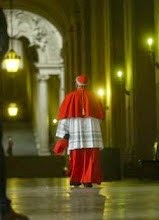
Along for the trip with B16 is the highest-ranking American the Vatican has ever known: Joseph Ratzinger's handpicked successor at the helm of the Congregation for the Doctrine of the Faith, the native Angeleno Cardinal William Levada.

Archbishop of San Francisco on his appointment to the post, Levada's nomination as the church's "Grand Inquisitor" barely three weeks after Pope Benedict's election caused shockwaves in the curial ranks. Known for his pragmatism, the 71 year-old theologian -- a seminary classmate of Cardinals Roger Mahony and Justin Rigali and his successor by the bay, Archbishop George Niederauer -- once chalked up his appointment to the Vatican's #3 post to both his "sense of the complex pastoral realities that a bishop faces" from his stints in San Fran and Portland in Oregon, and his experience in dealing with the sex-abuse crisis here in the States; the CDF handles the Holy See's end of the process for the suspension or laicization of credibly accused clerics.

On the latter topic, the "Theologian-in-Chief" made some news at a lunchtime briefing held yesterday at the offices of TIME (fullaudio... video):
[Levada] offered early signs on Friday that the Vatican will change its internal, or canon, laws concerning the church's response to sexual abuse allegations — a matter that has become the main topic of the Pope's American visit. The changes would follow adjustments made some time ago involving the church's statute of limitations with regard to some particularly egregious offenses. The Cardinal suggested that laws meriting amendment may involve statutes of limitations regarding abuse cases....

Asked whether the Vatican should consider such changes to canon laws, Levada said, "It's possible. There are some things under consideration that I'm not able to say."

The American-born Cardinal, who was Archbishop of San Francisco before Benedict brought him to Rome, said that there have already been some abuse cases in which the Vatican had "made exceptions" to canon laws — cases in which victims may not have spoken up until years later. "We found that many of the cases go back over quite a number of years, and [victims] don't feel personally able to come forward until they reach a certain level of maturity. Some canon norms are like statutes of limitations, and if the case warrants...we've been able to make exceptions." He said that those cases were ones in which "strong measures needed to be taken, even dismissal from the priesthood."

Levada's comments flowed out of a discussion initiated by this reporter's question regarding the Pope: having been so forthcoming about the abuse scandal during this trip, would he address one of its more disturbing aspects, by sanctoning supervisors and even bishops who had "aided and abetted" the crimes? Levada responded that cases would have to be judged individually: "I would want to see the situations that we'd be talking about," he said. "I personally do not accept that there is a broad base of bishops who are guilty of 'aiding and abetting' pedophiles."

Levada said, however, that bishops have admitted to him "that if they had known then what they know now they would have acted differently, but many bishops acted on the basis of psychological reports that were...not really on top of the various aspects of this" — a likely reference to the then little-known recidivism rates of offenders.
...today's Times offers this nugget:
The pope’s decision to reach out to victims and to speak out publicly, and repeatedly, about sexual abuse, said Cardinal Levada, came at the urging of several key church officials in the United States: Cardinal Sean P. O’Malley, archbishop of Boston; Cardinal Francis George, archbishop of Chicago and president of the United States Conference of Catholic Bishops; and Archbishop Pietro Sambi, an Italian who is the papal nuncio, or chief Vatican diplomat, to the United States.
...and Beliefnet blogger David Gibson offers another look at the session:
Cardinal Levada said that he had no input on the pope's addresses or preparation for this visit, even though Levada is the highest-ranking American ever to work in Rome. "I have my own little work to do all the time," Levada said drolly.

Asked about the question of giving communion to pro-choice Catholic politicians, Levada largely demurred. But he did seem to side against a handful of hard-liners in the U.S. hierarchy who have staked out an independent position on the practice, or at least against the current patchwork of positions. "My stand is that I don't think our Catholic population is served by a territorial morality." He said he hoped that when the election season ends there could be a "more serene and effective discussion" about church teaching and what ought to be done in this regard.

Returning to the issue of the scandal, Levada was asked if, in light of the pope's visibility on the abuse crisis, the Vatican foresaw any subsequent action or envisioned a future course for policies or programs. "That's a good question that I really hadn't thought of," Levada said. He said the pope's words and actions were meant to be "exemplary," in the sense of setting a pastoral example for others to follow. He said he hoped victims' stories would now "be given more prominence."

Levada later told a few reporters that the CDF was begininning to work through the backlog of laicization cases that had once built up to more than 700, according to reports. He did not say how many remained to be adjudicated. He also seemed to indicate that the CDF was considering ways to raise the church's canonical statute of limitations on reporting sexual abuse. He noted that it often took many years before victims felt they could come forward and report such abuse.

I also asked the cardinal if he could clarify remarks that the pope made on the plane that distinguished between pedophilia and homosexuality--a linkage many have tried to make. "I would not speak in this moment about homosexuality but pedophilia, which is another thing. We will absolutely exclude pedophiles from the sacred ministry," Benedict said.

Yet his statements raised questions about what the pope meant (there was no opportunity for follow-up) and whether his words signaled a re-thinking of the Vatican statement in 2006 that seemed to bar gay men from the seminary.

Levada said he would not interpret the remarks as any modification of the seminary policy. But he said he wasn't sure what else the pope's words indicated. "I don't know what to make of that myself," Levada said. He said he believes Benedict wanted to focus on "the grave problem of pedophilia"--defined as the abuse of a pre-pubescent child by an adult--rather than what Levada calls "ephebephilia," or "homosexual acting out with adolescent boys."

Levada called ephebephilia a clinical term, but it is not listed in the DSM and mention of it raises many red flags among experts and within the gay community. Victims advocates also dislike the term, preferring to denote all sexual activity by an adult on a minor as child abuse, which is the criminal and civil law definition.

In short, there still seems to be little clarity. Many believe the pope was trying to make a distinction in order to shield homosexuals from efforts to identify gays with pedophiles. That seems like an obvious--and laudable--goal. But the standing of gay men vis-a-vis holy orders is still a bit uncertain, and seems likely to remain the ecclesiastical version of "don't ask, don't tell."
On a final note, it's been over a year since the Roman buzz first whirled with speculation that Levada might be making a return trip to these shores: here to New York in succession to Cardinal Edward Egan, who reached the church's retirement age of 75 last year and is expected to leave office later this year.

Though muted -- and likely unfounded -- the talk keeps swirling... which just made his appearance in the Luce Room all the more interesting.

PHOTO: Jamal Countess/Wireimage


-30-

Saturday, December 31, 2005

THE CHURCHMAN OF THE YEAR: Benedict's First Choice

2005 Churchman of the Year -- US
The Most Reverend WILLIAM J. LEVADA
Archbishop-emeritus of San Francisco
Prefect of the Congregation for the Doctrine of the Faith


It didn't take long after Pope Benedict XVI asked William Levada to succeed him in global Catholicism's toughest job before the howls of discontent began.

For the former Cardinal Joseph Ratzinger, who had to deal with being tarred and mischaracterized over his 23 years in the job he had given to his old friend and confidant, bearing the brunt of ideologically-driven rage was nothing new. What had changed, however, was the source of the hyperkinetic fury: the ultraconservative base which, but a month before, perceived the former Grand Inquisitor as the one and only hope who, if elected to succeed John Paul II, could make their wildest dreams come true.

In naming Levada -- by no means a boat-shaker on the controversial issues which have polarized the church in recent decades -- Benedict sent a strong signal that his pontificate would not be dominated by the church's bellicose rightward fringe, who had long borne grudges against the archbishop for his effective, constructive handling of sensitive issues over his decade in San Francisco, where he continued the legacy of openness and outreach of his predecessor, John R. Quinn, while holding the Roman line on the hot-button topics of church teaching.

The historic appointment of the highest-ranking American in the history of the Holy See also signaled a strong vote of papal confidence in Levada's penchant for building solid working relationships with many communities in the city for whom Catholic doctrine was no obstacle to pushing law and culture to new frontiers, but who came to respect the archbishop as a fair broker who won the church a place at the table through his considerable gifts of savvy, intellect and consensus-building. Notably, despite Benedict's blessing, it is not a method which a significant number of his brother bishops find appealing.

Of course, that is just the prelude. Archbishop Levada stands head-and-shoulders above US Catholicism's newsmakers this year not for his past on this side of the Atlantic, but for the future he has begun to chart in Rome -- the exercise of a clout which will have a sizable impact on Catholic life in his home country for decades to come.

In a November interview with Vatican Radio, Levada said that when the Pope asked him to take over the leadership of the CDF, he "gasped," and said, "Holy Father, I'm not the person for that." "Yes, you are," Benedict replied, and proceeded to tell Levada why.

The Catholic Right still wasn't convinced.

Once Levada was unpacking in Rome, the former Cardinal Ratzinger's supporters continued to maintain that the new Pope was being "hoodwinked," that his choice was an outlier and that the American at Benedict's side would have no influence whatsoever in the affairs of the US church. Counterintuitively, for anyone to think these claims would have any merit would be to retroactively posit that Ratzinger's advice bore absolutely no weight in the considerations of John Paul II.

Yet again, reality has proven Levada's detractors wrong.

As expected, the new doctrinal strongman -- quickly appointed to the Congregation for Bishops after his August move to the Vatican -- moved quickly to ensure that Benedict's first major American appointment would bear the fruits of his counsel. In sending Levada's lifelong friend George Niederauer to succeed him in the City by the Bay, the Pope who had been championed by the doctrinally rigid sent the nation's liberal capital a message that its Catholic culture was healthy, vibrant and that the path marked out by the previous archbishop was to continue unhindered.

Within two weeks, the prefect then shepherded the nomination of another San Francisco priest, Fr. Randolph Calvo, who had served as vicar-general to Quinn as well as Levada, to the bishopric of Reno after an atypically short vacancy there. And with another opening in his former province currently pending, it's just one of many openings in the New Year which will be filled by the stamp of the archbishop's trusted hand.

The Levada movement -- which will reach its apex sometime in 2006, when (by seniority) his name appears first on the list of new cardinals to be created at Benedict's first consistory -- goes far beyond episcopal appointments. As he told Vatican Radio, "The fact that the [CDF] now has responsibility... for dealing with issues of sexual abuse of minors by clergy. Given the experience of that, the explosion of that, on the American scene over the past few years, my experience with that... I think probably also may have said to him maybe it wouldn't be bad to have someone also who has this experience."

The backlog of cases referred from American dioceses for the CDF's judgment has been said to stretch 18 months or thereabout. That the Prefect knows the lay of the land here, he knows the bishops, the canonists, the various legal situations can only help but ease the burden under which the Congregation's work has been placed.

Issues of education will come up, as will issues of authority, erroneous teaching and those who persist in propagating it, political questions alongside magisterial ones. And that's just at the Sant'Uffizio, where the CDF has its offices. Even as for those issues which lie beyond the competence of his own dicastery, anytime the United States comes up it's likely that the Prefect will be sounded out for his opinion as an indicator of how it will play on the ground at home.

(On the international front, the release of the Congregation's findings in its high-profile investigation into multiple allegations of sex abuse levied against Fr Marcial Maciel Degollado, founder of the Legionaries of Christ, is the most significant item of interest on its 2006 agenda. The probe of Maciel was initiated by Cardinal Ratzinger in late 2004.)

Levada said in an interview that one of the main strengths he brought back to the Vatican -- he worked at the CDF from 1976-82 -- was his "sense of the complex pastoral realities that a bishop faces."

Given the magnitude of his position, and his personal closeness with the Prefect-turned-Pope, it can be said that his calls won't go unreturned and his advice won't go unheeded. In the often unruly and highly-territorial world of Vatican bureaucracy, figures who can muster that kind of deference at the highest levels are few and far between.

For an American to occupy such rarified territory is nothing short of groundbreaking.

-30-

Friday, April 17, 2009

Under "Assessment"

Returning to coverage of things beyond the 212 area code, the Holy See has moved to tighten the bolts on the leading umbrella-group of Stateside nuns, ordering a "doctrinal assessment" of the Leadership Conference of Women Religious (LCWR):
The Vatican Congregation [for the Doctrine of the Faith] informed the leadership conference officers of its new “doctrinal assessment” in a February 20 letter, which the officers received March 10. The letter came from Cardinal William Joseph Levada, the congregation’s prefect.

In his letter, Levada explained the congregation is undertaking its “assessment” of the women’s leadership conference after initial Vatican doctrinal concerns were expressed in 2001.

Levada, the former archbishop of San Francisco, was appointed by Pope Benedict XVI to head the Congregation for the Doctrine of the Faith in 2005.

Officers at the Leadership Conference of Women Religious sent a letter to conference members April 2 telling them of the investigation. [The National Catholic Reporter] obtained a copy of that letter.

The conference is an association of the leaders of congregations of Catholic women religious in the United States. It has more than 1,500 members, who represent about 95 percent of the 68,000 U.S. women religious.

Asked by NCR to respond to the Vatican initiative, the leadership conference issued a brief statement.

“The Leadership Conference of Women Religious received on March 10 a letter dated February 20, 2009 from Cardinal William Levada, prefect of the Congregation of the Doctrine of the Faith (CDF). The letter announces CDF’s decision to conduct a doctrinal assessment of LCWR’s activities and initiatives.

“At this time, LCWR knows neither the process nor timeline for completion of this assessment. As more information is made available to LCWR, the conference will take the appropriate steps to prepare for its participation in the assessment. LCWR faces this process with confidence, believing that the conference has remained faithful to its mission of service to leaders of congregations of women religious as they seek to further the mission of Christ in today’s world.”

The Vatican assessment has become necessary, according to Levada, because at the 2001 meeting between the women’s leadership conference and the Congregation for the Doctrine of the Faith, which took place in Rome, the women were invited “to report on the initiatives taken or planned” to promote the reception of three areas of Vatican doctrinal concern: the 1994 apostolic letter Ordinatio sacerdotalis, the 2000 declaration Dominus Jesus from the Congregation for the Doctrine of the Faith, and “the problem of homosexuality.”

Ordinatio sacerdotalis, Latin for “On the Ordination to the Priesthood,” was a Vatican document that reasserted that Catholic ordination to the priesthood is reserved for men alone and that the church “has no authority whatsoever to confer priestly ordination on women.”

Dominus Jesus was a declaration that, in part, insisted that non-Catholic Christians are “in a gravely deficient situation in comparison with those who, in the church, have the fullness of the means of salvation” and that non-Catholic Christian communities suffer “defects.” It was viewed at the time by some Catholic theologians and leaders of other religions as a major setback in interreligious dialogue.

In a 1986 letter written by then Cardinal Joseph Ratzinger, now Pope Benedict, to the world’s bishops, he wrote: “Although the particular inclination of the homosexual person is not a sin, it is a more or less strong tendency ordered toward an intrinsic moral evil; and thus the inclination itself must be seen as an objective disorder.”

Regarding the investigation of the women’s leadership conference, Levada informed conference leaders: “Given both the tenor and the doctrinal content of various addresses given at the annual assemblies of the Leadership Conference of Women Religious in the intervening years, this Dicastery can only conclude that the problems which had motivated its request in 2001 continue to be present.”

As a result, Levada said, the Vatican had decided “a doctrinal assessment” of the “activities and initiatives of the LCWR would be helpful.”...

The new assessment of the women’s leadership conference, Levada stated in his letter, will be conducted by Leonard P. Blair, bishop of Toledo, Ohio, a member of the U.S. Conference of Catholic Bishops’ Committee on Doctrine.

Levada said Blair’s principal purpose is to “review the work of the LCWR in supporting its membership as communities of faith and witness to Christ in today’s church, and to offer any useful assistance.”

Officers at the Leadership Conference of Women Religious told their members that Blair had contacted them and they plan to meet later this spring. They also told members that they had asked for an appointment with Levada before the Vatican announcement that their conference was being investigated. The meeting with Levada is set for April 22.
In comments to CNS, the Vatican spokesman Fr Federico Lombardi said that the assessment was intended to take a closer look at "doctrinal problems that have presented themselves in the area of female religious life in the United States."

Earlier this year, a separate Vatican inquest into the "quality of life" of American communities of women was ordered by the Congregation for Institutes of Consecrated Life and Societies of Apostolic Life -- Rome's lead dicastery for religious -- with the approval of Pope Benedict. News of that apostolic visitation broke suddenly; LCWR officials were notified by letter of the move hours before it was publicly announced at a press conference in Washington.

Founded in 1956, LCWR represents some 95 percent of the US church's womens' communities, with the remainder belonging to more conservative-leaning Council of Major Superiors of Women Religious, which was founded in 1992 and received Vatican approval three years later.

-30-

Monday, March 19, 2007

Levada: Ma Vie en Rouge

A year ago this week, at the first consistory of his "serene and luminous" pontificate, the CDF Pope completed one of the more remarkable ascendancies in recent Vatican history by conferring his first red hat on William Levada, his successor at the Holy Office and the highest-ranking American ever to serve in the administration of the universal church.

Almost two years after the famous 3 May 2005 private audience in which Levada was offered the job, not a few still find themselves trying to get over the new Pope's selection of the former archbishop of San Francisco to take his place as the top guardian of church teaching. And it hasn't gone unnoticed, either, that Cardinal Ratzinger's cherished top two aides at the Congregation for the Doctrine of the Faith -- the secretary Archbishop Angelo Amato SDB, and the undersecretary Fr Augustine DiNoia OP, also an American -- have so far remained at Palazzo del Sant'Uffizio as opposed to pushing the Ratzinger revolution forward at higher rank in the other dicasteries of the Roman Curia.

Then again, with the cardinal-prefect having spent 18 months settling into the office where he served as a staffer from 1976-82, the gifts for his lieutenants will likely be in the offing sooner rather than later. Still, again, it's been historic; if you told someone a couple years back that two of the CDF's three top posts would soon be held by Yanks, you would've been looked at funny. That it's happened serves to burnish Benedict's trailblazer cred, and that he's got a keener eye on things US than some might think... and also than some might like.

Continuing his cycle through the media gauntlet -- begun last month with an extended interview for a Belgian journal -- the successor of the "Grand Inquisitors" of old talked to CNS' John Thavis in Rome on a variety of topics, including the abuse crisis (for which the CDF has particular competence), the challenge of addressing new developments in technology and bioethics, and most especially his first "Notification," released hours before the interview concerning the Basque theologian Jon Sobrino SJ.
The study of Father Sobrino's works began well before Cardinal Levada arrived at his position, at a time when Cardinal Joseph Ratzinger -- now Pope Benedict XVI -- was at the helm of the doctrinal congregation.

On March 15, the congregation said some of Father Sobrino's writings on the nature of Christ were "erroneous or dangerous" and conflicted with church doctrine.

Cardinal Levada said Father Sobrino was given ample opportunity to consider and respond to the critical review.

"The congregation works very slowly in reviewing a theologian's work, perhaps too slowly in many respects. It attempts to guarantee fairness for the theologian and put aside any idea that somebody is being railroaded," the cardinal said.

Theologians under review can have their own theological or canonical adviser. Any critique is based not on anonymous accusations but on the theologian's published works or public statements.

"Often the question is whether a theologian really believes something that is contrary to the faith, or whether he has expressed his thinking badly or partially," Cardinal Levada said.

Ultimately these questions are examined by a group of theological peers that routinely advise the congregation, then by the cardinal and bishop members of the congregation, and finally by the pope for his final judgment, the cardinal said.

"We don't publicize this process, because in some instances, I say gratefully, we have not had to come to a public notification. If a theologian acknowledges an error or a too-partial presentation and agrees to make an adequate correction in a subsequent book or article, then we'll consider the matter closed," he said.

So far, the cardinal said, that has not been the case with Father Sobrino, and so a public warning was necessary. Although Father Sobrino is 69 and currently not teaching, he remains an influential voice in Catholic theology, Cardinal Levada said.

"New generations of theologians and young believers need to have an accurate understanding of what the faith is. And here is a well-known, prominent Catholic theologian who does not give an accurate understanding of the faith, and we think someone has to correct it," he said....

With a permanent staff of only 36 people, the congregation is limited in what it can tackle at any one time. That's one reason documents and decisions are not churned out quickly, but take years to develop.

Currently, for example, the congregation is re-examining bioethics developments with an eye to updating its landmark 1987 instruction, "Donum Vitae" ("The Gift of Life").

"The principles of 'Donum Vitae' remain entirely valid, but there are new questions posed by technology and research -- in stem cells, to give just one example," Cardinal Levada said.

A separate question under study by the congregation is natural law, the term the church uses to describe the set of universal ethical or moral truths that form a common ground for all religious faiths and political systems.

Rather than embark on a new document, the congregation wrote to Catholic universities around the world asking them to focus their academic resources on the question of natural law, by sponsoring symposiums and other events. The idea was to get centers of Catholic learning involved in promoting a concept that is essential to understanding the church's position on issues like abortion, marriage, human rights and religious violence.

In dealing with fundamental issues of faith, Cardinal Levada said, the congregation must look sometimes at questions related to evangelization in the modern world: Is announcing the Gospel of Christ somehow an imposition on people?...

Pope Benedict, of course, can help set the agenda. Cardinal Levada meets with the pope almost every week, and said he finds the pontiff "keenly interested" in details of the congregation's affairs. But the pope also respects the autonomy of the prefect, he said.

"He's very interested in these things, but he does not try to micromanage in any sense. I take into consideration any indications he wants to give. But it's not like I'm looking over my shoulder," the cardinal said....

Since 2001, by decision of Pope John Paul II, the doctrinal congregation has been responsible for the handling of cases of clerical sex abuse against minors. That created an enormous amount of new work, and the congregation's disciplinary section had to be expanded.

Cardinal Levada said many cases are still being processed, but the number is finally tapering off.

"I think you could say the crisis dimensions (of the case load), caused by the situation in the United States, are behind us," he said.

A native of California, Cardinal Levada was archbishop of San Francisco for 10 years before the pope called him to Rome. He had one big advantage coming into the job: He had worked on the staff of the doctrinal congregation in 1976-82 and had been a bishop-member since 2000.

The cardinal studied with a language tutor after returning to Rome and found that his Italian came back nicely. That's important, he said, because most of the routine business is handled in Italian.
In his travels, the cardinal-prefect gave the closing talk at the biennial seminar for US bishops on bioethics last month in Dallas. Levada returns to the States next month, this time to receive an honorary doctorate from Cleveland's John Carroll University, where he'll give his first major talk since leaving for Rome and the congregation.

The title of the 24 April lecture is already circulating: "Where Do I Find Hope?"


PHOTO:
AP


-30-

Friday, April 20, 2007

Developing the Faith

The keenly awaited America interview with Cardinal William Levada, prefect for the Congregation for the Doctrine of the Faith, has dropped in the magazine's current edition.

As the highest-ranking American in Vatican history comes up on the second anniversary of his appointment to Cardinal Ratzinger's old job, he was queried for the Jesuit magazine by Doris Donnelly, director of the Cardinal Suenens Center at Cleveland's John Carroll University. Next week, as previously mentioned, Levada will receive an honorary doctorate from the Jesuit school, where he'll give his first major speech in the US since taking the reins of the former Holy Office.

As Donnelly noted that Suenens, the legendary Belgian progressive of Vatican II, "wrote in his memoirs that [then-]Monsignor Levada and he were 'on the same wave length,'" the cardinal spoke of the perils of globalisation and his keen interest in the development of the Magisterium on several issues, as he did in a lengthy February sit-down with a Belgian publication.

Among the developments he cited was the church's view of the slave trade: "There is a long tradition in the church of accepting the institution of slavery," he said, "but in the light of the repeated teachings of modern popes and the Second Vatican Council on the dignity of the human person, church teaching has evolved from acceptance of slavery as part of the human condition to its eventual condemnation."

The cardinal-prefect later touched on the evolution of church teaching regarding capital punishment. Donnelly noted the exclusion of the phrase "the traditional teaching of the church does not exclude recourse to the death penalty" -- present in the Catechism of the Catholic Church -- from 2005's Compendium to the 1992 text.

While Levada answers that he's "asked those responsible for the compendium to indicate whether" the phrase's elision "is a 'signal' of development," and that a "negative" reply came back, he cites that "the need to take into account Pope John Paul II’s 'development' in regard to the death penalty, contained in his 1995 encyclical letter The Gospel of Life (No. 56), resulted in a change in the text from the first editions of the catechism (French, 1992; English, 1994) to the Latin typical edition published in 1997.

"A comparison of the English translation of 1994 and those made after 1997 will demonstrate the 'development' in the catechism’s treatment of the death penalty to reflect, among other things, the papal teaching that 'cases in which the execution of the offender is an absolute necessity are very rare, if not practically non-existent' (Catechism of the Catholic Church, No. 2267)."

Noting the success of both the Catechism and the Compendium -- both produced under the aegis of the CDF -- the interviewee held them up as examples of his congregation's awareness "of the deliberate recommendation of the bishops in the postconciliar reform of Vatican II that this congregation would develop a positive orientation in its work, in addition to its traditional focus of rejecting heretical and erroneous teaching." Notably, given the interview's timing just before the CDF published its notification on the works of John Sobrino SJ, the Basque liberation theologian, he said of the latter element that "if corrections took place by peers, if there were a functioning process of serious review and assessment in light of Catholic doctrine by theologians competent to evaluate the work of one of their own, there would be much less work for us to do in the congregation."

Of the reign of Pope Benedict, a friend of 25 years and his predecessor at the doctrinal office, Levada said that he was "delighted" to see how the pontiff "has overcome a certain innate reserve so that he can accept his role comfortably." The former Cardinal Ratzinger "continues to have a very keen interest" in the work of the congregation he led for 23 years, and while his successor said that "along the way, if he wants to give us an orientation or direction, he can," the cardinal didn't disclose if the Pope had, indeed, exercised that prerogative to date.

They say a spot on Levada's reading list was once taken up by The Pope's Daughter, a look at pre-papal offspring of the future Julius II (who, history says, ended the reign of corrupt pontiffs). These days, the cardinal said, he's "fascinated" by the Oxford biologist Richard Dawkins, a prominent atheist. Levada copped to being "halfway through" Dawkins' book The God Delusion, saying as he did that "engaging religion and science in conversation is important, so for me it's necessary to understand Dawkins's arguments."

Asked by Donelly what he prays for, the interview wrapped with Levada's comment that, alongside the work of the Holy Father and his Roman Curia, "he prays also and especially, he said, for the poor who live with the unjust effects of globalization and are pushed even further into misery and suffering."

Since advance word of the interview hit these pages last week, Levada's made a bit more news across the Pond, the circulation of which spurred a clarification from the Roman backrooms that, confirming the prior expectation, no transition at the helm of the archdiocese of New York is foreseen before the end of its bicentennial in April 2008. Word from Gotham says this should be evidenced shortly on the ground by a mini-reshuffle in 1011's top ranks.

In advance of his Cleveland lecture on Tuesday, Levada will be spending the weekend on the East Coast.

-30-

Tuesday, April 27, 2010

CDF Meets PBS...

...literally.

He might not be so hot on the Grey Lady these days, but in yet another intervention underscoring the significance with which the Holy See's taken the latest cycle of clergy sex-abuse revelations and the reaction to them, the prefect of the Congregation for the Doctrine of the Faith Cardinal William Levada sat for an extended interview with PBS' "Newshour," which ran tonight.

Calling himself "a great fan" of the program, fullvideo's up of the unprecedented broadcast TV sit-down with the Vatican's #3 official -- the highest-ranking American ever at the Holy See, and Rome's top hand on the handling of abuse cases...


...and a full transcript, snipped below:
MARGARET WARNER: ...Last week the pope accepted the resignation of two prominent bishops in Europe. Another bishop tendered his resignation in this clergy sex abuse scandal. Are there going to be more?

CARDINAL WILLIAM LEVADA: I don't think there is any way to predict. There have been several in the past, over the past 10 years let's say for various reasons. There is no way of predicting that, but I wouldn't be surprised.

MARGARET WARNER: Is there a new test really, a new standard for bishops to meet in the way they handle clergy sex abuse cases?

CARDINAL WILLIAM LEVADA: I think the standard is not new but it's being applied more rigorously than in the past.

MARGARET WARNER: And were all these resignations voluntary?

CARDINAL WILLIAM LEVADA: Yes they were.

MARGARET WARNER: Would this pope in these sorts of cases consider asking for resignations?

CARDINAL WILLIAM LEVADA: Yes he would.

MARGARET WARNER: We've had people say to us that this is the worst crisis the church has faced in a couple hundred years. Do you see it that way?

CARDINAL WILLIAM LEVADA: It's a big crisis. I think no one should try to diminish that. I think the crisis is particularly grave because priests are ordained to be good shepherds. We had Good Shepherd Sunday this last Sunday, and this is anything but being a good shepherd when you abuse children and you violate their innocence and their persons and they are too young to be able to respond on their own. So this is a crisis if you will that I think caught most of us by surprise. One bishop told me this isn't the cruise I signed up for, but that's in fact what has happened. I think the pope that was not his training and background I think he is the right man to be guiding the church at this time....

MARGARET WARNER: So do you think that some of the media are out to get the pope or the church?

CARDINAL WILLIAM LEVADA: Well you know I guess the media likes a good story but I think that by reasonable standards I think that they have not been fair in giving a balanced picture, a picture in context.

MARGARET WARNER: And what is that picture? What is that context that isn't being reported?

CARDINAL WILLIAM LEVADA: I haven't seen in the reporting much attention given to what the United States church has done. The bishops, it's true through media attention, constant media attention in 2002, met and took very concrete action. When you see the programs that have been developed, the educational programs for parents, for children, for all church workers, including priests and teachers, there is a real success story that I personally we ought to be proud of and say this also can be a model. We're not proud that we had to create it but it can be a model for public schools, Boy Scouts, some of these other groups where we're seeing now, while they don't get the media attention the church has in this, we see either huge punitive damage case in Oregon was reported today for the Boy Scouts so I think that's one aspect of it.

MARGARET WARNER: So you don't think it's appropriate that people hold the church to a higher standard? There is more focus on the church?

CARDINAL WILLIAM LEVADA: That's a fair question. I think we should hold ourselves to a higher standard in the sense that this is not something that one would have expected that a bishop or anybody in the church, parents none of us would have expected this but I think the causes we will see go back to changes in society that the church and priests were not prepared for, particularly changes involving how to be a celibate person in a time of the sexual revolution, that's one of the causes I'd say.
* * *
Meanwhile, from the "Rome of the West," the intrepid Patricia Rice -- one of the most-accomplished church-beat scribes American journalism has ever known, "red phone" across the Tiber and all -- unearths a long-hidden story in today's St Louis Beacon, revealing a strikingly candid 2002 father's plea written by David Spotanski, a top diocesan aide to the then-president of the US bishops, Wilton Gregory of Belleville, to the bench chief.

Among its many clarion-call passages, the father of three (then as now, the chancellor of the Belleville church) told "Wilton" that, among other things, the church "chooses to disregard the wellbeing of Her children -- my children -- to protect Her own icons and Her image," warning that "you can issue gracious statements after the fact until there's not a tree left in the forest, but until someone holds the bishops' collective feet to the fire, you've done precious little but make yourself feel better."

As the memo served as "a very important touchstone" that influenced the making of Gregory's highly-regarded response that June to "the gravest" crisis American Catholicism has ever faced, suffice it to say, it's worth reading in full.

PHOTO: Reuters

-30-

Monday, August 08, 2005

One Prefect's Disgrace...

I love the smell of scandal in the afternoon.

Great respite, breathing easier, back to biz. It really was a crazy week -- another contribution to The Tablet, readership still going up, draining battles behind-the-scenes. Good thing I was able to sneak in a getaway.

Despite spending yesterday on the road, the news had a curious way of following me. I'd gotten about 18 calls about Levada being subpoenaed in the sacristy of San Fran Cathedral before his farewell liturgy. Whether this was breathless glee or actual reporting depended on the caller.

But here's a development which really rubs me batty:
Cookie Gambucci, whose brother is one of the plaintiffs in the Portland [sex-abuse] case, served the court papers on Levada. She told KCBS reporter Tim Ryan the archbishop called her "a disgrace to the Catholic church."
Are you kidding me? I think I need to vomit.

LATimes runs it a bit differently, but it's still nauseating:
When Levada balked at accepting the subpoena, Cookie Gambucci, who runs a court support services company in nearby Martinez, said she told him he could receive it then or that it would be served on him at the altar during the service.

She said Levada accepted the subpoena, but told her: "This is a disgrace to the church."

Portland attorney Erin Olson, who represents 15 of the Oregon plaintiffs, said Levada had been avoiding the subpoena since May.
Look, I defended Levada against all the screaming at his appointment and am on-record deeming his promotion a good thing for American Catholicism and the future of the CDF. Hell, I'll even give him the benefit of the doubt on the Uribe defense. But if this report is true, his comment is an enormous setback to any illusions of restored credibility or good faith on the part of the bishops, and now from Rome. Levada should absolutely be ashamed of himself and needs to apologize -- and not just because he got snitched out.

For all the out-of-proportion caricatures of Ratzi through his Prefect years, he never called anyone a "disgrace" to the church. And he sure as hell didn't do it to victims of abuse and their families -- after all, who pulled the Maciel and Burresi files out, over the preferences of JP and the Stateheads? And as Anne Burke said, the Panzer gave the Review Board way more respect than many American bishops.

But it's all thrown into question now if the Vatican's new point-man on the matter leaves for Rome seeing just restitution to victims as a "disgrace to the church."

John Wester has been named the new apostolic administrator in San Fran (at Levada's request, bypassing an election by the consultors), and with Levada heading over sometime this week, B16 really has to do damage-control on this one. He absolutely can't let it stand that his hand-picked successor called an abuse case a "disgrace to the church."

With JP in the last years, his health was a valid excuse -- the circle of handlers were frightened that seeing the files in-depth would kill him. But the one who did the "Friday penance" of that close reading for years really has to step up in his new robes and speak out, overruling the man who, this week, is formally taking his place at the desk.

-30-

Tuesday, May 03, 2005

Habemus Prefectum?

Observant readers will note my post from last week of "The Pope's Men" in Benedict XVI's Vatican. Well, one of the buzzwords is coming to light.

This morning, B16 (sounds like a vitamin, eh? Does it make you holy?) received Archbishop William Levada of San Francisco in private audience -- his first such encounter granted to an American bishop. Levada was received third, after the Italian President Carlo Ciampi and Cardinal Lubomyr Husar, the major-archbishop of the Ukrainian Greco-Catholic church who is pushing Rome to concede patriarchal status to the UGCC. (Husar, who spent most of that church's time of trial in Stamford, CT, is an American citizen.)

However, we can be sure Benedict was happy as a clam to see his old buddy Bill. They only worked together for a year at CDF -- Ratzinger arrived in late 1981, Levada was called back to California the next year -- but he seemed to make a swift impression on his boss. Levada is one of only two non-cardinal members of the Congregation, whose membership Ratzi was practially able to have John Paul rubber-stamp.

In 2002, Levada served as a member of the mixed commission of American bishops and Curial officials which devised the compromise on the Essential Norms that finally won the recognitio. More likely than not, given the Pope's assurance to Cardinal George minutes after his election that sex abuse would be handled effectively and with great diligence by him, this was brought up, in-between showing Levada the recent renovations (which probably cost less than $25K -- Bishop Braxton, take note)....

But more importantly, could there have been a job offer on the table? It's quite possible -- the wisdom of an American prefect of CDF, given its point-man role in abuse cases, would be significant. George's name was kicked around Rome, but it would be imprudent to take the next head of the US bishops away from that mission, given that he enjoys the Pope's trust (and, they're probably thinking, God knows who those Americans would pick to replace him -- they don't want to take that risk, not to mention opening Chicago up so early on in the game). Benedict enjoys having people around him with whom he is comfortable, who have long proven their loyalty, and it seems Levada enjoys that confidence and that loyalty. Who better to lead his beloved former Office?

Whatever happens, even if Levada stays on the Bay, Benedict has sent a big signal to the family in the States that Levada is his guy. Talk about a statement worth its weight in scarlet moire'.

-30-

Saturday, March 03, 2007

Levada Gives Rare Interview: "I Am Not Responsible For the Crusades" -- Past or Present

Twenty-two months ago today, the newly-elected Pope Benedict changed his good friend's life, asking then-Archbishop William Levada of San Francisco to take the former's job of 23 years as prefect of the Congregation for the Doctrine of the Faith.

Coming but two weeks after the conclave's close, the appointment of Levada -- a doctrinally solid prelate with a pragmatic bent -- as the church's guardian of orthodoxy both shocked many veteran Vatican-watchers and marked the beginning of the end of some ideologues' years-long love affair with the former Cardinal Ratzinger, whose pontificate has since continued to thwart the expectations of his pre-electoral base at a fairly consistent clip.

Outside an interview with Vatican Radio shortly after his Fall '05 arrival in the Eternal City, Levada has kept a low profile since settling into the Sant'Uffizio, preferring to speak through his various homilies, talks, and trips back home to the US. The highest-ranking and most influential American in the history of the Holy See, a year ago this month the doctrine czar was elevated to the Sacred College as the first cardinal-creation of the pontificate of Benedict XVI.

A CDF staffer from 1976-82 and long the global church's poster-bishop for the school of creative engagement with a constructive, practical twist, the prelate whose job is descended from the Grand Inquistors of old recently gave his first major sit-down since before his elevation to the Belgian publication Mondiaal Nieuws -- and it's been translated into English.
Cardinal Levada is not the kind of person you would expect to pat you on the back or to share a pitcher of beer with, though his formal distance does not stand in the way of a genuine friendliness. He is very accurate and articulate, and does not shy away from taking clear positions.

Before his appointment, Cardinal Levada served as Archbishop of San Francisco. His American background often comes through when he explains his explicitly conservative views on Church and society. MO* refrained from focusing on typical church issues such as same-sex marriage, clergy sexual abuse, and abortion. Instead, we focused on global issues including the relationship between Christians and Muslims, and between Europe and its Muslim neighbors.

The Catholic Church shares quite a few values and even elements of faith with Islam. That should make Rome an important player in the indispensable dialogue between the West and Islam, says Cardinal Levada. "That dialogue is a crucial effort at this moment of history, not just for the religions but also for the future of humanity. We both share a common resistance to the violence that is perpetrated in the name of religion. Even though the Old Testament contains many passages in which God uses violence against the enemies of His people, we know that God is not a God of violence".

The rejection of a religiously motivated violence, in Levada's view, is in the first place a call to respect each person's freedom. "In the Catholic Church we needed centuries of religious and doctrinal development to arrive at the insight that each person has a right to religious liberty", says Cardinal Levada.

Would not the defense of religious pluralism gain in strength and credibility if the Church itself would present it with a bit more humility, for example by recognizing its own mistakes in the past? "I am not anymore responsible for the crusades than atheists are responsible for what Hitler or Stalin did", the cardinal responds.

"The Church's clear position on religious freedom is the result of many painful experiences: the crusades, the religious wars in Europe, the martyrs under the Protestant kings of England, and the Catholic prelates in Spain and France", he adds. "And, as a matter of fact, Pope John Paul II did recognize those mistakes in the past. But it becomes a bit strange when the Church, time and again is denied credibility to speak up against violence by referring to the crusades"....

The place religious conviction has in the public arena and in political discussions is an issue that gets the Cardinal sit up and speak out. "I discern the emergence of a 'fundamentalism of religious exclusion'. That is a position that under no circumstance accepts the holy conviction of a believer, unless he is willing to present himself as a searcher among searchers, and his convictions as a possibility among possibilities. Once you say that you've searched and you've found the answer, you're excluded. Conservative believers in the US describe this tendency as the aspiration for a naked public square: a public square stripped from every religious reference and from every religious participation". Cardinal Levada rejects that approach and reckons that his Catholic Church and the Islamic communities in Europe can agree on this point....

A good number of Christians would fall under the category "closed believers" and would only accept the literal text of the Bible as the guiding principle of their lives and, if possible, of the way society is organized. Asked if he would consider this fundamentalism problematic, Cardinal Levada responded:

"From the point of view of society, not necessarily. Take for instance the Amish, a Christian sect largely living in Pennsylvania. They continue living like their forefathers of the 17th century did, they reject modern farming equipment and mostly all electricity and powered machinery. But that does not seem to be a problem for them. Their agriculture often is more successful than that of their neighbors, and they get along quite well with the rest of society.

Their fundamentalist beliefs would turn problematic if they would start to believe that God calls them to use violence against all those who do not share their convictions. The crucial thing is that free choice is guaranteed. Even though that freedom is conditional too, of course. As soon as parents reject, from their literalist beliefs, blood transfusions and thereby endanger the lives of their children, we are in problematic territory.

It is like the conviction of the Mormons who hold polygamy acceptable. Society at large in the United States thinks that is unacceptable because it is detrimental to the women and the children and thus for society. So the law interferes and forbids this belief to be put in practice. A society has to formulate limits, whatever the religious convictions of individual believers or churches".
Someone has to decide

Cardinal Levada does not like fundamentalism as a way of life. At the same time he heads the administration responsible for formulating and guarding the doctrine of a billion Catholic believers. In what sense does his mission differ from the ambitions of movements who preach an undisputable truth and try all they can to subject others to that truth? The prelate's answer is a lengthy dissertation on the relation between faith and reason, concluded by the statement that accepting the dogmas of the Church is not the same as abdicating one's freedom of thought or capacity to reason.

"After all", he said, "human reason and intelligence are, after divine grace, the ultimate gifts, the capacities that differentiate us from the rest of creation. But reason is balanced by devotion, the acceptance of an authority beyond yourself, of God. That is not the same as a rejection of human reason or an autonomous judgment, but an exercise in challenging our own thinking by confronting it to calls that supercede or, on first view, even contradict this thinking".

The role of the Church in that dialogue between an individual and his or her God, says the Cardinal, is not to be the first interlocutor, but the role is indispensable. "We believe that the apostles and their successors received the mission to interpret revelation in new circumstances and in the light of new challenges. That creates a living tradition that is much larger than the simple and strict passing of existing answers, insights and convictions from one generation to another.

But at the end of the day there has to be an instance that can decide whether a specific lifestyle is coherent with the principles and values of our faith, that can judge whether our actions are in accordance with the commandment to love your neighbor. The mission of the Church is not to prohibit people from thinking, investigate different hypotheses, or collect knowledge. Its mission is to give those processes orientation"....

Liberation theology did not quite endear CDF predecessor Cardinal Ratzinger to the Catholic left, to put it mildly.

The current Prefect nuances the situation: 'The documents on liberation theology that were published by Cardinal Ratzinger defend the social teachings of the Church in their right application. They do warn however against a theology that makes common cause with communist or socialist ideologies, because that is in contradiction with the liberation as it was revealed in Jesus Christ and of which the gospels give testimony. The condemnation of liberation theology, in other words, was not a condemnation of a socially oriented Christendom".

If the Church could speak out so clearly against the combination of Christianity and Marxism, would there not be a need today for an equally clear pronouncement that Christianity is not compatible with the praxis and the values of neoliberalism? Cardinal Levada answered unequivocally: "That would certainly be in accordance with the teachings as formulated from Leo XIII onwards".

He continued: "In the United States, neoliberalism was fiercely debated on the occasion of the signing of NAFTA. The unions opposed that free trade treaty because they feared the consequences of a globalized competition for the workers and the circumstances and conditions in which they work. My sympathy in that debate is clearly with the unions. We cannot just leave the issue of a global economy to a few people with economic degrees. Economics is far too soft a science for that. Economists come along with new theories every so often, without a guarantee for the people that they will serve them better. That is why Catholic teaching says that we cannot blindly jump into this neoliberal approach of the globalizing economy.

You just cannot say that in the end everything will be all right, when your theory in its contemporary practice costs the lives of millions of human beings. That is not what we understand to be a successful economy and it does not stand the test of gospel values. Our mission is: love your neighbor. But how do you do that when almost every African country is suffering from the most acute poverty? How do we practise charity in Darfur, where hundreds of thousands are dying? Those are the challenges that really matter in the world today".

Big thanks and tip to Gashwin for picking this up.


PHOTO 1:
CNS


-30-

Wednesday, March 22, 2006

THE CONSISTORY: Angelenos in Rome

With all the hubbub about the Boston/Miami/DC delegation for Cardinal Sean, let's not forget that a son of the West Coast is getting a red hat for the first time since Roger Mahony got his in 1991 with the elevation of Bill Levada to the College of Cardinals.

To honor to the blessed event, a sizable Californian group -- Levada's friends, classmates, relatives, etc. -- has gone over to pay tribute.

The prefect's got a close-knit group of friends who absolutely love him, and an impressive loyalty and camaraderie which has stretched through across years and decades marks these friendships.

A flood of clergy and laity -- even some of his seminary students who decided that Camarillo wasn't for them, but stayed in close touch -- will be in attendance for the weekend. And, of course, the bishop-members of the group -- Tod Brown, Justin Rigali, George Niederauer (his successor in San Francisco), John Vlazny (his successor in Portland) and Roger our bishop, among others -- are all there as well.

Levada's hometown paper, the Long Beach Press-Telegram, covers the SoCal pilgrimage:
The power of the [Congregation for the Doctrine of the Faith] lies within its mission. The job of the nearly 500-year-old congregation, in part, is to promote doctrine and defend traditions viewed as being under attack by what the church calls "unacceptable doctrines." So powerful is the congregation that it is also known as La Suprema.

Given that status, could Levada become pope himself?

Like many prominent Catholic laymen, Murchison shuns such speculation. But others, including some making the pilgrimage to Rome, have considered the possibility.

Dan Slater, a civil engineer who lives in Naples, is taking his wife, Janet, and three of their five children to the consistory. "We're practicing Catholics," he says, "and I want my children to be able to say they saw the pope."

When the suggestion is made that they might be seeing two popes, he replies, "Yes, potentially. Wouldn't that be something!"....

For all this, Levada's elevation to the Vatican and to the office of cardinal weighs heavily on some church members.

"Regardless of how you feel about the Catholic Church, you have to admit this is an amazing position for a man from the United States," says Mike Murchison, George's son. "I think this is a great opportunity for Long Beach from that standpoint."

Murchison's son, Ryan, a student at St. Joseph Elementary School, will accompany his grandparents to Rome.

Although only 12, Ryan is no stranger to high-level church activities. He traveled with his family to San Francisco when Levada became bishop there. Says his father, "Bishop Levada started calling him Ryan, so Ryan started calling the bishop Bill."

Apparently, they got along famously.
So, along the lines of "Cardinal Sean," does that mean we can call Levada "Cardinal Bill"?

-30-

Monday, February 27, 2006

Levada, Hard-Core

Yesterday, Msgr. Jimmy Checchio was installed -- some said "crowned" -- as rector of the Pontifical North American College in what one visitor to the Gianicolo called "A very uneventful occasion with a long drawn out liturgy."

All the bells and whistles were out, and dear old Cardinal Baum (avec the famous Msgr. Gillen) made a hero's effort to be there. Even though the senior American prelate, created a cardinal 30 years ago (he was archbishop of Washington then), held up pranzo for 20 minutes, everyone was still quite happy to see the Wakefield make his entrance.

The installation was presided over by Cardinal-designate Levada, with several other prelates of note in attendance.

I got an e.mail this morning from a witness to all of this who wrote that Levada's 22-minute homily was something I should try to get my hands on, because "it was just W E I R D."

Well, thanks to Cindy Wooden, we now know why....
Cardinal-designate William J. Levada said a priest who publicly announces he is homosexual makes it difficult for people to see the priest as representing Christ, the bridegroom of his bride, the church.

A public declaration of homosexuality places a priest "at odds with the spousal character of love as revealed by God and imaged in humanity," said the U.S. cardinal-designate, who is prefect of the Congregation for the Doctrine of the Faith.

Cardinal-designate Levada made his remarks during a Feb. 26 homily as he presided over a Mass for the installation of the new rector of Rome's Pontifical North American College....

"One of the more immediate challenges facing seminaries," he said, is the implementation of the Congregation for Catholic Education's November instruction that men with "deep-seated homosexual tendencies" should not be admitted to the seminary or ordained to the priesthood.

The instruction, however, made clear that the church was not questioning the validity of the ordinations of gay men who already are priests.

The cardinal-designate said the instruction "is not directly related to the U.S. sexual abuse crisis, but it is not without relevance for it," insofar as a study commissioned by the U.S. bishops identified homosexual behavior as a component in many clerical sex abuse cases.

Beyond the issue of psychosexual maturity, Cardinal-designate Levada said, "the question also needs to be viewed from its theological perspective," particularly in light of the biblical images of God's spousal relationship with his people and Gospel passages in which Jesus refers to himself as the bridegroom.

The doctrinal chief said he wanted to look specifically at "the situation of the gay priest who announces his homosexuality publicly, a few examples of which we have recently heard reported" in reaction to the Vatican document.

"I think we must ask, 'Does such a priest recognize how this act places an obstacle to his ability to represent Christ the bridegroom to his bride, the people of God? Does he not see how his declaration places him at odds with the spousal character of love as revealed by God and imaged in humanity?'" he said.

"Sadly, this provides a good example of the wisdom of the new Vatican instruction," he said.

The cardinal-designate also told the seminarians: "It is important for our people to hear us priests preach and teach about the fundamental character of God's love imprinted upon humanity in the original act of creation: 'God created man in his image; in the divine image he created him; male and female he created them.'"
OK, so Levada -- you know, the man whose job is to guard the teachings of the church -- has long been accused by the "true guardians of orthodoxy" (better known as the "Rightward Fringe") of being a wholly-owned subsidiary of the gays, the liberals and Cardinal Mahony....

I'm keen to hear their judgment on where these comments put him.

-30-

Tuesday, November 01, 2005

Levada Speaks

In his first interview since arriving in Rome to take the reins of the CDF, Archbishop William Levada gave an extended encounter to Vatican Radio.

"It's a big change," the doctrinal enforcer said of his new responsibilities.

Levada was asked about his "read" of the reasons which led Benedict XVI to name him the highest-ranking American in the history of the Holy See. The interviewer said many people "were surprised" by his appointment to head the former Holy Office.

Many were surprised. I wasn't one of them. But here's what the man of the hour had to say.
"From my ten years as archbishop of a major metropolitan center, of commerce and of media in the United States, San Francisco, [I bring] a sense of the complex pastoral realities that a bishop faces.... The Pope wanted to get someone quickly into this office as his successor, because he knew that if this Congregation were left headless, you could say, for a long period of time, the work would not effectively go forward.... I think he found me because he had known me, I was a member of the Congregation, I had worked here, I think that he felt experience at this point was something that counted a lot for him."
On being informed of his appointment in an audience with the Pope on 3 May -- the same day this appeared -- Levada said he "gasped, and said, 'Holy Father, I'm not the person for that.' He said 'Yes you are,' and gave me his reasons."

Alongside Levada's experience factor (he spent six years as an official of the Congregation for the Doctrine of the Faith from 1976 until his 1982 ordination as an auxiliary bishop of his native Los Angeles), he offered that the Pope was also thinking of "The fact that the Congregation now has responsibility... for dealing with issues of sexual abuse of minors by priests, by clergy. That given the experience of that, the explosion of that, on the American scene over the past few years, my experience with that both as a local bishop and as a member of the mixed commission that was sent over here by our [US] Conference [of Catholic Bishops] to iron out some differences in our approach here with the Vatican; those things i think probably also may have said to him maybe it wouldn't be bad to have someone also who has this experience.

You know, somebody else said the same thing back in May, two days before the CDF appointment was announced....
Palmo noted that Levada has extensive experience dealing with the sexual abuse scandal in the U.S. church.

"He has on-the-ground experience in the United States," Palmo said. "That is priceless."
Who has known the mind of Papa Ratzi, again?

Beyond his own duties, the Grand Inquisitor did offer up a pointed critique of a central element of the recently-concluded Synod of Bishops, saying that the 50 propositions presented for a vote on the floor of the Aula "didn't capture the very beautiful and inspiring interventions that many bishops gave from their experience around the world." Citing as an example the intervention of president-delegate Cardinal Telesphore Toppo of Ranchi, India, the soon-to-be Cardinal-Prefect mentioned "The love for the Eucharist that missionaries would bring to that low-caste tribe: the idea that Christ would come to abide with [the people], to be with them and to give himself to them. What that did for their own sense of self-worth it gave them, how it transformed their culture.

"There's nothing of that in the propositions," he said.

Levada announced that, indeed, Benedict XVI will release a Post-Synodal Apostolic Exhortation "over the next year," and expressed his hope that the Pope will "put something of those beautiful interventions into the work product that goes into [the final document]."

-30-

Wednesday, July 08, 2009

Ecclesia Dei, Ecclesia Doctrina: Econe's New "Holy Office"

...and just like that, an already full week got fuller still at Roman Noon.

On the heels of yesterday's encyclical, this morning's Daily Bulletin of the Holy See Press Office carried another much-awaited text: the Pope's delayed motu proprio decree uniting the Pontifical Commission Ecclesia Dei -- the Vatican organ overseeing all things traditionalist -- with the Congregation for the Doctrine of the Faith.

As expected in the text, dubbed Ecclesiae Unitatem ("The Unity of the Church"), Benedict XVI named California-born Cardinal William Levada, the CDF prefect, to the added task of overseeing Ecclesia Dei, founded in 1988 after the late Archbishop Marcel Lefebvre illicitly ordained four bishops for his Society of St Pius X (and the five were excommunicated). In the years since, the commission -- first given the competence of aiding the reconciliations of individual SSPX defectors -- has become increasingly immersed in the task of dialogue with the Lefebvrites, whose prelates saw their ultimate sanction lifted last January in testimony to the pontiff's wish that the leaders of the controversial traditionalist group might "resume the path of full communion with the church," healing the lone major schism to take place following the Second Vatican Council.

At the same time, both this morning's decree and a separate statement from Levada reaffirmed that the Swiss-based Society -- which recently ordained 24 new priests at its houses in Europe and the US -- "has no canonical status... and its ministers cannot legitimately exercise any ministry" in the Catholic church.

In succession to the Colombian Cardinal Dario Castrillion Hoyos -- a staunch SSPX ally who reached the retirement age of 80 last weekend -- Benedict's choice of Levada puts a more skeptical hand at the helm of the traditionalist dialogue; according to prior reports, the cardinal was seen as an opponent of what would become Summorum Pontificum, 2007's "universal indult" for the pre-Conciliar liturgy, which the SSPX leadership sought as Rome's first act of goodwill with an eye toward reconciliation.

In his statement today, Levada thanked the Pope for his trust, and assured Benedict of the "importance" he'll place upon a "doctrinal dialogue" with the Swiss-based Society.

Shuffled out alongside the Colombian cardinal was ED's second-in-command, Msgr Camille Perl, who had served at the dicastery since its inception. To succeed Perl, the Pope named another of his trusted former CDF staffers, Italian Msgr Guido Pozzo.

Despite having shouldered much of the blame for the debacle earlier this year that saw the Holy See caught flat-footed after comments by SSPX Bishop Richard Williamson denying the Holocaust were broadcast on the eve of the clerics' de-excommunication, Levada's statement noted that the Pope had sent Castrillion a handwritten letter of "lively thanks" for his "great dedication" to the work of Ecclesia Dei. The gentlemanly, low-profile Perl, meanwhile, was simply "thanked... for many years of work."

A Los Angeles native and archbishop of San Francisco prior to his surprise selection for the Pope's old job days after Benedict's election, Levada had already been among the cardinal-members of Ecclesia Dei since shortly after his 2006 elevation to the "Pope's Senate."

PHOTO: AP


-30-

Tuesday, June 07, 2005

John Allen Speaks

It should go without saying that vast majority of the Catholic blogosphere doesn't listen to NPR. They miss some interesting stuff, however anathema it may be to the mission of the Republican party.

John Allen today did his best Billy Flynn tapdance on Fresh Air to plug his new book, The Rise of Benedict XVI, out today from Doubleday. (I've spent hours calling every B&N within 40 miles and can't find it anywhere.)

Allen did me the favor of speaking about Ingrid Stampa (you're welcome, John), and it's a great interview -- JLA being just folks from Kansas...

As Dorothy was taken to Oz, so was John to Rome. Good witches, wicked witches and a Wizard -- oh, my!

The interview can be heard here. I particularly enjoyed the following exchange:


Gross: Pope Benedict... was head of Pope John Paul's doctrinal office. What can we learn about Pope Benedict to see who he's chosen to fill that position?

Allen: Oh, I think it's actually fascinating. Pope Benedict has named as his successor Archbishop William Levada of San Francisco. This is is the only really significant personnel move he's made to date. [Editor's Note: Allen probably doesn't see Dziwisz to Krakow as a significant move because he didn't break it. Well, he didn't break Levada's appointment, either. I had the first report on both.]

And I think it is very telling, because I think that some of the expectations about Pope Benedict -- both on the Catholic right and the Catholic left -- were that, because he had been for 24 years the 'top cop' of the Catholic church -- that is, the great "Enforcer," the great "bruiser" in Catholic affairs, that once he took over the top job, there would be this "night of the long knives" that would follow, and that there would be this great purge of dissent. And, to date... none of that has materialized. And I think, in the Levada appointment, what you have is clearly a man who is a doctrinal conservative as you would expect... But by no means does he have a reputation as a headhunter. Quite the opposite. He is seen a somebody who is very clear in his principles but very flexible in his application of those principles, who is always seeking to defuse conflict rather than to allow it to fester.

And, interestingly, when his appointment was rumored and then announced, the most ferocious early criticism of it came actually from the Catholic right in the United States, that felt Levada should have been tougher against the gay culture in San Francisco, and they pointed especially to [the 1997 accord].... It looked like the church might lose $6 million in public funding, that went largely to care for HIV/AIDS patients and other charitable activities... At the end, what Archbishop
Levada proposed was a solution that basically shifted the focus from homosexuality to health care.... 'And that way we're expanding health care'... The conflict was avoided.

So, bottom line, I think, by putting Archbishop Levada in this job, Pope Benedict has opted for someone who clearly will safeguard the teaching of the church, but is not going to be looking to create conflict if he can avoid it, who is actually a very adept administrator and a very creative administrator, and therefore this does not augur the "great crackdown," or "great purge" that I think some people have been expecting.


If only he saw it coming on May 3. Hey, gotta get my plugs in....

-30-

Thursday, February 21, 2008

Doctrine Tackles Preaching

The "Vice-Pope" may be in Cuba -- where, earlier today, he addressed the island's bishops -- but, per usual, more of the Vatican orbit's been seen passing through New York.

While Msgr Guido Marini wraps up his two-day advance tour there later today, Cardinal William Levada reportedly made his own Gotham visit last weekend, albeit keeping a much lower profile than the invariably cassock-clad Papal MC.

As his Curial confreres retreated with Benedict XVI, the SoCal native -- now Papa Ratzi's successor as the global church's "Grand Inquisitor" -- headlined an Indiana conference on "Doctrine, Scripture and Preaching in the Church" organized by the USCCB's Committee for Doctrine, which he chaired on his 2005 appointment to Rome...
Levada noted that the trend to eliminate catechetical homilies after Vatican II was not really in the spirit of "Dei Verbum," the council document on divine revelation.

He said the Scripture commentary aspect of the homily was emphasized because it had been so lacking prior to the council.

The cardinal, prefect of the Congregation for the Doctrine of the Faith, said the church should now seek to integrate these two aspects.

Titled "Eloquence of Teaching: Doctrine, Scripture and Preaching in the Life of the Church," the seminar was a follow-up to a 2005 conference at the University of Notre Dame marking the 40th anniversary of "Dei Verbum."

It was sponsored by the U.S. Catholic bishops' Committee on Doctrine and Notre Dame's Institute for Church Life.

The seminar looked at the problem faced by priests who feel they must choose between preaching on the Scriptures or preaching on the church's doctrines and moral teachings.

"Dei Verbum," as noted at the seminar, does not see the two as mutually exclusive, but rather as two components that can work well together.

"We have to find ways to improve homilies so that they are at one and the same time genuinely exegetical -- genuinely interpretative of Scripture -- and genuinely catechetical," said another speaker, John Cavadini, chair of the theology department at Notre Dame.

He gave a talk on how the Catechism of the Catholic Church can be a resource to priests by helping to identify Scripture passages related to certain doctrinal or catechetical themes.

According to Cavadini, this integration of Scripture and doctrine should not be so difficult.

"All of the major doctrines of the Catholic faith were articulated in defense of Scripture and with scriptural language, while the canon of Scripture itself -- what books were chosen and what books preserved -- was a function of doctrinal considerations," he said.

In other words, "Scripture itself has a doctrinal shape, and doctrine has a scriptural context," Cavadini said.

Preaching his homily on the final afternoon of the seminar, Cardinal Levada recalled how God called upon Jonah to save the people of Nineveh by preaching his word.

"If Jonah could be eloquent under those circumstances," said Cardinal Levada of the reluctant prophet, "how much more eloquent, brother bishops, can you and I be? An eloquence not from our own skills, but from the Spirit teaching us."

He continued, "Only Jesus can lead us in the Spirit and make us sharers in the Holy Trinity. It's not what we say or do, but the person of the risen Christ, present in the word and the sacrament. This is how we are drawn into communion with God."
While the program was originally scheduled to be held at Notre Dame itself, a planned on-campus performance of "The Vagina Monologues" compelled organizers to change venues to the nearby convent.

As one report depicted the decision, informed of the controversial play's impending return to South Bend, "Levada said 'Nuh-uh,' and [the seminar] got moved."

-30-

Monday, March 04, 2013

In the Conclave, A Question of History: Could Camarillo Hold the Keys?

For those of us who revel in the history of the shop, this Conclave brings some sizable milestones to the fore for American Catholicism, each reflecting the dramatic shift of the nation's largest religious body on the global church's brightest stage.

Of course, this new reality centers on the swing of momentum and prominence away from the old Northeastern "powerhouse" to the booming South and West: for the first time, Texas – where Catholics have just come to comprise the biggest faith-group – has a vote in this papal election, while in another occurrence without precedent, a cardinal-elector left for Rome from Tennessee. Yet most of all, likely for the only time – and under circumstances that, not long ago, would've been deemed as unlikely as a Pope's resignation – a trio of red-hats who've become the most influential group of seminary-mates the Stateside church has ever seen will be locked in the enclosure together, bearing between them the ability of forming a bloc to be reckoned with.

Most tellingly, the three hail not from the traditional flagships of Baltimore, Boston, New York – indeed, not even Philadelphia – but what's only recently become the largest diocese ever upon these shores: the 5 million-Catholic behemoth in Los Angeles, 70 percent of it Hispanic, its population doubled over the last two decades. And what's more, each having reached the papal "Senate" on drastically different paths, Cardinals Roger Mahony, Justin Rigali and William Levada combine a shared long-standing bond with a spread of philosophies and networks among the body so sprawling that, if they combined, could end up producing the next Pope... or, if nothing else, contributing mightily to the result.

In any event, "The Cardinals of Camarillo" would make a great book – in all honesty, it's one this scribe's wanted to write for some years. In all due praise, though, the Salt Lake Tribune's Peggy Fletcher Stack went first, producing an immaculate study on two of the group along with the other two bishops from their class back in December. (In retrospect, maybe it's a good thing the idea never got moved on, as we might just be coming to the culmination of the epic.)

Still, between their backgrounds – Mahony, the progressive activist who John Paul II iconically dubbed "Hollywood" and has since taken to blogging the interregnum in the face of controversy; Levada, the moderate theologian and all-around "fixer" who'd shock many by becoming B16's first red hat, and Rigali, the quintessential Roman heavyweight formed by Paul VI and the mighty Giovanni Benelli, who's been spending these days alongside his St Louis protege, now the cardinal-president of New York – together with spheres of influence which respectively reach deep into Latin America and the wider global south, the CDF-centric Curia built by Benedict and Bertone, and the Ratzinger crew's eternal rivals in the ancien regime of the Secretariat of State, practically every geographic, ideological and situational (e.g. Curia vs. diocesan) base of this Conclave is covered.


Despite their differing experiences and outlooks, the trio have remained close since their start at St John's Seminary (above) – Levada joins Mahony for part of the retired LA prelate's annual summer getaway at his Yosemite cabin, and as CDF chief, the former archbishop of San Francisco flew into Philly for Rigali's 50th anniversary as a priest amid the tumultuous fallout of the 2011 grand jury report on clergy sex-abuse that would expedite the legendary diplomat's departure. 

Last time, however, the triangle wasn't completed – only with Benedict's election did Levada become the highest-ranking American in Vatican history with the new Pope's nod to succeed himself at the head of the doctrine office, a choice born both from their own long, comfortable history, but likewise Joseph Ratzinger's desire for a US prelate to bring his bench's experience in tackling clergy sex-abuse onto the global stage. (Despite the flack he's invariably taken from more traditional elements, it bears reminding that as archbishop of Portland in the late 1980s, Levada was the lone American Ratzinger recruited to serve on the editing commission of what would become the Catechism of the Catholic Church.)

Within months of each other, only last summer did all three enter retirement. Yet in a voting college where a full quarter were only elevated in 2012 – and at least to some degree, are still getting used to the reality of themselves in scarlet, let alone as papal electors – the dynamic of this Conclave lends an even greater weight to the contacts and memory of the veterans who've bestrode the scene for decades and know the elements at hand well enough to start toward a consensus.

Ergo, can they join forces? At first glance, it'd seem pretty possible. So, then, will they? 

Of course, that answer now rests in the rapidly-shifting, seemingly volatile Roman air. Still, heavy as the talk of contenders might be out there – and, to be sure, that point is upon us where it counts – the reality of this moment lies most in the exchange of ideas, priorities, and what would and wouldn't float in the balloting. And amid the thick sea of it all, well, who'd have a more effective melding of minds than three friends of 50 years?

To be sure, all this is nothing more than speculation. Still, it's one born of experience. In any event, for now, the sheer possibility of the unique moment – and with all three in the Sistine, the wider watershed it signifies here at home, regardless of who might emerge – simply feels like story enough.

PHOTOS: St John's Seminary, Camarillo(2)

-30-