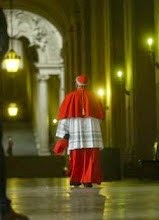
An interesting comment just got dropped. I'll parse it:
Piero Marini will be named to an Italian Diocese.
I noted a couple weeks ago a report that Marini's name was in the hopper to go to Ischia. Teheran? Not so much... it's much nicer than Teheran, even in the glory days of the Shah.
Mgr. Franco Camaldo will replace him as Vatican Master of Ceremonies.
Is Camaldo the one whom, I'm told, tried to sit down and stay in the Sistina after Marini declared "Extra omnes"? Very respectful gesture, there -- a sign of things to come.
Mgr. Josef Clemens will become Prefect of the Papal Household...
The CP (Casa Pontificia) would be in for a Teutonic rein-tightening. Score one for CDF.
...and the current Prefect, Archbishop James Harvey, will replace Archbishop Levada as Archbishop of San Francisco.
It's funny, the Milwaukee-born Harvey's name has been going around for a couple places here -- a well-connected bishop went so far as to suggest to me a couple weeks back that Harvey could get DC, which would fit with his background in the Secretariat of State. It wouldn't be a con victory by any stretch; Harvey's smart, too smart to be a political puppet.
If Harvey ends up on this side of the pond again, score two for CDF -- and -2 for State.
Maestro Georg – B16 Taps Secretary to Run the House
In a move of massive significance which'll be seen as either a doubling-down on the clout of B16's longtime private secretary – or his being distanced from the daily minutiae of the Papal Apartment in the wake of the "Vatileaks" fiasco – at Roman Noon, the Pope named Msgr Georg Gänswein, his closest aide from well before his 2005 election, as prefect of the Papal Household. With the nod, the 56 year-old native of Germany's Black Forest was simultaneously elevated to the rank of archbishop. (The Pope and now-Prefect are shown above in a May shot from B16's Study.) Ordained a priest of Freiburg in 1986 and trained as a canonist, Gänswein joined the staff of then-Cardinal Joseph Ratzinger's Congregation for the Doctrine of the Faith a decade later, becoming the now-pontiff's personal aide in 2001 in succession to Bishop Josef Clemens – now #2 at the Pontifical Council for the Laity – a figure with whom Gänswein has long been alleged to have a bitter rivalry. Within days of his boss' election as Pope – and the sudden ubiquity that came with it – the cleric's looks earned him the moniker of the Vatican's "George Clooney" and a raft of global press coverage, all of which which sparked an even further degree of resentment behind the walls. Of course, Archbishop-elect Georg succeeds now-Cardinal James Harvey, the Milwaukee native who formally ran the Pope's affairs since 1998 and was appointed archpriest of the Basilica of St Paul's Outside the Walls on receiving the red hat at last month's Consistory.
In official terms, the prefect is responsible for arranging all papal audiences – public and private, regardless of their size or rank of visitor(s) – as well as handling the logistics for every major Vatican event and the pontiff's travels both in Rome and all of Italy.
Beyond a doubt, this morning's appointment will raise an inevitable raft of comparisons to the 1998 appointment of Gänswein's predecessor – Stanislaw Dziwisz, arguably the most powerful papal secretary of modern times – as an unprecedented "adjunct prefect" of the Papal House, named alongside Harvey. (Neither of the duo, however, were raised to the rank of archbishop until five years later, in the wake of John Paul II's last Consistory.) While, by longstanding Vatican custom, papal secretaries are accredited and report to the Secretariat of State, the prior move was intended to give Dziwisz – now his Blessed Pope's successor as cardinal-archbishop of Krakow – added room to maneuver with a free hand in the Apostolic Palace. This time, though, the new arrangement could prove tricky on at least some fronts; as the pontiff is traditionally accompanied by both the prefect of the House and his secretary during audiences, that'd mean Don Georg would somehow have to bilocate to fill both the usual seats that flank the Man in White.
Along those lines, at first glance, it appears that the papal secretary will somehow aim to fill both slots – the Holy See's release on the appointment initially contains no reference to the archbishop-elect's current role, while Gänswein's biography curiously offers no verb-tense in describing him as "Particular Secretary" to the pontiff. Put simply, the construct can be seen a subtle, yet no less clear indication that – at least, for now – "Bel Giorgio" will continue on in his existing slot alongside the new one. While no ordination date has been publicly disclosed, smart money says Benedict himself will "hat" his right-hand man on Epiphany Day, January 6th, when the Pope is already scheduled to say Mass in St Peter's. At the end of their respective terms in the post, each of Gänswein's three predecessors – Jacques Martin, Dino Monduzzi, and now Harvey – were elevated to the College of Cardinals. -30-
As this morning's word came "out of the blue" and the traditional lead-in wasn't able to be run in advance, well, better late than never.... On a history note, today's shock announcement of a consistory a month from today to elevate six new cardinals marks the first time since 1929 that the Pope's "Senate" will see two separate intakes within the same calendar year. At the same time, there was an even shorter interval – all of three and a half months – between two groups created by Blessed John XXIII in December 1959 and March 1960.
* * *
That said, consistories are never about the past, but the future... and as each one tends to have its "star," it's a pretty obvious call that the coming intake will be decidedly Chito-centric.
Even if Tagle is a decorated doctoral alum of the Catholic University of America in Washington – where the Asian "star" studied under Fr Joe Komonchak – on a note closer to home, with the elevation of Cardinal-designate James Harvey after 15 years at the helm of the Papal Household, for the second time in B16's pontificate, the prelate given the first slot on the biglietto (literally, the "ticket" into the College) will be an American. With the 63 year-old Milwaukee native's transfer to the basilica of St Paul's Outside the Walls – the first American ever to hold one of the "Big Five" posts in the Secretariat of State – the job of a overseeing a papal court that's fallen under scrutiny in the wake of the "Vatileaks" fiasco likewise opens up, prompting a heady succession stakes all its own.(The cardinal-to-be is shown left welcoming Barack Obama to the Apostolic Palace on the President's July 2009 visit to the Pope.)
In a first, meanwhile, alongside his ordination classmate – now the church's "chief justice" – on Harvey's impending elevation, two Roman cardinals will have come from Wisconsin roots.
And now, of course, where else to end this Red-Letter Day but with the "star" of the show. Even as the timing of another intake might've made for a surprise, it's fair to say this Consistory's safest bet was that, at some point, Chito Tagle would burst into tears. As the wider church has come to learn over recent months, that's a rather common occurrence. And right on the money, no sooner did the 55 year-old "golden child" of Manila kneel before Benedict XVI this morning to receive The Ultimate "Like" than the weeping commenced, prompting a moved Pope to cradle the new cardinal's face in his hands and offer a word of encouragement as, holding onto the armrests of the papal throne, a trembling Tagle lowered his head and broke down. Notably – yet perfectly in keeping with the unspoken "script" evident from this gathering's outset – the moment likewise seemed to spark B16's warmest expressions of the day.
Say what you will, but on a day when the Roman Curia – and, for that matter, its home-Continent as a whole – was pointedly and completely shut out of a Consistory's center stage for the first time in nearly nine decades, it sure beat the giddy triumphalism we've seen from other neo-Porporati in our time. And whether it's expressed through tears, song or preaching, the unfailingly effusive heart-on-sleeve quotient provides a big key to understanding the lure surrounding the head of Asia's marquee diocese, around whom an admittedly predictable chorus has already sprouted to wield that ominous, unfortunate, but maybe just as inevitable word – "Papabile." (Among at least some traditionalists, meanwhile, the Filipino prelate has conjured a different epithet, with the Vatican II historian of the progressive "Bologna School" being portrayed as "Syncretism" Incarnate... irrespective of what the Pope of Summorum Pontificum has just as clearly and authoritatively determined in this case.) Installed in the capital just 11 months ago, the unexpectedly quick elevation of the Philippines' seventh native cardinal caps a meteoric year for the Washington-trained theologian, who had the even rarer privilege of receiving the red hat with both of his parents on-hand to witness the moment. Following his globally-televised cry, Rome Reports caught up with Tagle during the evening's courtesy visits, where he explained his emotiveness....
Even before leaving Manila, meanwhile, the welling up had already begun as Tagle admitted to a quasi-apocalyptic fear of the new role in the most recent edition of his weekly TV catechesis on the Sunday readings:
And as no Chitofest would be complete without singing, here's earlier footage of the neo-Cardinale backed up by a school choir at home:
Barely three months after Tagle's predecessor, Cardinal Gaudencio Rosales, "aged out" of a hypothetical Conclave on turning 80, the elevation of a new Filipino elector restores the lone vote for a Pope held by one of the world's most densely-Catholic countries, whose 75 million faithful comprise a larger group than its 67 million-member counterpart in the US. By contrast, with today's elevation of the Milwaukee-born Vatican "lifer" James Harvey, the Stateside church now returns to a bloc of 11 cardinal-electors.
* * *
Touching down at Fiumicino on Wednesday clad in a windbreaker, a backpack strapped on and bottled water hanging out, it wouldn't be a surprise if at least a few untrained observers mistook the boyish cardinal-designate for a returning student-priest... if only the welcome from the Filipino ambassador to the Holy See (below) hadn't blown his cover.
Like much else on all sides these days, the sheer existence of a College of Cardinals – to say nothing of its makeup and traditions – is enough to make a good chunk of the Catholic conversation foam at the mouth. Ask what a better substitute would be, though, and when you get as many differing answers as there are critics, any constructive discussion from there tends to fall by the wayside. Put simply, as the system's roots date back some 1,900 years – and any thoughts of outliving it prove less a commentary on the needs of the church than the state of one's ego – highlighting what's good with what is and encouraging its spread tends to be a much healthier use of time. And when a figure who, as a bishop, has declined the use of a car in favor of buses and his bike, does his pastoral rounds alone and has repeatedly called the church to divest itself of arrogance is brought into the Papal Senate, many of today's supposedly "knowledgable" or "enlightened" criticisms and claims suddenly ring rather hollow, and could be deemed as willfully blind or even disingenuous. Then again, since the temptation to talk more, listen less and look to the rest to testify stands as a towering danger for the church in an internet age, perhaps it was especially fitting that Rome's Man of the Hour – already Catholic new media's most popular prelate – counterintuitively used his talk at last month's Synod for the New Evangelization to press instead for an ecclesial rediscovery of "silence" and, soul by soul, a return to "a simpler witness to Jesus, meek and humble of heart." Along those lines, following Tuesday's piece here on Tagle's unparalleled new-media credfor a top hierarch, it bears noting thatan American priest who's no stranger in wider church-circles wrote to say that the post had missed the mark.... And to a big degree, he was right.
While "it is good to know that thousands and thousands 'like' him on Facebook," the cleric – for purposes of context, pretty firmly a man of the center – mused that "few outside of the Philippine community understand why so many don't just like" the new cardinal, "but love him, or [know] just what an extraordinary man he really is.
"I am not Filipino," he added, "but was able to experience [Tagle's] character as a truly GOOD shepherd in a very special way."
Having requested to speak on background, here's the story he told....
"After finishing [a lengthy, high-profile assignment], I took a few months of sabbatical in the Philippines. A priest friend of mine arranged with then Bishop Chito to direct a thirty-day Ignatian retreat for me. I was the given a small room in a convent in Tagaytay, a resort town that is part of his former diocese of Imus, in Cavite [province]. For thirty days, this bishop with plenty else to do [Ed. Note: the Imus diocese numbers some 2.3 million Catholics] took an hour out of his day to come by the convent and visit with me, guiding me gently and assuredly towards a deeper and ever more rich experience of God's presence in my life. He also shared much of his own life with me. I was able to meet as much in him Jesus, the Good Shepherd, as in my own meditations on the various scripture passages he offered to me for prayer. Just one moment of grace among many: One evening, he invited me to join him and his seminarians for dinner at their nearby seminary, where he served as rector and bishop. What a lovely surprise when dinner was served to find the seminary staff, the cooks, the maintenance boys, the shepherds just in from the barn, all take their seats with their bishop and the seminarians for the meal together. No rank, no superiority or inferiority, no cleric versus laity, no rich versus poor, just one family enjoying a simple meal together.
Besides being a fine theologian, a master of the internet and mass media, a very competent administrator, in a society filled with extraordinary corruption, Chito Tagle stands as one of the few public figures who is absolutely unbribable. And on top of that, he is authentically humble. He is simply the smartest, holiest, most courageous, most sacrificial, most pastoral man, priest, bishop, archbishop… and now cardinal I have ever met anywhere. These are the reasons he is so popular in the Philippines and why he has so many "likes" on his Facebook page. This is why politicians and government officials, not to mention priests and seminarians, religious and laity, seek his counsel in their difficult moments.
More than any single person in the Catholic Church today, this simple and loving shepherd gives me, by far, the most hope and joy. For him and those like him, today I give thanks...."
And especially on this Thanksgiving weekend, so should we all give thanks for all the many, many great lights among us... because, even for the high challenges and roiled scene of these times, what Church could ever ask for more than these? May the lot of us know the grace to be ever more like them – in truth, to be them – today, tomorrow, and always. -30-
B16's October Surprise – Pope Calls Shock Consistory for 24 November
In an announcement that seems to have taken everyone by surprise, this morning the Pope called Red Dawn, announcing the elevation of six new cardinals at a consistory scheduled for 24 November, the vigil of the feast of Christ the King. In order of their announcement, the cardinals-designate are:
Archbishop James Harvey, 63, the Milwaukee-born prefect of the Papal Household (who, Benedict said today, he will soon name as archpriest of the Basilica of St Paul's Outside the Walls);
Patriarch Bechara Boutros al-Rai, 72, the Lebanon-based head of the worldwide, 5 million-member Maronite church;
Major Archbishop Basilios Cleemis, 53, head of India's Syro-Malankara church – the first hierarch from the 600,000-member community to receive the red hat (and, by two years, set to become the youngest cardinal);
Archbishop John Onaiyekan of Abuja (Nigeria), 68
Archbishop Ruben Salazar Gomez of Bogotá, 70
Archbishop Luis Antonio Tagle of Manila, 55; head of Asia's largest diocese
The new intake – the second one of this year following the creation of 22 in February – will be Benedict XVI's fifth turn at topping up the College which will elect his successor. Following the gathering, the number of cardinal-electors will be restored to its statutory maximum of 120 red-hats under age 80, a figure from which the pontiff "derogated" earlier this year to add five additional members. During his pontificate, John Paul II had ballooned the Electoral College to a size as high as 135 voters. While two of the voting seats to be filled only come open within the next month, at least an additional 11 electoral spots will be freed up in 2013 as their current holders "age out" of Conclave privileges. Given the relative flood of vacancies, a consistory – normally foreseen weeks, if not months, in advance – had previously been expected for sometime in the first part of next year.
Notably, the "mini-consistory" is the smallest to be called since Paul VI's final intake of four cardinals in June 1977, at which Papa Montini elevated the freshly-ordained 50 year-old archbishop of Munich and Freising, Joseph Ratzinger (above). That gathering was known as the "Benelli consistory" for its linchpin figure – the longtime Curial titan Giovanni Benelli, who had been dispatched to Florence earlier that month amid heavy speculation that the move reflected his status as Paul's preferred successor. In other words, the small intake was seen as a frail pontiff's taking care of his "unfinished business." Whether that's the case again, of course, time will tell, but the sudden move is bound to fan concerns over the 85 year-old Pope's health. Either way, the snap announcement does assuage two significant critiques of Benedict's recent elevation classes: first, an "excessive" distribution of seats to Italians – none of whom made today's cut – at the expense of diocesan bishops from Asia, Latin America and Africa. Given the group's size, meanwhile, it seems fairly certain that the organizational chaos which has seen seen several thousand ticket-holders – including relatives of the new cardinals – kept out of St Peter's Basilica at the last several consistories due to repeated overallotments of seating won't be an issue again this time. In a break from usual practice, all of the diocesan cardinals-designate but one (Salazar) are in Rome for the Synod of Bishops for the New Evangelization, and so are unable to mark today's announcement with their communities at home. Reflecting the degree to which the move was unforeseen, statements on the elevations have yet to emerge from the dioceses of the far-flung designates. The Synod closes on Sunday with a papal Mass inside St Peter's. SVILUPPO: Additional notes/background.... and for the latest, continuing updates on the Front Page.
So it was noted here yesterday that Bishop-elect Provost of Lake Charles was an ordination classmate of Archbishop Burke of St Louis. Both had their priestly beginnings on 29 June 1975, when they were among a group of deacons personally elevated by Pope Paul VI to mark the feast of Ss. Peter and Paul and the twelfth anniversary of his coronation (even though he renounced the tiara in 1965).
Thanks to a tip, it can be reported that the prelates are far from alone in sharing the day. No, it's not a conspiracy -- a group of 359 priests ordained together in Rome, by the Pope, to commemorate a Holy Year is bound to produce a bevy of bishops.
Thirty-two years on, it's done that and then some.
Provost is but the latest of his ordination class to be raised to the fullness of the priesthood. Alongside Burke, others from its number include Cardinal Josip Bozanic of Zagreb, Archbishops James Harvey, the prefect of the Papal Household; Michael Miller CSB, secretary of the Congregation for Catholic Education, and the currently-omnipresent Malcolm Ranjith, the secretary of CDW. Bishops Michael Cote of Norwich, Patrick Zurek, auxiliary of San Antonio, and a host of others from Latin America, Asia and Africa round out the list, which a quick Catholic-Hierarchy.org check turns up.
"Is Not the Church the First Social Network?": Ever a "Beacon," Vatican Radio Turns 80
Amid the clamor of late week, a milestone was marked as Friday saw 80 years since Vatican Radio was launched with the first-ever broadcast of a Roman pontiff -- an utterance from Pope Pius XI, the father of the medium at his side....
"Being, by ancient design of God, successor of the Prince of the Apostles, of those whose doctrine and preaching by divine command was destined to all peoples and to every creature, and able to be among the first to take advantage of this wonderful Marconian invention, we firstly wish to address all things and people, telling them, here and those who will follow, with the words of Sacred Scripture: "Hear, o Heaven, what I am to say; let the earth hear the words of my mouth (Dt 32:1). Hear, all you peoples, lend your ear, all you who occupy the globe, united in one intent, the rich and the poor (Ps 47:1) -- Hear, o islands, and listen, o faraway peoples" (Is 49:1)...."
Eight decades later, now broadcasting over AM, FM, shortwave and digital bandwith in some 40 languages, the "Pope's voice to the world" remains a superlative source not just of evangelization, but information and culture far beyond the church's walls. And to commemorate its milestone, the Radio -- and the church well beyond -- were egged even further on in a speech given on the eve of the anniversary by the outlet's lead overseer in the Apostolic Palace, who delivered the remarks as the specially-tapped papal legate for the event.
A native of Tulsa, Msgr Peter Wells serves as Assessore, the third-ranking official of the Secretariat of State, roughly the equivalent of the Holy See's "deputy chief of staff." Among his duties, the Oklahoman -- the first American to hold the critical post since then-Msgr James Harvey, now the archbishop-prefect of the Papal Household -- supervises the Vatican's Information Office, its organs comprised of the Press Office, Vatican Radio and Television, the Internet Office and, of course, the "Papal Paper" L'Osservatore Romano.
On a side-note, while the rest of Vatican media -- not to mention, above all, the Holy See's website -- still has to catch up, the Radio took the Curia's first step into the new digital reality early last year with the release of an app which streams the outlet's content straight off its five channels.
That said, given the significance of Wells' post and the relevance his comments have for the wider world of Ecclesia in Media, here's the fulltext of the Assessore's speech for the Radio's 80th.
* * *
Your Eminence, Your Excellencies, Rev. Fr. Director General Priests, Collaborators and Friends of Vatican Radio, all:
I am honored to be representing the Secretariat of State today at the commemoration of the 80th anniversary of the founding of Vatican Radio, which began its service as proclaimer of the Word of God, of the teaching of the Holy Father and of the authentic Magisterium of the Church in 1931, by happy coincidence, the year of the 150th anniversary of the birth of L’Osservatore Romano.
I will not hide a certain emotion, even a certain trepidation in speaking with you today – not only because the relationship between Vatican Radio and the Secretariat of State is constitutive, as the Statutes of the station say: “Vatican Radio, for its programming and doctrinal and informative content, answers to the Secretariat of State, which exercises vigilance over the broadcasting Station, which [in turn] is bound to follow with care the directives that are imparted to it” (art. 2.1 of the Statutes of Vatican Radio, 1 Sept. 1995) – but also, as the same Statutes indicate, because the larger public easily attributes an authoritative character to the programming produced by Vatican Radio, and it is therefore necessary to assure that VR content is “fully in tune with the Magisterium and with the activity of the Holy See” (art. 2.2. of the Statutes of Vatican Radio, 1 Sept. 1995). It is precisely because of this that I am aware of how heady and how demanding has been the work that Vatican Radio has heretofore advanced. The celebrations of the important milestones reached throughout these 80 years are, therefore, undoubtedly worthwhile and joyful.
Allow me to join myself to these by offering a brief reflection focused more on the challenges of the future, challenges which arise out of the success of the past, in order that these last might not only live in our memory, but also be a stimulus on the way that is unfolding before us.
We are all aware that there is a veritable revolution underway today in the world of media. As the Holy Father stressed recently in his Message for the 45th World Day for Social Communications (24 January 2011):
The new technologies are not only changing the way we communicate, but communication itself, so much so that it could be said that we are living through a period of vast cultural transformation. This means of spreading information and knowledge is giving birth to a new way of learning and thinking, with unprecedented opportunities for establishing relationships and building fellowship.
Technical as much as it is cultural, this upheaval directly involves radio broadcasting both in its technological aspects, and in those concerning content. Classic media, including radio, can no longer ignore the power and pervasiveness of the new media.
Just think: a recent study found that cell phones are habit-forming – they call it “mobile addiction”, and since the advent of smart phones, it can become so severe as to force those who suffer from it to go without food rather than be separated from the device that allows them to send and receive calls and text messages. Then consider that Nielsen polling data for Western nations show people under 35 spend many more hours online than they do watching television.
One may also note how the new media have served as the catalysts for phenomena in the public sphere, such as the “Manifestation de la Honte” in Belgium and the “Jasmine Revolution” in Tunisia.
These events indicate that radio broadcasting services cannot fail to take into consideration the emergence of a series of other technological instruments, from the podcast to the iPad, from social networks like Facebook, to micro-blogging platforms like Twitter. The new means of communication are to be thought of as interlocutors, not as competitors. Radio should look on new media as an opportunity, not as a threat. Herein lies the spirit of “convergence” among media, to which the Holy Father pointed in his Discourse to Managers and Employees of the Vatican Television Center, 18 December 2008. Commenting on the way that the boundaries between the various media are fading and how, at the same time, their synergies are increasing, Benedict XVI expressed himself in the following terms:
[T]oday the Internet requires an ever increasing integration of written, audial and visual communication, and thus is a challenge to broaden and intensify the forms of collaboration between the media which are at the service of the Holy See.
To succeed in this task, it will be necessary to think outside the box: to see radio, television, internet and newspapers not as free-standing tools with well-defined competences, but rather as circles to intersect and link together.
For Vatican Radio, such a convergence will have a first beneficial effect on the economic level: the use of new technologies, in fact, allows for a maximization of productivity. I am aware of how difficult it is to speak of these things, and I am also well aware of how much Vatican Radio has been able to do, compared with competitors both public and private.
Certainly, an integrated information process is already underway at Vatican Radio, one that foresees the use of new media and all they have to offer. The new means of communication, intelligently employed and wisely integrated into existing structures, can be important vehicles for the transmission of the Radio’s message, guaranteeing an extremely wide diffusion at an extremely low cost. One need only think of how hubs or web streaming permit a much more rapid and certainly more widespread distribution of information, at a much more measured cost. The principal reason that must push Vatican Radio to embrace new tools and technologies, however, is to be found neither exclusively nor even principally in the economic efficiency that they promise.
The phenomenon of the convergence of classic media with new media – specifically, though not uniquely, the confluence of radio and internet – is to be thought of as the inevitable transformation that will give birth to a new specific role of radio service, in the context of a completely transformed system of information.
We are not talking about taking away radio’s proper function: reaching listeners. Rather we are talking about using new media to render radio capable of meeting the expectations of listeners who are more and more sensitive to information. I think a new concept of radio is being born. This arises from three considerations. The first is that radio is more flexible than other media, and can find distribution platforms very easily. The second is that radio is a pervasive, though not intrusive, medium: unlike a picture, the voice surrounds and immerses the listener in an environment of sound, without imposing itself on the listener’s space. The third is that the radio is an intimate, relational medium, a place for interiority, for responsibility, and not for the externals and appearances that pictures convey.
The convergence of radio and new media will not destroy the essence of radio. Rather, this convergence will strengthen radio communications. In the specific case of Vatican Radio, the convergence with new media will include two complementary processes. The first process concerns the harmonization of the work of Vatican Radio with other Vatican communications tools. The second process regards the relationship of the Holy See’s radio station to other Catholic radio stations around the world.
The Vatican media outlets have undertaken the first process with determination: the areas of cooperation between the Vatican Television Center, the Pontifical Council for Social Communications and Vatican Radio are proof of this. Nevertheless, these developments are only the first stages of a larger, more broadly encompassing phenomenon able to establish the permanent presence of the Holy See in the world of new media.
The second process is even more specific: Vatican Radio has the role of setting the example, of being a beacon, a guide for all other Catholic radio stations. The use of new technological tools can then ensure that Vatican Radio be a source of ideas and services to her sister stations – and at the same time a means by which local Catholic radio services can be shared on a global level. To succeed in this difficult challenge it will be necessary to continue in the direction – long since undertaken – of a new organic relationship between Vatican Radio and other Catholic radio stations throughout the world, a relationship that is now possible precisely thanks to new technologies.
The nature of this new relationship has its roots in the specific role given to Vatican Radio, that of being an integral element among the tools for evangelization available to the Holy See. As the Holy Father explained in his June 20, 2008 Discourse to the International Congress for Catholic Radio Personnel:
By virtue of its association with the word [sic – It. la parola] radio shares in the Church's mission and in its visibility but also creates a new way of living, being and making Church
As the Church is by nature universal, so too does Vatican Radio have a universal mission. It resounds in more than forty languages, and presents itself as the instrument par excellence for dialogue with different cultures and religions. Precisely for this reason is it necessary that you, the operators of Vatican Radio, constantly keep yourselves up to date: technically, professionally, culturally.
To just this end, the new tools of communication can be particularly useful, because in them lies the key to the achievement of a truly global reach: I think of the ability to reach millions people with an idea or a news item sent right to their cellular phones, or the ability to guarantee messages in real time to those who live in war zones or under the harshest regimes.
To evangelize means to address the difficulties to which the Church is subject. Vatican Radio must be the voice of the Church that contests those who say the Church is not capable of inner renewal, showing instead the tireless desire for purification expressed by Her Supreme Pastor. Vatican Radio needs to be the voice that promotes religious freedom in the world. Vatican Radio needs to be the voice that calls for dialogue and harmony in a world that turns increasingly to hatred and violence to solve conflicts.
All of us here know that the new media are absolutely essential, if Vatican Radio is to succeed in being such a voice. In this day, newswires, newspaper articles and even talk shows have given way to blogs, to the buzz and to going viral. Even before reaching the traditional media, a news item is worked over and modified, and new mechanisms shape and influence public opinion from the very beginning, in order either to make the news item important, world-wide, or to let it die and disappear.
It is no longer enough to go on air, to publish, to write. Today one needs to be present in the marketplaces, to update the web pages, in order to reach a world ever hungrier for news. In other words, not having new technical tools at one’s full disposal, or not knowing about the most current tools, will mean that one’s message will arrive late, will arrive wrong, and might even arrive in vain. In the aforementioned Message for the 45th World Communications Day, The Holy Father has reminded us how the new media:
[are] contributing to the development of new and more complex intellectual and spiritual horizons, new forms of shared awareness.
It is therefore essential for Vatican Radio to continue to adapt to these new tools if it wants to be the engine of new forms of consciousness, of awareness: in other words, of a new culture. Come to think of it, the development of a new culture based on a specific relationality is typical of the Church. Is not the Catholic Church the first global social network? Long before the new media existed, the Church’s liturgical language, values, and way of thinking about the human person have bound together Catholics from around the world, whatever their culture, language, age, race or economic status. The globalization of the media cannot frighten us, because we were the phenomenon’s first authors.
I conclude my speech to you, who spread the messages of the Holy Father, by repeating – as an expression of hope, as the driving force and core of your mission – the greeting that opens and closes all your services, and that throughout the whole world, like the notes of Christus vincit, identifies your station – our station: Laudetur Iesus Christus.
Benedict XVI's first major appointee as Pope – Joseph Ratzinger's choice to succeed himself as prefect of the Congregation for the Doctrine of the Faith – as well as the first cardinal created in this pontificate, not until earlier today did we hear from the highest-ranking American in Vatican history: the now-retired Cardinal William Levada, who returned to San Francisco after leaving the helm of the historic "Holy Office of the Inquisition" last July.... YouTubed in six parts – and including a discussion of Vegas odds and Levada's 11th hour move on the leadership group representing most of the nation's women religious just before his retirement – the full presser is available here. The first impressions of the other Stateside electors were previously relayed in the wake of the resignation announcement. While the US' delegation of 11 cardinal-electors is of a standard size for recent years – identical in number to the 2005 group – the "split" of the bunch is historic: an unprecedented four of the American electors (alongside Levada, Cardinals Raymond Burke, Edwin O'Brien and James Harvey) were given their red hats not at the helm of dioceses on these shores, but as holders of offices in the Roman Curia or other Rome-based posts. For purposes of context, last time, the diocesan-Curial split was 8-3.
As noted earlier, however, thanks to an unprecedented level of churn in the ranks over his eight-year pontificate, Benedict has named fully eight of the voters in this Conclave's second-largest national bloc. But don't expect them to be voting together – as the colorful history shared by Wuerl and Burke has returned as a popular reference-point, the US group is looking set to at least initially split up between the likely Latin America/Third World bloc and one or another of the rival Italian factions.
In other words, much as the world beyond can't get enough of talking "candidacies" that don't exist, at this stage, the matter at hand is far more rudimentary – namely, the shaping of the coalitions which, in time, will begin to reach that point.
Three days in, the first Stateside appointment of the year is in the bag.
This morning, the Pope named Auxiliary Bishop Patrick Zurek of San Antonio as bishop of Amarillo. Zurek, 59, succeeds Bishop John Yanta, who reached the retirement age of 75 in October 2006.
Zurek (left) served 21 years in the trenches as a priest of Austin, including assignments on both sides of the UT-A&M Divide and founding a parish. The incoming head of the 39,000-member church in the Texas Panhandle led the National Conference of Vocation Directors before being named an auxiliary of the state's elder archdiocese ten years ago this week. He speaks four languages, including his ancestral Czech.
A Rome-trained moral theologian who was a chaplain at the Bambino Gesu Children's Hospital during his seminary days, Zurek is the third Stateside appointee in the last ten months who Pope Paul VI ordained to the priesthood on 29 June 1975.
Named last year, new Bishops Michael Hoeppner of Crookston and Glen John Provost of Lake Charles further upped the mitre quotient of an ordination class that, among others, also includes Archbishops Raymond Burke of St Louis, the Vancouver coadjutor Michael Miller CSB, Culto Divino prefect-in-waiting Malcolm Ranjith and James Harvey, the Milwaukee-born prefect of the Papal Household, not to mention a smattering of cardinals. All told, Papa Montini ordained 359 in that one sitting to commemorate the 1975 Holy Year.
Under its retiring bishop, the Panhandle diocese -- which still considers itself mission territory -- saw a distinct shift of emphasis.
While his predecessor Bishop Leroy Matthiesen garnered a rep for his social-justice protests and was one of three prelates to attend last year's Minneapolis conference of New Ways Ministry (the Rome-banned apostolate to gays and lesbians), Yanta wrote pastoral letters advocating "modesty in dress" and the denial of the Eucharist to politicians whose public positions defied church teaching. In 2005, the prelate incardinated the prominent pro-life activist Fr Frank Pavone into his diocese and announced the founding of a community of priests and brothers dedicated to the cause under the leadership of the native New Yorker.
The Amarillo church was among the US dioceses hardest hit by the sex-abuse crisis. According to published reports, the Dallas Norms forced the removal of a quarter of its 32 active priests, leaving 16 of its 35 parishes without a resident pastor. As settlements, counseling and other costs left the diocese in a six-figure budget deficit, the accused later saw their diocesan subsidy slashed from $1,600 to $100 a month.
Per the norms of the canons, Zurek's installation as the Panhandle's eighth bishop must take place within two months.
Zurek: "I was a little shocked at the suddenness of the announcement, my acceptance and how life would change quickly. I was very happy that he had the confidence in me to appoint me a diocesan bishop. I started to realize that a new chapter in my life was about to unfold. It was exciting!"
Yanta: “Bishop Zurek has great experience in evangelizing, shepherding, teaching, sanctifying and serving the People of God…He has earned through experience a reputation for his respected, ecclesial and pastoral relationship with all.”
SA Archbishop Jose Gomez: “Bishop Zurek has been a blessing in many ways to me personally and to all the people of the Archdiocese of San Antonio. All who have worked alongside him will miss a good friend and a talented and dedicated bishop. However, I am happy that the Diocese of Amarillo will now benefit from his inspired leadership and dedication.” -30-
For anybody just waking up, here's full video of the centerpiece moment at this morning's "rites of creation" – the Pope's conferral of the red hat and ring on new Cardinals James Harvey (archpriest of St Paul's Outside the Walls), Bechara al-Raï (Maronite patriarch of Antioch), Baselios Cleemis Thottunkal (major-archbishop of Trivandrum of the Syro-Malankars), John Onaiyekan (archbishop of Abuja), Ruben Salazar Gomez (archbishop of Bogotá) and Luis Antonio Tagle (archbishop of Manila):
Sure, B16's social encyclical might be three days away... but beneath the top line of Caritas in Veritate, a good bit else is well in motion behind the Vatican walls.
This morning, the latest round of Curial chair-shifting continued with the outbound transfer of Bishop Giampaolo Crepaldi, #2 at the Pontifical Council for Justice and Peace, to the Italian border-diocese of Trieste.
Holder of the secretary's post since 2001, when he succeeded then-Bishop Diarmuid Martin (now archbishop of Dublin) on the Irishman's transfer to the UN mission in Geneva, no Vatican successor was named to replace the veteran social worker, who'll be one of four top prelates to lead the presentation of the new encylical on Tuesday morning in the Holy See Press Office.
Likewise today, the Pope named the vicar-general of Toledo, Msgr Juan Miguel Ferrer, as a "second under-secretary" at the Congregation for Divine Worship and the Discipline of the Sacraments. While the English Marist Fr Tony Ward already holds the #3 post at Culto Divino, the Spaniard's appointment is worth noting as it reunites Ferrer with his past and future boss, Cardinal Antonio Cañizares -- the "Little Ratzinger" who took the reins of the global church's "liturgy office" late last year.
(Of course, the other top transition at CDW will be completed a week from today in Washington with the ordination of the office's new secretary, the Bronx-born Archbishop-elect Gus DiNoia OP, in the capital's the Basilica of the National Shrine of the Immaculate Conception.)
Today's twin moves follow yesterday's promotion of the longtime secretary of the Congregation for Bishops, Archbishop Francesco Monterisi, to the archpriest's post at the papal Basilica of St Paul's Outside the Walls. With that shift, the 75 year-old Italian is now placed in line to become a cardinal, keeping with the longstanding tradition for former seconds-in-command at the dicastery overseeing episcopal appointments for the global church's non-mission dioceses. Named to succeed Monterisi in the critical post was Archbishop Manuel Montiero de Castro, 71, who had served since 2000 as the papal nuncio to Madrid and, as a result, was the Holy See's lead voice to the Socialist government of Premier Jose Luis Rodriguez Zapatero, whose efforts to liberalize Spain's abortion laws and legalize same-sex marriage have met with ferocious criticism from the country's hierarchy.
Most of the already-announced moves were foreseen last week by the most reliable of the current Curia's court scribes, Il Giornale's Andrea Tornielli, who likewise lifted the veil on several other shifts supposedly at hand.
Among the yet-unannounced bunch are two that'd be of special interest to North Americans: according to Tornielli, the highly-regarded nuncio to Ottawa, Archbishop Luigi Ventura, is likely bound for the papal nunciature in Paris (whose occupants traditionally end up with the red hat) and, with the Secretariat of State's #3 official said to be in line for a return to the field, the post of Assessore is reportedly headed toward Msgr Peter Wells, a priest of Tulsa and the current head of Stato's English Desk.
The top aide to the all-important Sostituto -- the archbishop who, in essence, serves as the Roman Curia's "chief of staff" -- past Assessori have customarily gone on even higher: among others, both the current overseer of the Eastern churches Cardinal Leonardo Sandri and Cardinal Crescenzio Sepe of Naples once held the job, as did another American, then-Msgr James Harvey of Milwaukee, who John Paul II named to run his Household in 1998.
As the official responsible for arranging the pontiff's audiences and visits, the Midwesterner will return to his usual place in the San Damaso courtyard next Friday afternoon, this time to welcome President Obama to the Vatican and escort the visitor through the Apostolic Palace to the Papal Apartment. PHOTO: AP
As intimated last night (see next post), Crookston's day has arrived.
This morning, the Pope accepted the resignation of Bishop Victor Balke, who turns 76 tomorrow, naming in his stead Msgr Michael Hoeppner, heretofore vicar-general of Winona.
A native Minnesotan, the 58 year-old bishop-elect comes with a background steeped both in parish work and administration, and with a good bit of teaching ministry, to boot. An alum of the Pontifical North American College, Hoeppner is yet another member of the class of 29 June 1975 -- when Pope Paul VI ordained 359 priests to mark the Holy Year -- to be elevated to the episcopacy, and the second US appointee this year to come from the group, which also counts Archbishops Raymond Burke of St Louis, the prefect of the Papal Household James Harvey and Michael Miller CSB, now the coadjutor of Vancouver, among its members.
Possessed of a JCL from St Paul's in Ottawa and a master's in Education from a Winona-area university, the bishop-elect's priestly ministry included a seven-year stint in the triple roles of high school teacher, school administrator and diocesan director of vocations. He served as Winona's judicial vicar from 1988-97, when then-Bishop John Vlazny named him vicar-general.
Following Vlazny's 1997 transfer to the archbishopric of Portland in Oregon, Hoeppner was elected to oversee the diocese during the interregnum before the appointment and arrival of Bishop Bernard Harrington, who subsequently confirmed Hoeppner as his chief deputy.
For the northern diocese of 36,000, Balke's resignation marks the end of an era -- the bishop observed his 31st anniversary in the Northwestern Minnesota outpost earlier this month.
To become the seventh ordinary of Crookston, the bishop-elect must be ordained and installed in the post within four months from his reception of the papal decrees of his appointment. And once he does, another celebration won't be far off -- the diocese marks its centenary on the last day of 2009.
On Immaculate Conception, the Madonna as "Victory of Mercy"
And so, a busy Jubilee Year began with just the first of many packed days to come.
Keeping the tradition of his predecessors, as night fell on Rome the Pope made the trek to a packed Piazza di Spagna for the annual "homage" to the Immaculate Conception statue there – a beloved rite among the natives that's become the city's rough equivalent of Santa's arrival at the end of a US Thanksgiving parade, marking the start of the Christmas festivities. Fullvid:
With the wake of last month's Paris attacks (coupled with an ongoing ISIS threat on the Vatican) having spurred a remarkably heavy security operation in Rome for the Holy Year – Italian reports indicated a team of some 3,000 military and police on hand for this morning's opening rites – Francis kept to his preference of working the crowd at length following the brief Marian ritual, walking the length of the square to greet the elderly who lined the throng's front flank in wheelchairs.
For his own tribute to the Immacolata – enshrined atop a pillar in the midst of the city's shopping hub – the Pope's prayer this year touched on refugees, the life of the family and the Year of Mercy now underway:
Virgin Mother, On this day, the feast of your Immaculate Conception, I pay homage to you in faith and love On behalf of God’s holy people who live in this city and diocese. I come before you in the name of families, with their joys and troubles; On behalf of children and young people, exposed to life’s challenges; On behalf of the elderly, laden with age and years of experience; I come especially On behalf of the sick, the imprisoned, And those who struggle. As a leader I also come here for the sake of all those Who have come from far-away lands in search of peace and work. There is space for everyone beneath your cloak, Because you are the Mother of Mercy. Your heart is full of tenderness towards all your children: The tenderness of God, who, by you, became incarnate And became our brother, Jesus, Saviour of every man and every woman. Looking at you, Our Immaculate Mother, We see the victory of divine mercy Over sin and all its consequences; And hope for a better life is reignited within us, Free from slavery, rancor and fear. Here, today, in the heart of Rome, we hear your motherly voice Calling all of us to walk towards that door, Which represents Christ. You say to everyone: “Come, come closer, faithful ones; Enter and receive the gift of mercy; Do not be afraid, do not be ashamed: The Father awaits you with open arms. He will forgive and welcome you into his house. Come, all those in search of peace and joy.” We thank you, Immaculate Mother, Because you do not make us walk along this path alone; You guide us, You are near us and help us through every difficulty. May God bless you, now and forever. Amen.
Back at the Vatican, meanwhile, tonight saw a big splash of a spectacle tied to Francis' eco-cyclical Laudato Si and the ongoing global climate change summit in Paris – the projection onto St Peter's Basilica of Fiat Lux (Let There Be Light), a light-show sponsored by a host of environmental groups to encapsulate both the wonders of "our common home" and the dangers facing it....
With the St Peter's Holy Door now open – and as many as 30 million pilgrims projected to pass through it over the next 11 months – on Sunday morning (the day set for the Jubilee's opening in the dioceses of the world), the Pope will push through the portal of Rome's cathedral, St John Lateran, following suit at St Mary Major on the New Year's Day feast of Mary, Mother of God. At St Paul's Outside the Walls, however – where St John Paul II opened the Holy Door in 2000 during an ecumenical prayer service – the honors won't be done by the pontiff, but the basilica's Wisconsin-born archpriest, Cardinal James Harvey, at a Sunday rite.
Even if the sede vacante doesn't take effect for another six days, some might want to get used to the image at right – that's the ombrellino (the "little umbrella"), which will again replace the papal tiara over the crossed keys of the Vatican's "logo" during the interregnum between B16's resignation and the emergence of his successor to symbolize the lack of a Pope. Beyond topping formal Vatican documents and the masthead of the daily L'Osservatore Romano between pontiffs, the city-state's post office traditionally issues stamps featuring the device to mark the interregnum, a release said to be highly-coveted among collectors. While we're talking PopeArms, one point that bears watching early in the next pontificate will be whether Benedict's successor will maintain Joseph Ratzinger's break from tradition in ditching the triregno – the "triple crown" retired from actual use by Paul VI at the close of Vatican II – on his own shield, replacing it with a three-striped mitre to represent the Pope's authority as that of a bishop, not a secular monarch. (Given as a gift to Paul from the people of Milan – where Giovanni Battista Montini served prior to his 1963 election – the last tiara is kept on display in the crypt of Washington's Basilica of the National Shrine of the Immaculate Conception. Several others remain in the Vatican collections, and – however unlikely – it's indeed fully possible that the next Pope can choose to be crowned again in place of the simpler ritual of "installation" that's been employed throughout the post-Conciliar period.)
While the shift was explained at the time as Benedict's way of signaling "the necessity of a church in continual purification from earthly temptations, that it may shine forth uniquely in the world as a sign of the power of the Spirit," the heraldic hat-swap never ceased to infuriate traditionalists, some of whom in Vatican circles tried to keep the crown in circulation, only to be shut down in short order. Within a year of making the change, Benedict named his heraldist – the longtime Italian diplomat Andrea Cordero Lanza de Montezemolo – a cardinal and archpriest of St Paul's Outside the Walls, the post currently held by the junior member of the 11-vote US delegation going into the next Conclave, Milwaukee's own Cardinal James Harvey. -30-
Tapped Msgr David Malloy, 55 -- a priest of Milwaukee, onetime Vatican diplomat and, from 2005 until last June, General Secretary of the US Conference of Catholic Bishops -- as bishop of Rockford, succeeding Bishop Thomas Doran, who reached the retirement age of 75 in February 2011. Long a close friend of the prefect of the Papal Household -- fellow Beer City native Archbishop James Harvey -- the bishop-elect joins Bishop Robert Lynch of St Petersburg and Archbishop Dennis Schnurr of Cincinnati in the group of former Mothership chiefs named to the bench at the end of their service to it;
And appointed Fr Gregory Parkes, 48, vicar-general of Orlando and a pastor there, as bishop of Pensacola-Tallahassee, succeeding Bishop John Ricard SSJ, who took early retirement in March 2011 following a significant stroke. Ordained in 1999, Parkes becomes the first priest of the Disney diocese to be raised to the episcopacy since its founding in 1968. A protege of his former ordinary, now Miami's Archbishop Thomas Wenski, the Long Island-born appointee attended Florida State University, located in his new charge, going on to work in banking for several years before entering the seminary.
To the North, meanwhile, in a shocking move, B16 has appointed Auxiliary Bishop Christian Lepine of Montreal -- only named a bishop last June -- as the new archbishop of Francophone Canada's largest church, traditionally a cardinalatial see.
A seminary formator who spent four years working in the Roman Curia, the surprise choice to lead the 1.5 million-member archdiocese succeeds Cardinal Jean-Claude Turcotte, who reached the retirement age last June. In the reign of the Quebecois Cardinal Marc Ouellet as the Vatican's top hand on the appointment of bishops, Lepine is the second recently-elevated auxiliary in a row to receive a metropolitan post in the province's beleaguered church, following Ouellet's own successor in Canada's oldest diocese, Archbishop Gerald Lacroix of Quebec City, 54, who became a deputy to the now cardinal-prefect less than two years before being tapped as Primate.
Likewise within the hour came the release of a seven-page Final Summary of the Apostolic Visitation on the Irish church in the wake of the country's abuse scandals.
The Baltimore nominee will be formally introduced to the Premier See at a 10.30 press conference (livestream) in the nation's first cathedral, the Basilica of the Assumption. Lori's installation in Charm City is scheduled for Wednesday, May 16th.
With this morning's moves, six Stateside Latin dioceses (two of them arch-) stand vacant, with another eight led by bishops serving past 75 and awaiting their successors.
One of global Catholicism's most prominent chroniclers, Rocco Palmo has held court as the "Church Whisperer" since 2004, when the pages you're reading were launched with an audience of three, grown since by nothing but word of mouth, and kept alive throughout solely by means of reader support.
A former US correspondent for the London-based international Catholic weekly The Tablet, he's been a church analyst for The New York Times, Associated Press, Washington Post, Reuters, Los Angeles Times, BBC, NBC, CNN and NPR among other mainstream print and broadcast outlets worldwide.
A native of Philadelphia, Rocco Palmo attended the University of Pennsylvania, where he earned a Bachelor of Arts in Political Science. In 2010, he received a Doctorate of Humane Letters honoris causa from Aquinas Institute of Theology in St Louis.
In 2011, Palmo co-chaired the first Vatican conference on social media, convened by the Pontifical Councils for Culture and Social Communications. By appointment of Archbishop Charles Chaput OFM Cap., he's likewise served on the first-ever Pastoral Council of the Archdiocese, whose Church remains his home.