Monday, January 07, 2008

The "Black Conclave" Opens

After more than two years of preparations, the General Congregation of the Jesuits began this morning in Rome with a papal delegate's call for enhanced fidelity from the church's largest religious community.

Representing Pope Benedict, Slovenian Cardinal Franc Rode CM, the Vatican's prefect of the Congregation for Religious Life and Societies of Apostolic Life, celebrated the opening liturgy of GC35, which'll shortly see the election of the Society's new superior-general to replace the retiring Fr Peter-Hans Kolvenbach.

In his homily at the Mass, held in the Jesuit mother-church of the Gesu, Rode said that "with sadness and apprehension," he noticed an increasing lack of "sentire cum ecclesia" -- the "thinking with the church" -- on the part of "some members of the religious families."

What's more, the cardinal added that, with "sadness and apprehension," he sees "a growing detachment from the hierarchy" among the Jesuits.

"The Ignatian spirituality of apostolic service 'under the Roman pontiff' does not accept this separation," he said.

"Your work must be eminently apostolic with a universal, human, ecclesial apostolic breadth," Rode said. "It must always be accomplished in the light of your charism, in which the growing participation of the laity in your activities must not obscure your identity, but rather enrich it."

Led by Kolvenbach, the 226 delegates concelebrated the Mass, most of which was said in Latin. Following the liturgy, the outgoing Father-General lit the traditional lamp at the tomb of Ignatius of Loyola to burn for the duration of the gathering. While the delegates' rooms have been booked for two months, the GC will remain in session until its business is finished.

The increasing presence of laity in Jesuits apostolates is high on the congregation's agenda, as is its vow of obedience, and how its "true spirit... [can] be renewed in the Society today."

Representing the community's Italian province (which he once headed), among the delegates is the "papal spokesman" Fr Federico Lombardi. Led by the new Father-General, the congregation's audience with Pope Benedict has been scheduled for 21 February, the eve of the Feast of the Chair of Peter.

SVILUPPO: More from CNS:
"Consecration in service to Christ cannot be separated from consecration in service to the church," Cardinal Rode said....

"Love for the church in every sense of the word -- be it the church as the people of God or the hierarchical church -- is not a human sentiment, which comes and goes" depending on who its leaders and members are at any given moment in history, Cardinal Rode said.

"Love for the church is a love based on faith, a gift of the Lord which, precisely because he loves us, he gives us faith in him and his spouse, which is the church," he said....

"The fundamental nucleus of Ignatian spirituality consists in uniting love for God with love for the hierarchical church," Cardinal Rode said.

The cardinal said the world urgently needs to hear the proclamation of the truth revealed in Scripture and tradition and authenticated by the official teaching of the church.

"The doctrinal diversity of those who ... by vocation and mission are called to announce the kingdom of truth and love, disorients the faithful and leads to a relativism without limits," he said.

The cardinal also urged the members of the General Congregation to continue and to strengthen the work of the Jesuits and their institutions in stemming and reversing a separation between faith and culture, especially by being men of deep prayer as well as highly educated.

"It is not possible to transform the world or to respond to the challenges of a world which has forgotten love, without being firmly rooted in love," Cardinal Rode told them.

As they elect a new superior and make decisions for the order's future, the Jesuits must give priority to imitating St. Ignatius, whose life was marked by generosity, penance, apostolic zeal, obedience, charity, fidelity and "love for the hierarchical church," Cardinal Rode said.
-30-

Thursday, February 04, 2010

Rodé: Consecrated in "Crisis"

Fresh off the church's annual celebration of consecrated life -- and with the US' womens' communities already facing top-level scrutiny -- the Vatican's lead overseer of religious made a fresh batch of pointed comments yesterday on the state of the professed.

First given at a Naples conference, the key points from Cardinal Franc Rodé CM were given an added amplification on their appearance in the Vatican daily L'Osservatore Romano... and from Rome, CNS' John Thavis brings the story home:
A top Vatican official said religious orders today are in a "crisis" caused in part by the adoption of a secularist mentality and the abandonment of traditional practices.

Cardinal Franc Rode, prefect of the Congregation for Institutes of Consecrated Life and Societies of Apostolic Life [CICLSAL], said the problems go deeper than the drastic drop in the numbers of religious men and women.

"The crisis experienced by certain religious communities, especially in Western Europe and North America, reflects the more profound crisis of European and American society. All this has dried up the sources that for centuries have nourished consecrated and missionary life in the church," Cardinal Rode said in a talk delivered Feb. 3 in Naples, Italy.

"The secularized culture has penetrated into the minds and hearts of some consecrated persons and some communities, where it is seen as an opening to modernity and a way of approaching the contemporary world," he said.

Cardinal Rode said the decline in the numbers of men and women religious became precipitous after the Second Vatican Council, which he described as a period "rich in experimentation but poor in robust and convincing mission."...

In any case, he said, "big numbers are not indispensable" for religious orders to prove their validity. It's more important today, he said, that religious orders "overcome the egocentrism in which institutes are often closed, and open themselves to joint projects with other institutes, local churches and lay faithful."
Of course, an assessment of the sort from the Slovenian Vincentian is nothing new -- Rodé blasted what he termed a "pseudo-aggorniamento" on the part of many communities at a 2008 conference on religious life held at Massachusetts' Stonehill College.

That gathering is believed to have played a key part in the cardinal's subsequent call for an Apostolic Visitation of Stateside communities of women, which was announced four months later. In comments last fall, the prefect said the two-year study of American sisters was motivated by perceptions of "a certain secularist mentality that has spread among these religious families, perhaps even a certain 'feminist' spirit."

Named to head CICLSAL in 2004, the cardinal reached the retirement age of 75 in September.

-30-

Saturday, May 06, 2006

Filling the Offices

Moving to integrate his first class of new cardinals into the daily administration of the universal church, Pope Benedict gave the 12 prelates under 80 years of age who were elevated to the college in March their dicastery assignments this morning.

The Pope is shown at a Mass held earlier today in St Peter's to mark the annual 6 May observance of the Swiss Guard. This year, the Guard's 500th anniversary made the rite even more celebratory.

The long-awaited dicastery list -- which arrives as speculation of a curial reshuffle returns to the fore -- contains no great surprises. However, of note is the relative absence from prominence of the March consistory's "star," Cardinal Stanislaw Dziwisz of Krakow, whose 27 years as private secretary to the late Pope John Paul II would have made him pre-eminently familiar with the competencies and work of each of the offices of the Roman Curia. Dziwisz was named to the memberships of the Congregation for Catholic Education and the Pontifical Council for Social Communications.

Also lacking high-profile assignments is Cardinal Carlo Caffara of Bologna, who will serve on the Congregation for the Evangelization of Peoples and the Pontifical Council for the Family.

Fuelling further grist for the rumor mill of a Curial shake-up is the unusually high number of dicasteries which have received no new cardinal-members: the Pontifical Councils for the Laity, the Pastoral Care of Health Workers (the office responsible for the much-reported study on condoms and HIV), Cor Unum, and Migrants and Itinerant Peoples. With the exception of the Councils for the Family, which received two new members, and Social Communications, to which four cardinals were named, each of the other second-tier offices was given one new cardinal-member. No cardinals were named to the Congregation for the Oriental Churches.

At the level of the Congregations, which handle the church's internal functions, the Pope named the two new cardinals seen as his closest allies among the group -- the Spaniard Antonio Canizares of Toledo and the Frenchman Jean-Pierre Ricard of Bordeaux -- to the Congregation of the Doctrine of the Faith. (The Pope had already named those two, along with Cardinal William Levada, the prefect of the CDF, to the Pontifical Commission Ecclesia Dei last month.)

Cardinal Joseph Zen of Hong Kong will join the Congregation for Divine Worship and the Discipline of the Sacraments, alongside prefect for Religious Cardinal Franc Rode, CM. Rode and Levada were the only two new cardinals named to the Congregation for Bishops. However, it was but a reaffirmation -- the two are ex officio members of the body and have sat on it since their appointments to their primary curial posts.

The wish of Boston Cardinal Sean O'Malley to maintain a low international profile has been honored by Benedict XVI. The Capuchin cardinal was named to two dicasteries, both Congregations -- Clergy, which now handles dispensations from the clerical state, particularly vis a vis sex-abuse cases; and the Congregation for Religious Life and Societies of Apostolic Life.


PHOTO:
Reuters/Tony Gentile


-30-

Tuesday, October 27, 2009

Rome-Bound?

B16's weekend integration of Cardinal Peter Turkson into his top team was just the latest instance of this pontificate's significant trait for drawing senior Curialists from among the ranks of diocesan bishops.

For the record, that's Joseph Ratzinger's keen commentary on a longstanding complaint of ordinaries the world over -- namely, that the Roman Curia had enjoyed a too-heavy hand in the oversight of their local churches during the reigns of his recent predecessors.

Almost five years since his election, nearly three-fifths of Benedict's picks to head the global church's 24 cabinet ministries -- ten of the 17 he's named -- have come from the trenches... and with Turkson's appointment now finally put to bed, one of Australia's leading papers is running buzz that Down Under's leading churchman could be next:
Catholic circles in Rome and Australia are abuzz with speculation that Pope Benedict XVI will shortly appoint Australia's Cardinal George Pell to a prestigious job in the top echelons of the Roman Curia.

Cardinal Pell's experience as Archbishop of Sydney and Melbourne, and his service on a range of Vatican organisations, is seen as an ideal background to take on a senior Vatican job.

Cardinal Pell, who was ordained in 1966, served as a member of the Congregation for the Doctrine of the Faith when Cardinal Ratzinger was in charge.

He is also a member of the Congregation for Divine Worship and president of the Vox Clara Committee, which advises the Vatican on English translations of liturgical texts used at Mass.

One possible senior job becoming vacant in Rome is the powerful position of Prefect of the Congregation for Bishops, which helps advise the Pope on the appointment of new bishops across the world.

Its Prefect, Cardinal Battista Re, who has held the job since 2000, reached the retirement age of 75 this year.
Tip to Insight Scoop.

To be sure, speculation on a potential Pell-to-Rome move has been bandied about since the weeks following last summer's World Youth Day in Sydney; talk linking the fiercely outspoken prelate to the Bishops post was reported on these pages last March. As one Oz op put it at the time, Pell "has done everything you could do here," indicating that the 68 year-old cardinal -- who once famously remarked that he didn't "think a Christian can say 'I’m a lover, not a fighter'" -- isn't one to rest on his laurels.

On a related note, only in recent days were the traditional post-WYD papal honors conferred on several of the top planners behind Sydney's staging of the church's "Olympic event."

In its report, the Australian already took to proffering two potential successors to Pell at the helm of the 580,000-member Sydneyside church; Archbishop Mark Coleridge of Canberra, a former Melbourne auxiliary and lead player on the Roman Missal project, and the Oxford-trained Sydney auxiliary Antony Fisher, a onetime barrister, leading moral theologian and Pell protege long seen as a rising star of the English-speaking church worldwide.

That said, Fisher earned scorn during WYD's first days by characterizing the family of a dead abuse victim who garnered a high profile in the event's run-up as "dwelling crankily on old wounds."

In the incident's aftermath, the 50 year-old prelate maintained that he was taken out of context, terming the quote's fallout "very hard."

"It taught me not to criticise the media," Fisher told a local paper, "because they’ll get you back."

Since the internationalization of the Curia began in earnest under Paul VI, there is a history of Australians serving in top Vatican posts; a former archbishop of Melbourne -- Oz's largest diocese -- Cardinal James Knox ran two dicasteries (including the Congregation for Divine Worship) before his 1983 death, and Cardinal Edward Cassidy held the influential post of Sostituto in the Secretariat of State before becoming head of the Pontifical Council for Promoting Christian Unity in 1990. (Now 85, Cassidy chose to retire to his homeland.)

The latter's successor at the ecumenical office, Cardinal Walter Kasper, is one of four Curial heads currently serving past the retirement age; alongside Re, Cardinals Franc Rode (prefect of the "Congregation for Religious") and Paul Josef Cordes (president of Cor Unum, which handles humanitarian affairs) both turned 75 last month.

-30-

Thursday, January 17, 2008

On Election Eve, Pope to Jesuits: Remember the Fourth Vow

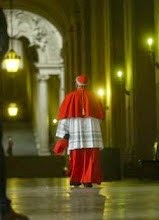
Within 48 hours -- likely early Saturday morning, Eastern time -- the (figurative) Black Smoke will rise from Borgo Santo Spirito with news that the 30th Superior-General of the Jesuits has been elected, and a scene like the above will ensue from the 217 electors.

With the 96 hours of murmuratio half-past and all quiet at the Jesuit Curia, made public this morning was a message sent to the General Congregation by B16 earlier this week, in which the pontiff underscored the Jesuits' mission of especial obedience to the Pope and offered his wish that the GC would reaffirm strongly the community's "total adhesion to Catholic doctrine, in particular on those neuralgic points which today are strongly attacked by secular culture, as for example the relationship between Christ and religions; some aspects of the theology of liberation; and various points of sexual morality, especially as regards the indissolubility of marriage and the pastoral care of homosexual persons."

Dated 10 January and addressed to the General-emeritus Peter-Hans Kolvenbach, the letter provides no small amount of reinforcement to the opening message given the body by the prefect of the "Congregation for Religious" Cardinal Franc Rode CM four days earlier.

Fulltext:
On the occasion of the 35th General Congregation of the Society of Jesus, it is my fervent desire to extend to you and to all those taking part in the Assembly my most cordial greetings, together with an assurance of my affection and of my constant spiritual nearness to you. I know how important for the life of the Society is this event which you are celebrating, and I further know that, consequently, it has been prepared with great care. This is a providential occasion for impressing upon the Society of Jesus that renewed ascetic and apostolic impulse which is wished by all, so that Jesuits might fulfill completely their mission and confront the challenges of the modern world with that faith to Christ and to the Church which distinguished the prophetic action of Saint Ignatius of Loyola and his first companions.

The Apostle writes to the faithful of Thessalonica of having announced to them the gospel of God, “encouraging you and imploring you” — Paul specifies — “to comport yourselves in a manner worthy of God who calls you to his kingdom and to his glory” (1 Th. 2:12), and he adds: “Indeed on account of this we continually thank God because, having received the divine word preached by us, you welcomed it not as the word of men, but as it truly is, as the word of God, which works in you who believe” (1 Th. 2:13). The word of God therefore is first “received”, i.e., heard, and then — penetrating all the way to the heart — it is “welcomed”, and who receives it recognizes that God speaks through the agent sent to deliver it: in this way the word acts in believers. As then, so even today evangelization demands a total and faithful adhesion to the word of God: adhesion first of all to Christ and to attentive listening to his Spirit which guides the Church; humble obedience to the Pastors whom God has placed to guide his people; and prudent and frank dialogue with the social, cultural, and religious appeals of our time. All this presupposes, as we know, an intimate communion with Him who calls us to be friends and disciples, a unity of life and of action which is fed by listening to his word, by contemplation and by prayer, by detachment from the mentality of the world and by unceasing conversion toward his love so that it may be He, the Christ, who lives and works in each of us. Here is the secret of authentic success for the apostolic and missionary commitment of every Christian, and even more of all those called to a more direct service of the Gospel.

Such an awareness is certainly well present among those taking part in the General Congregation, and I am eager to honor the great work already completed by the preparatory commission which in the course of 2007 has examined the postulates sent by Provinces and indicated the themes to be faced. I would like to direct my thoughts of gratitude in the first place to you, dear and venerated Father Superior General, who since 1983 has guided the Society of Jesus in an enlightened, wise, and prudent manner, seeking in every way to maintain it in the channel of its founding charism. For objective reasons, you have at various times asked to be relieved of so heavy a post, assumed with a great sense of responsibility at a moment in your Order’s history which was not easy. I express to you my most heartfelt gratitude for the service you have rendered to the Society of Jesus and, more generally, to the Church. My sentiments of gratitude extend to your closest collaborators, to the participants of the General Congregation, and to all Jesuits scattered in every part of the world. To all and to each should arrive this greeting from the Successor of Peter, who follows with affection and esteem the multiple and appreciated apostolic works of the Jesuits, and who encourages all to continue in the path opened by your holy Founder and walked by innumerable hosts of your brothers dedicated to the cause of Christ, many of whom are inscribed by the Church among its saints and blessed. From heaven, may they protect and sustain the Society of Jesus in the mission which it carries out in this our current age, marked by numerous and complex social, cultural, and religious challenges.

Indeed regarding this theme, how can one not recognize the valid contribution which the Society offers to the Church’s activity in various fields and in many ways? Truly a great and meritorious contribution, one which only the Lord will be able to rightly reward! As did my venerated Predecessors, the Servants of God Paul VI and John Paul II, I too gladly wish to take this opportunity of a General Congregation to bring such a contribution to light and, at the same time, to offer for your common reflection some considerations which might be of encouragement for you and a stimulus to implement ever better the ideal of the Society, in full fidelity to the Magisterium of the Church, such as described in the following formula which is well familiar to you: “To serve as a soldier of God beneath the banner of the Cross and to serve the Lord alone and the Church, his spouse, under the Roman Pontiff, the Vicar of Christ on earth” (Apostolic Letter Exposcit debitum, 21 July 1550). One treats here of a “peculiar” fidelity confirmed also, by not a few among you, in a vow of immediate obedience to the Successor of Peter “perinde ac cadaver”. The Church has even more need today of this fidelity of yours, which constitutes a distinctive sign of your Order, in this era which warns of the urgency of transmitting in an integral manner to our contemporaries — distracted by many discordant voices — the unique and immutable message of salvation which is the Gospel, “not as the word of men, but as it truly is, as the word of God”, which works in those who believe.

That this might come to pass, it is indispensable — as earlier the beloved John Paul II reminded participants of the 34th General Congregation — that the life of the members of the Society of Jesus, as also their doctrinal research, be always animated by a true spirit of faith and communion in “humble fidelity to the teachings of the Magisterium” (Insegnamenti, vol. I, pp. 25-32). I heartily hope that the present Congregation affirms with clarity the authentic charism of the Founder so as to encourage all Jesuits to promote true and healthy Catholic doctrine. As Prefect of the Congregation for the Doctrine of the Faith, I had the opportunity to appreciate the valid collaboration of Jesuit Consultors and experts, who, in full fidelity to their charism, contributed in a considerable way to the faithful promotion and reception of the Magisterium. Certainly this is not a simple undertaking, especially when called to announce the Gospel in very different social and cultural contexts and when having to deal with different mentalities. I therefore sincerely appreciate such labor placed at the service of Christ, labor which is fruitful for the true good of souls in the measure in which one lets oneself be guided by the Spirit, remaining humble as regard the teachings of the Magisterium, having reference to those key principles of the ecclesial vocation of the theologian which are delineated in the Instruction Donum veritatis.

The evangelizing work of the Church very much counts on the formative responsibility which the Society has in the areas of theology, of spirituality, and of mission. And, really so as to offer the entire Society of Jesus a clear orientation which might be a support for generous and faithful apostolic dedication, it could prove extremely useful that the General Congregation reaffirm, in the spirit of Saint Ignatius, its own total adhesion to Catholic doctrine, in particular on those neuralgic points which today are strongly attacked by secular culture, as for example the relationship between Christ and religions; some aspects of the theology of liberation; and various points of sexual morality, especially as regards the indissolubility of marriage and the pastoral care of homosexual persons.

Reverend and dear Father, I am convinced that the Society senses the historic importance of this General Congregation and, guided by the Holy Spirit, wants once again — as the beloved John Paul II said in January 1995 — to reaffirm “unequivocally and without any hesitation its specific way to God, which St. Ignatius sketched in the Formula Instituti: loving fidelity to your charism will be the certain source of renewed effectiveness” (Insegnamenti, vol. XVIII/1, 1995, p. 26). Furthermore, the words my venerated Predecessor Paul VI directed to the Society in another analogous circumstance appear so very current: “All of us must be vigilant so that the necessary adaptation will not be accomplished to the detriment of the fundamental identity or essential character of the role of the Jesuit as is described in the Formula Instituti as the history and particular spirituality of the Order propose it, and as the authentic interpretation of the very needs of the times seem still to require it. This image must not be altered; it must not be distorted.” (Insegnamenti, vol. XII, 1974, pp. 1181-1182)

The continuity of the teachings of the Successors of Peter stands to demonstrate the great attention and care which they show toward the Jesuits, their esteem for you, and the desire to be able to count always on the precious contribution of the Society to the life of the Church and to the evangelization of the world. I entrust the General Congregation and the entire Society of Jesus to the intercession of your holy Founder and the saints of your Order, and to the maternal protection of Mary, so that every spiritual son of Saint Ignatius might be able to keep before his eyes “first of all God and then the nature of this his Institute” (Formula Instituti, 1). With such sentiments, I assure you of a constant remembrance in prayer and in a heartfelt way I impart to you, Reverend Father, and to the Fathers of the General Congregation and to the entire Society of Jesus, a special Apostolic Blessing.

From the Vatican, 10 January 2008

BENEDICTUS PP. XVI
Come Saturday, Election Day will proceed as follows (all times Rome):
The day will begin at 8:00 with the concelebrated Mass at the Church of the Holy Spirit which is across the Curia. At 9:30 the electors will convene in the aula, recite the Veni Creator Spiritus, listen to an exhortation by Father Jacques Gellard, Assistant ad providentiam, and continue in personal prayer for the rest of an hour.

As prescribed by the Formula, each elector writes in his own hand, on the ballot he has received, the name of the one whom he chooses to be Superior General. After the ballots have been completed, Father Peter-Hans Kolvenbach, the Secretary of the Congregation, Father Orlando Torres and his Assistant, Father Ignacio Echarte swear to God and in the presence of the electors to perform faithfully the duties of receiving and making public the votes. The votes are then collected and counted. The one who receives a simple majority of 109 votes is considered elected. The name of the one elected is immediately communicated to the Holy Father.

The Secretary of the Congregation handwrites the Decretum of election which is signed by Father Kolvenbach. Father Kolvenbach reads the Decretum in Latin: Ego Peter-Hans Kolvenbach S.J., auctoritate Sedis Apostolicae et universae Societatis, Reverendum Patrem N…declaro electum in Praepositum Generalem Societatis Jesu, in nomine Patris et Filii et Spiritus Sancti. (“I declare Father N…elected as General of the Society of Jesus, in the name of the Father and of the Son and of the Holy Spirit”). The newly elected General turns to the crucifix which has been placed in the center of the aula, and makes his profession of faith: I, N… firmly believe all and each of the truths contained in the Symbol of the faith. And proceeds to read the Creed.

At this point, all the electors, beginning with Father Kolvenbach, the Secretary and his Assistant, come forward to greet the new Superior General. When all the electors have greeted the new General the doors of the aula are opened and the Curia community greets Father General. The election ends with a procession to the chapel for a short prayer of thanksgiving.
On Sunday afternoon, the new Father-General will offer a Mass of Thanksgiving in the Gesu Church.
A few minutes before the Mass, the newly elected Superior General, accompanied by four electors and a deacon, will enter the rooms of Saint Ignatius (camerette). In the place where Father Ignatius wrote the Constitutions, the group will pause for a moment of silent prayer. The deacon will proclaim the following passage from the Gospel of Saint Mathew (Mt. 2: 8-12): You must not be called “teacher” for you are all brothers and have only one Teacher, […] Nor should be called “leader” because your one and only leader is the Messiah. The greatest among you must be your servant. […].

The most senior member of the electors will turn to Father General and remind him of the kind of person Part IX of [the Jesuit] Constitutions says the Superior General ought to be. In the rooms where Saint Ignatius wrote these words, they will hold an especially poignant meaning.
And, lastly, the opening prayer for Election Morning's Mass of the Holy Spirit reads thus:
O God, Creator and Lord,
in your almighty Wisdom and goodness
you guide and uphold this least Society,
to undertake that which you have deigned us to commence:
enlighten, we beseech you, with the light of your Spirit,
those who have the responsibility of choosing a leader
to guide us in this way that leads to you,
and preserve in unity and love
this apostolic body which you have called to your service,
under the standard of the cross.
We ask this through Jesus Christ your only Son our Lord,
who lives and reigns with you and the Holy Spirit, one God for ever and ever.
PHOTO: Don Doll SJ

-30-

Tuesday, January 08, 2008

"Black Conclave" Update

Shortly after yesterday's candid message from the papal legate to its opening, the first working session of GC35 was held in the Aula of the Jesuit Curia. As the body doled out its initial round of appointments, the front rank of the generabili were much in evidence.

It'll be another ten days or so before one of the 226 delegates emerges as the 29th successor of Ignatius Loyola and new "Black Pope," but after the outgoing Father-General Peter-Hans Kolvenbach relinquished the chair, the representatives of the church's largest religious community placed two potential candidates at the center of the spotlight. The Puerto Rican Orlando Torres -- a Kolvenbach favorite currently running the Society's formation desk -- was elected to preside over the assembly until the election, with Basque Fr Ignacio Echarte, head of the Jesuit houses in Rome, chosen as his deputy.

Two committees were also established. The first, compiled by seniority, keeps watch to ensure that no Jesuit has "aspired to the office of General." Representing Western Europe, Kolvenbach -- the region's senior delegate -- is among its ten members, as is the longest-tenured US delegate, Fr Vincent Cooke, the president of Canisius College in Buffalo and the Spanish provincial Elias Royon, cited as a possible "compromise candidate" for the top post.

The second committee, charged with preparing the De statu Societatis report on the "State of the Society," includes several of the oft-mentioned, including Royon (the only Jesuit to serve on both of the sub-groups), the rector of Mexico City's Iberoamericana University (and former global head of formation) Jose "Pepe" Morales, and the European super-provincial Mark Rotsaert.

After a week of preparing the report that'll form the "job description" for the new General, the body will move to the four-day period of the formal murmuratio; the Society's chief spokesman, Fr Jose DeVera, said last week that the election is expected to take place on or about 19 January.

Conspicuously absent from the first-day mix was the Australian provincial Mark Raper. Once the Rome-based head of Jesuit Refugee Services, Raper -- along with Morales and Torres, among others -- was a mainstay among the most-mentioned names even before the congregation was convoked in early 2006, and has since remained among the widely cited.

While, in the run-up to the GC, his "maverick" tendencies had been viewed in some Jesuit quarters as too provocative given the sensitivity of the Society's relations with the Holy See, yesterday's public rebuke from the Vatican's "prefect of Religious" Cardinal Franc Rode CM just might've given new life to a mindset that sees the electors responding in kind.

Unlike the conclave that yields a "white" Pope, the Jesuit chosen as Father-General is not asked whether he accepts the post. As the choice comes from the community's supreme authority -- the congregation -- it is considered a mission under obedience and cannot be declined.

-30-

Monday, January 07, 2008

In Charism and Tradition

Following is the fulltext homily of the papal legate Cardinal Franc Rode CM, prefect of the Congregation for Institutes of Consecrated Life and Societies of Apostolic Life, given at the opening of GC35 earlier today in Rome

* * *

Dear Members of the XXXV General Congregation of the Society of Jesus,

St Ignatius considered the General Congregation “work and a distraction” (Const. 677) which momentarily interrupts the apostolic commitments of a large number of qualified members of the Society of Jesus and for this reason, clearly differing from what is customary in other religious Institutes, the Constitutions establish that it should be celebrated at determined times and not too often.

Nevertheless, it must be called principally on two occasions: for the election of the Superior General and when things of particular importance or very difficult problems which touch the body of the Society must be treated.

This is the second time in the history of the Society wherein a General Congregation gathers to elect a new Superior General while his predecessor is still living. The first time was in 1983, when the XXXIII General Congregation accepted the resignation of the much loved Fr. Arrupe, for whom the exercising of the role of governance had become impossible, due to a serious and unforeseen illness. Today it gathers a second time, to discern, before the Lord, the resignation presented by Fr. Kolvenbach, who has directed the Society for nearly twenty-five years with wisdom, prudence, commitment and loyalty. This will be followed by the election of his successor. I wish to express to you, Fr. Kolvenbach, in my name and in the name of the Church, a heartfelt thanks for your fidelity, your wisdom, your righteousness and your example of humility and poverty, Thank you Fr. Kolvenbach.

The election of a new Superior General of the Society of Jesus has a fundamental value for the life of the Society, not only because its centralized hierarchical structure constitutionally concedes to the General full authority for good governance, the conservation and growth of the whole Society, but also because as Saint Ignatius says so well, “the wellbeing of the head resounds throughout the whole body and as are the Superiors so in turn will their subjects be.” (cf. Const 820) For this reason your founder when pointing out the qualities which the general must have places first of all that he must be” a man very united to the Lord our God and familiar with prayer” (Const 723). After having mentioned other important qualities which are not easily found in a single person, he ends by saying “if any of the above qualities should be missing, at least may he not lack much goodness, love for the Society and good judgment” (Const 735).

I join you in your prayer that the Holy Spirit, the father of the poor, giver of graces, and light for hearts will assist you in your discernment and your election.

This Congregation also gathers together to treat important and very difficult matters which touch all members of the Society, such as the direction which the Society is presently taking. The themes upon which the General Congregation will reflect have to do with basic elements for the life of the Society. Certainly you will deal with the identity of today’s Jesuit, on the meaning and value of the vow of obedience to the Holy Father which has always defined your religious family, the mission of the Society in the context of globalization and marginalization, community life, apostolic obedience, vocation recruitment and other important themes.

Within your charism and your tradition you can find valuable points of reference to enlighten the choices which the Society must make today.

Certainly and necessarily, during this Congregation you are carrying out an important work but it is not a “distraction” from your apostolic activity. As St Ignatius teaches you in the Spiritual Exercises you must with the same vision of the three Divine Persons, look at “the entire surface of the earth crammed with men” (n 102) Listening to the Spirit, the creator who renews the world and returning to the fonts to preserve your identity without losing your own lifestyle, the commitment to discern the signs of the times, the difficulty and responsibility of working out final decisions are activities which are eminently apostolic because they form the base of a new springtime of being religious and of the apostolic commitment of each of your brothers in the Society of Jesus.

Now the vision becomes broader. It is not only for your own Jesuit brothers that you provide a religious and apostolic formation. There are many institutes of Consecrated Life who, following an Ignatian spirituality, pay attention to your choices; there are many future priests in your Colleges and Universities who are preparing for their ministry. There are many peoples from both within and outside the Church who frequent your centers of learning seeking a response to the challenges which science, technology and globalization pose to humanity, to the Church, and to the faith, with the hope of receiving a formation which will make it possible for them to construct a world of truth and freedom, of justice and peace.

Your work must be eminently apostolic with a universal human, ecclesial and evangelical fullness. It must always be carried out in the light of your Charism, in such a way that the growing participation of laity in your activities does not obscure your identity but rather enriches it with the collaboration of those who, coming from other cultures, share your style and your objectives.

Once again I join in your prayer that the Holy Spirit may accompany you in your delicate work.

As a brother who is following your works with great interest and expectation, I want to share with you “the joys and hopes” (GS. 1) as well as “the sorrows and anguish” (GS. 1) which I have as a man of the Church called to exercise a difficult service in the field of Consecrated Life, in my role as Prefect of the Congregation for Institutes of Consecrated Life and Societies of Apostolic Life.

With pleasure and hope I see the thousands of religious who generously respond to the Lord’s call and, leaving all they have behind consecrate themselves with an undivided hear to the Lord to be with him and to collaborate with him, in his salvific desire to “conquer all things and thus enter unto the Glory of the Father” (Spiritual Exercises, 95). It is clear that consecrated life continues to be a “divine gift which the Church has received from the Lord” (LG 43) and it is for this very reason that the Church wants to carefully watch over it in order that that the proper Charism of each Institute might be evermore known, and, although with the necessary adaptations to respond to the present time, it keeps its proper identity intact for the good of the whole Church. The authenticity of religious life is characterized by the following of Christ and by the exclusive consecration to Him and to his Kingdom through the profession of the evangelical counsels. The Second Vatican Ecumenical Council teaches that “this consecration will be the more perfect, in as much as the indissoluble bond of the union of Christ and His bride, the Church, is represented by firm and more stable bonds” (LG 44) Consecration to service to Christ cannot be separated from consecration to service to the Church. Ignatius and his first companions considered it thus when they wrote the Formula of your Institute in which the essence of your charism is spelled out: “To serve the Lord and his Spouse the Church under the Roman Pontiff” (Julio III, Formula I). It is with sorrow and anxiety that I see that the sentire cum ecclesia of which your founder frequently spoke is diminishing even in some members of religious families. The Church is waiting for a light from you to restore the sensus Ecclesiae. The Spiritual Exercises of St Ignatius are your specialty. The rules of sentire cum Ecclesiae form an integral and essential part of this masterpiece of Catholic spirituality. They form, as it were, a golden clasp which holds the book of The Spiritual Exercises closed.

You hold in your very hands the elements needed to realize and to deepen this desire, this Ignatian and Ecclesial sentiment.

Love for the Church in every sense of the word, – be it Church people of God be it hierarchical Church – is not a human sentiment which comes and goes according to the people who make it up or according to our conformity with the dispositions emanating from those whom the Lord has placed to direct the Church. Love for the Church is a love based on faith, a gift of the Lord which, precisely because he loves us, he gives us faith in him and in his Spouse, which is the Church. Without the gift of faith in the Church there can be no love for the Church.

I join in your prayer asking the Lord to grant you the grace to grow in your belief in and love for this holy, catholic and apostolic Church which we profess.

With sadness and anxiety I also see a growing distancing from the Hierarchy. The Ignatian spirituality of apostolic service “under the Roman Pontiff” does not allow for this separation. In the Constitutions which he left you, Ignatius wanted to truly shape your mind and in the book of the Exercises (n 353) he wrote” we must always keep our mind prepared and quick to obey the true Spouse of Christ and our Holy Mother, the Hierarchical Church”. Religious obedience can be understood only as obedience in love. The fundamental nucleus of Ignatian spirituality consists in uniting the love for God with love for the hierarchical Church. Your XXXIII Congregation once again took up this characteristic of obedience declaring that “the Society reaffirms in a spirit of faith the traditional bond of love and of service which unites it to the Roman Pontiff” You once again took up this principle in the motto “In all things love and serve”.

You must also place this XXXV General Congregation, which opens with this liturgy, celebrated close to the remains of your founder in this line, which has always been followed by the Society throughout its multi-century history in order to show your desire and your commitment to be faithful to the charism which he left you as an inheritance and to carry it out in ways which better respond to the needs of the Church in our time.

The service of the Society is a service “under the banner of the Cross” (Formula I). Every service done out of love necessarily implies a self-emptying, a kenosis. But letting go of what one wants to do in order to do what the beloved wants is to transform the kenosis into the image of Christ who learned obedience through suffering (Hebrews 5, 8). It is for this reason that St. Ignatius, realistically, adds that the Jesuit serves the Church “under the banner of the Cross” (Formula I).

Ignatius placed himself under the orders of the Roman Pontiff “in order to not err in via Domini” (Const 605) in the distribution of his religious throughout the world and to be present wherever the needs of the Church were greater.

Times have changed and the Church must today confront new and urgent necessities, I will mention one, which in my judgment is urgent today and is at the same time complex and I propose it for your consideration. It is the need to present to the faithful and to the world the authentic truth revealed in Scripture and Tradition. The doctrinal diversity of those who at all levels, by vocation and mission are called to announce the Kingdom of truth and love, disorients the faithful and leads to a relativism without limits. There is one truth, even though it can always be more deeply known.

It is the “living teaching office of the Church, whose authority is exercised in the name of Jesus Christ” (DV 10) which is the voucher for revealed truth. The exegetes and theological scholars are involved in working together “under the watchful care of the sacred teaching office of the Church, to an exploration and exposition of the divine writings (DV 23). Through your long and solid formation, your centers of research, your teaching in the philosophical-theological-biblical fields you are in a privileged position to carry out this difficult mission. Carry it out with study and in-depth examination, carry it out with humility, carry it out with faith in the Church. carry it out with love for the Church.

May those who, according to your legislation, have to oversee the doctrine of your magazines and publications do so in the light of and according to the “rules for sentire cum ecclesia”, with love and respect.

The feeling of ever growing separation between faith and culture, a separation which constitutes a great impediment for Evangelization (Sapientia Cristiana, proemio) also worries me.

A culture immersed with a true Christian spirit is an instrument which fosters the spreading of the Gospel, faith in God the Creator of the heavens and of the earth. The Tradition of the Society, from the first beginnings of the Collegio Romano always placed itself at the crossroads between Church and society, between faith and culture, between religion and secularism. Recover these avant-garde positions which are so necessary to transmit the eternal truth to today’s world, in today’s language. Do not abandon this challenge. We know the task is difficult, uncomfortable and risky, and at times little appreciated and even misunderstood, but it is a necessary task for the Church. The apostolic tasks demanded of you by the Church are many and very diverse, but all have a common denominator: the instrument which carries them out, according to an Ignatian phrase must be an instrument united to God. It is the Ignatian echo to the Gospel proclaimed today: I am the vine, you are the branches. He who remains in me and I in him will bear much fruit (Jn.15, 15). Union with the vine, which is love, is realized only through a personal and silent exchange of love which is born in prayer, “from the internal knowledge of the Lord who became man for me and who, integral and alive, extends himself to all who are close to us and to all that is close to us”. It is not possible to transform the world, or to respond to the challenges of a world which has forgotten love, without being firmly rooted in love.

Ignatius was granted the mystic grace of being “a contemplative in action”(annotation to the Examine MNAD 5, 172). It was a special grace freely given by God to Ignatius who had trodden a tiring path of fidelity and long hours of prayer in the Retreat at Manresa. It is a grace which, according to Fr. Nadal, is contained in the call of every Jesuit. Guided by your Ignatian magis keep your hearts open to receive the same gift, following in the same path trodden by Ignatius from Loyola to Rome, a path of generosity, of penance, of discernment, of prayer, of apostolic zeal of obedience, of charity, of fidelity to and love for the hierarchical Church.

Despite the urgent apostolic needs, maintain and develop your charism to the point of being and showing yourselves to the world as “contemplatives in action” who communicate to men and women and to all of creation the love received from God and to orient them once again toward the love of God. Everyone understands the language of love.

The Lord has chosen you to go and bear fruit, fruit that lasts. Go, bear fruit confident that “all that you ask the Father in my name, he will give you (cfr. Jn 15, 16).

I join with you in prayer to the Father through the Son and in the Holy Spirit together with Mary, Mother of Divine Grace, invoked by all the members of the Society as Santa Maria della Strada, that he may grant you the grace of “seeking and discovering the will of God for the Society of today which will build the Society of tomorrow”.

-30-

Thursday, January 10, 2008

Ratzinger's Revolutionary-in-Chief

"Benedetto è il Papa, ma Bertone è il Sommo Pontefice" -- "Benedict is the Pope, but Bertone is the Supreme Pontiff."

That's the word from Rome these days as Cardinal Tarcisio Bertone keeps consolidating the sort of all-powerful brief his recent predecessors as Secretary of State could only dream of.

Every pontificate has one figure of overarching influence: John Paul II had his private secretary of four decades, now-Cardinal Stanislaw Dziwisz; Paul VI's über-aide was his Sostituto, Giovanni Benelli, who was rewarded shortly before his master's death with the archbishopric of Florence and -- at a "snap" consistory called with the prime intent of ensuring his presence in the next conclave -- the red hat. (In a historic irony, while Benelli died prematurely at 61 five years later, one of the other three cardinals created with him was the freshly-ordained archbishop of Munich and Freising, Joseph Ratzinger.)

For all these, it's been seven decades since the official who's job is being the Pope's chief lieutenant has actually been that, the last instance being Cardinal Eugenio Pacelli, who succeeded Pope Pius XI after serving as his predecessor's voice, eyes, ears and, thanks to his unprecedented global travel, his unchallenged messenger at home and abroad.

Almost 81, Benedict XVI "realizes he doesn't have the energy to do everything," as one curial hand put it. While the pontiff has devoted much of his time to teaching -- writing his catecheses, letters and homilies, to say nothing of the books -- he's reserved the appointment of bishops and, to a lesser extent, questions of liturgy as his prime ad intra pursuits. The rest is largely left to Bertone, the 73 year-old Salesian who served as Cardinal Ratzinger's #2 at the Congregation for the Doctrine of the Faith (where the former is still said to keep a more-than-gentle hand) before being named archbishop of Genoa in 2002 and a cardinal the following year.

Returning to his boss' side in 2006 as the Vatican's "prime minister" and chief diplomat, the football/soccer enthusiast with no diplomatic training and a penchant for blunt talk has since carved himself a purview including facets as the pontiff's chief spokesman, loyalty enforcer, administrative delegate and, most crucially, reinventor of the Roman Curia in his own image.

Sixteen months on, the ripple-effects of the "Vice-Pope" have only increased with time, and exponentially at that.

Among other aspects, an unprecedented flood of Salesians have been called to the episcopacy from the community's ranks, the Vatican offices have become more Italianized (with international veterans said to be "feeling the chill"), his Genoa secretary and MC Guido Marini has been brought in to implement the "restoration" of papal liturgy, and after Monday's strong message to the opening of their General Congregation, one attuned Jesuit remarked that Cardinal Franc Rode's homily bore "all the fingerprints" of the Secretary of State. As concerns these shores, Bertone's credited (or blamed) with successfully persuading Benedict that the initially-planned Boston stop on his first US visit in mid-April would unwisely make the sex-abuse crisis the frame of the entire six-day trip, and it's said that his leanings have already been made known on the Stateside church's Big Story of 2008: the appointment of a new archbishop of New York.

Given the perceived resistance within the Curial ranks from loyalists of his predecessor, Cardinal Angelo Sodano -- who, after retiring, delayed his departure from the Secretary's traditional apartment in the Apostolic Palace, leaving Bertone consigned for months to St John's Tower in the Vatican Gardens -- Bertone chose a week in November to send two unmistakable signals, exiling Sodano's "favorite son" from the diplomatic corps and announcing plans for a first-ever system of "merit-based" (read: loyalty-based) pay for Curial employees.

That week in November just happened to coincide with Sodano's 80th birthday.

Made Camerlengo by Benedict last April (and thus responsible for the affairs of the Holy See in the event of its vacancy), circles close to the papal apartment have spoken to a sense that Bertone isn't just being given the broad portfolio to carry it out for the reigning Pope, but with a thought that, like Pacelli before him, the deputy is being "groomed" to ascend even further.

In the new edition of The Tablet, Robert Mickens explores the Revolution and its leader:
Now in his seventeenth month in the post, the northern Italian cardinal has not only had to deal with the usual diplomatic controversies that come with the territory, but he has also had to cope with negative news reports that he himself has often generated. These have mainly resulted from his own personal penchant for frequently "issuing statements" in informal press scrums only to chide reporters later for quoting him "out of context". Thus he routinely has accused the "secularist" media for waging an "orchestrated campaign" to discredit, embarrass and attack the Catholic Church. This, in turn, has helped feed a growing victim mentality among many Catholics, especially in Italy.

But Cardinal Bertone's biggest obstacles are not from the outside world. Rather, they are found among certain segments of the Roman Curia where a wall of passive-aggressive opposition to him was already forming in the weeks when his appointment as Secretary of State was still just a rumour.

The curial "obstructionists" and other critics are still convinced that the cardinal lacks essential qualifications for such an internationally important job. Some of them quietly bristle at his lack of experience as a papal diplomat; for example, he was not groomed at the prestigious Accademia Ecclesiastica, as were they and most of the cardinal's predecessors of the past 300 years. Some point to what they call the cardinal's unspectacular academic career; one of his former confrères claims that professors at the Rome-based Salesian University awarded the then-Fr Bertone (also a professor at the time) his canon law doctorate behind closed doors, rather than requiring him to defend his thesis in the more customary setting of a "public defence". And still others consider the Secretary of State's cultural background as far too limited for his post; he has only ever lived in Italy and, while he claims familiarity with several foreign languages (but not English), he is not known to speak any of them with proficiency....

The Pope probably has few genuine and long-time admirers or supporters more eager to serve him than the strapping Salesian cardinal. During nearly eight years (1995-2003) as secretary of the Congregation for the Doctrine of the Faith (CDF), the then-Archbishop Bertone proved his worth. It is well known that he did much of the so-called "heavy lifting" for the prefect at the time - Cardinal Joseph Ratzinger. And evidently the then future Pope never forgot it. As Benedict XVI approaches the third anniversary of his pontificate, it appears increasingly more plausible that he may have picked Cardinal Bertone as his Secretary of State for the very reasons the curial "obstructionists" have opposed him.

In choosing an Accademia "outsider", the Pope was perhaps hoping for a right-hand man that would help him rid the Roman Curia of "church bureaucrats" and bring in new personnel more in line with his own theological and ecclesiological thinking. And while few people are under the illusion that the cardinal alone is making the major personnel decisions, his influence on the Pope cannot be discounted. How else does one explain the ever-increasing Italian population in the middle and upper ranks of the Curia? Or the fact that Italian continues to become more and more the only accepted language in what the Second Vatican Council hoped would be a fully "internationalised" papal curia?

Cardinal Bertone's view on this is conditioned by the fact that he is a Salesian. "I am and remain a priest of Don Bosco," he never tires of repeating. Although now present all over the world, the Salesians are undoubtedly the "most Italian" of all the major religious orders in the Church - even more so than the Franciscans. And having an especially outgoing Salesian as his top aide adds extra punch to the more cerebral Pope Benedict's main cultural project; namely, strengthening the Catholic Church's influence in Italy and, even more importantly, reawakening the Christian identity of Europe....

Cardinal Bertone has tried to emulate some of the style of Pacelli, the future Pius XII. Despite the enormous intellectual, diplomatic and temperamental differences between the two churchmen, the current Secretary of State has been playing a ubiquitous public role in the past few months in much the same way his predecessor did in the 1930s. He has carried out high-profile and much-publicised travels throughout Eastern and Western Europe. He went to Peru last summer on a scheduled visit that happened to coincide with post-earthquake clean-up efforts. And he was the keynote speaker at a Knights of Columbus convention in the United States, despite not speaking English. He has spoken at universities, business clubs, the annual gathering of Communion and Liberation, and just about any other event that his schedule permits.

He says: "In response to the critics I have to say that from the beginning of my academic activities I have never wanted to close myself in an office to study papers." He adds that even people who hold "the highest and most important roles" in the Church should be out "meeting the people".

This populist touch has won him praise from many people - certainly at the beginning of his appointment. And it has marked a major change from his most recent predecessor, Cardinal Angelo Sodano, who was seen (perhaps unfairly) as a grey Vatican statesman, formal and distant from ordinary people. Most curial officials from the Sodano school of thought - and there are many - are not comfortable with their current boss' activism and are more convinced than ever that the Holy See's diplomatic work is most effective when it is done meticulously and without attracting headlines.
As mentioned above, on his first US visit last year, Bertone served as papal legate to the 125th Supreme Convention of the Knights of Columbus.

With an intended audience of the entire church in the United States, his keynote address to the Nashville gathering is arguably the most authoritative preview you'll find to April's papal visit, lest anyone hasn't yet read it.

In a press conference during the trip, he also gave his blessing to the burgeoning community of the Nashville Dominicans, calling the "incredibly young" sisters "very beautiful and very intelligent," also hailing Secretary of State Condoleeza Rice's work for peace as being "accompanied by the angels."

The "Vice-Pope" then lashed out at "the business created around" the sex abuse scandals, terming it "really unbearable" and praising the US church for "fac[ing] this trial with dignity and courage."

-30-

Monday, January 14, 2008

Ladies and Jesuits, the General Has Left the Borgo

"And thus, the 24 year, four-month ministry of focused and single-minded care for and stewardship of the universal Society of Jesus by Father Kolvenbach has come to an end."

With those words, the Jesuit Curia announced earlier today that Father-General had officially resigned.

After Peter-Hans Kolvenbach presented his unprecedented resignation to the General Congregation and its 225 delegates voted to accept it, the diplomatic Dutchman returned to thank the body "for the elegant way you have found to fire me."

Statement:
Dear Fathers and Brothers,

Today the General Congregation has thought it well to accept my resignation as General Superior of the Society of Jesus. At the end of these nearly 25 years of service, I want first of all to thank the Lord, who - to use the words of Saint Ignatius - has truly been propitious to me at Rome, in leading a Society He has called into service for his greater glory.

I am also most grateful for the privilege of having met and accompanied so many friends in the Lord, who in their many diverse vocations have always shown themselves to be true servants of the Mission of Christ.

No single Jesuit should feel himself excluded from this profound sentiment of recognition. Nonetheless I would like to thank in a particular way those in the General Curia who have helped me day after day over many years in carrying out my responsibilities for the Society, as well as all the Major Superiors spread throughout the entire world.

Earlier I was able to express my great thanks to the Holy Father for his apostolic orientations which have allowed the Society to continue our mission "under the banner of the cross and under the Vicar of Christ on earth".

Let us be grateful to the Lord that despite a disconcerting diversity of persons and cultures, of desires and works, our union of minds and hearts has never failed, and, despite an increasing fragility, the Society retains the capacity of apostolic dialogue before the challenges of the modern world in proclaiming the one Good News.

On this eve of the election of my successor and of the many decisions that the General Congregation will have to make, I unite myself with the prayer with which Saint Ignatius finished his letters: "May God our Lord in his infinite and supreme goodness be pleased to give us his abundant grace, so that we may know his most holy will and entirely fulfill it."
Addressing the General-emeritus on behalf of the Society, Kolvenbach's top aide for Latin America Fr Valentin Menendez thanked him for showing "an example... very different from what commonly is found in a world characterized by the clinging to, and fighting for, positions of power and prestige.

"Our charism and legislation are not good merely because they propose beautiful ideals," Menendez said, "but precisely because there are people who know how to embody and live them." In his remarks, the curial counselor made sure to remind the brethren of "the difficult 1981 Pontifical intervention," while noting that Cardinal Franc Rode's blunt opening message last week constituted "the thinking of the church."

Tomorrow morning, the delegates will move to the traditional four days of murmuratio in preparation for Saturday's election of the new "Black Pope."

Repeat: The Election is Saturday.... Stay tuned.

PHOTO: Don Doll, SJ


-30-

Wednesday, July 12, 2006

Rome Notes

Just because it's summer and Archbishop Milingo's gone Stateside doesn't mean that interesting things aren't happening in the Eternal City....

Filling a post which has been vacant since 1993, Msgr Piero Pioppo will soon be publicly named to the prelature of the Institute for the Works of Religion, better known as the Vatican Bank.

Pioppo, 45, has served from 1999 until the present as private secretary to Cardinal Angelo Sodano, the retiring Secretary of State who leaves office on 15 September. The new IOR chief is the first marked member of a group which can be christened the "Widows of Sodano," who will be revealed to the world over the following weeks and months as the departing Lord of San Damaso works to place his dearest aides in high posts as a reward for their loyalty.... This would lead us to believe that Broglio's on deck, but I digress.

Italian wire reports stated that Pioppo appointment was secured at the behest of Sodano, who serves as head of the cardinalatial commission which oversees the Bank. The post of prelate of the IOR was created in 1990, following the retirement of the Bank's then-President, Archbishop Paul Marcinkus, who died last February. For the following three years, the job was filled by Msgr Donato DeBonis, described as the Chink's "right hand." DeBonis was then named a bishop and moved from the Bank.

Yesterday's appointment of Jesuit Fr Federico Lombardi as director of the Holy See Press Office overshadowed Pope Benedict's latest foray into the episcopal rungs of the Curia, when he named Conventual Franciscan Fr Gianfranco Gardin as Secretary of the Congregation for Religious Life and Societies of Apostolic Life.

(Clearing the record: Admittedly, Monday's post first said "Pontifical Council for Religious Life," etc. All apologies -- I was posting from a hotel bar after a daylong meeting, and the supposedly-new Dell laptop purchased in December was (yet again) giving me severe difficulty. I regret the initial error; given the computer's already-lemony state, it was frustration-induced. Same goes for the confusion over the link to Saint Anthony Messenger -- the American version is not one and the same as the Italian Messaggero di Sant'Antonio, which was edited by Gardin from 1978-88.)

Apparently, word on the ground in Rome is that Gardin was a "compromise candidate" beyond the terna presented -- a compromise in the name of continued peace with the powerful superior of the Brigittine Sisters, Mother Tekla Famiglietti. The three shortlisted names were deemed "hostile" to Tekla, a close ally of Cardinal Crescenzio Sepe, the Vatican lifer recently dispatched to the archdiocese of Naples.

Citing the reality that Gardin's tact and record showed himself to be a more amenable fit, the Religious prefect, Cardinal Franc Rode, CM, appealed to Benedict to go beyond the prepared terna. The Pope acceded to the request.

Oh, and for those whose ears get tickled by the polemics of a certain Curial chief, the news is making the rounds that someone's going to get eclipsed very soon -- not God, but himself.

As always, stay tuned.

-30-

Monday, July 10, 2006

From the Secretaries' Desk....

This morning, the Pope named Conventual Franciscan Fr Gianfranco Gardin as Secretary of the Congregation for Religious Life and Societies of Apostolic Life. Archbishop-elect Gardin succeeds Archbishop Piergiorgio Silvano Nesti, a Passionist, whose resignation was accepted for reasons of age.

The new secretary, who will serve alongside Slovenian Cardinal Franc Rode, a Vincentian, was born at Treviso in 1944. He made his final vows as a Conventual in 1965, was ordained a priest in 1970 and taught moral theology for 15 years at his community's seminary in Padua.

From 1980 to 1998, the archbishop-elect edited the magazine he founded, Credere oggi, whose title translates as "Believing Today." He led the Conventuals as their Minister-General from 1995 to 2001, served as president of the Union of Superiors General from 2000 and since last year served as general director of the Conventual journal, St Anthony Messenger.

For those of you keeping score, Archbishop-elect Gardin is the fifth major Curial appointee of the pontificate of Benedict XVI. To date, the pontiff named Cardinal William Levada to take his place at the Congregation for the Doctrine of the Faith, Cardinal Tarcisio Bertone as his Secretary of State (to take effect on 15 September), Archbishop Malcolm Ranjith as Secretary of the Congregation for Divine Worship and the Discipline of the Sacraments and Cardinal Ivan Dias of Bombay as the incoming Prefect of the Congregation for the Evangelization of Peoples.

Archbishop Michael Miller, the Secretary of the Congregation for Catholic Education, marked his 60th birthday yesterday. E buon compleanno a lui.

But could Miller wind up wearing "red Maple Leaves"? That's what a friend tells me, seemingly implying a move for the Ottawa-born archbishop to Toronto, where Cardinal Aloysius Ambrozic reached the retirement age in January, 2005.

The hitch? Miller's US passport -- he became a naturalized American citizen while serving as president of the University of St Thomas in Houston, in advance of his 2004 appointment to the #2 post at Catholic Ed. Oh, and there's the little matter of the apostolic visitation of Canadian seminaries, which Miller -- renowned for his German diction -- will oversee beginning later this year.

Still, it's interesting spec. Keep an eye.

And lastly, the talk of the weekend in Valencia was on the succession to Joaquin Navarro-Valls as director of the Holy See Press Office. Navarro-Valls implied shortly after Benedict's election that his days in the press post, which he's held for 22 years, were nearing their end at his own wish.

While names of potential portavoci buzzed around since, I always told friends to not be surprised if -- in fact, to expect that -- the post would go, in a first, to a laywoman.

Well, it seems we might just have our winner....

She's well-connected. Even better-travelled. She's already served as a Vatican correspondent. She speaks five languages. Her fidelity to the church and longstanding personal loyalty to Ratzinger is beyond doubt. And, not to be outdone, she would return the Sala Stampa to Italian hands.

If it came to pass, however, it wouldn't be her name written all over the appointment, but that another, that of her "Apostle":

Gloria.... G-L-O-R-I-A.... Gloria.

And, it would be quite the event. Stay tuned.

-30-

Wednesday, February 22, 2006

THE CONSISTORY: The List

Seconds ago, in the setting of the General Audience on this feast of the chair of Peter, Benedict XVI announced that he would hold his first Consistory to create new cardinals on Friday, 24 March. The announcement was met with applause. The Pope called it opportune" to make the announcement on the Feast of Cathedra Petri, "becacuse the cardinals have the charge of sustaining and helping the successor of Peter," and their unique service of the whole church alongside the Pope.

The pontiff announced that he will hold to the fixed limit of 120 cardinals under the age of 80, and therefore able to elect a Pope. That figure was set by Paul VI in 1975, and ignored by John Paul II toward the end of the latter's pontificate.

In order of their placement on the biglietto, the cardinals-designate are:
  • Archbishop William Levada, Archbishop-emeritus of San Francisco, Prefect of the Congregation for the Doctrine of the Faith
  • Archbishop Franc Rode, C.M., Archbishop-emeritus of Ljubljana, Prefect of the Congregation for Institutes of Consecrated Life and Societies of Apostolic Life
  • Archbishop Agostino Vallini, Bishop-emeritus of Albano, Prefect of the Supreme Tribunal of the Apostolic Signatura
  • Archbishop Jorge Liberato Urosa Savino of Caracas
  • Archbishop Gaudencio Rosales of Manila
  • Archbishop Jean-Pierre Ricard of Bordeaux
  • Archbishop Antonio Canizares Llovera of Toledo
  • Archbishop Nicholas Cheong Jin-Suk of Seoul
  • Archbishop Sean O'Malley, O.F.M. Cap. of Boston
  • Archbishop Stanislaw Dziwisz of Krakow
  • Archbishop Carlo Caffara of Bologna
  • Bishop Joseph Zen Ze-kiun, S.D.B of Hong Kong
The Pope announced his intent to elevate three additional clerics who are above voting age to the College of Cardinals, in recognition of their service to the life of the church
  • Archbishop Andrea Cordero Lanza de Montezemolo, Archpriest of St. Paul's Outside the Walls
  • Archbishop-emeritus Peter Proeku Dery of Tamale, Ghana
  • Father Albert Vanhoye, S.J., former secretary of the Pontifical Biblical Commission
And now, if you'll excuse me, it's time to open the champagne. In a month's time, I'm going back to Disney World.

-30-

Friday, February 03, 2006

From the Apartment

In yesterday's Il Foglio, an unsigned piece points to further changes in the papal apartment.

At the New Year, Angelo Gugel, valet to the Popes since time immemorial, retired. He was replaced by "the young" Paolo Gabriele, the father of three young children.

The author couldn't help noting, however, that Gugel's three daughters are in the employ of the Holy See in various capacities -- "Rafaella at the IOR [the Vatican Bank], Carla at the administrative office of the Propaganda Fide, Flaviana at the Central Statistics Office [the good people who compile the Annuario]."

If you find that shocking, then the Italian way must be news to you.

For some reason, Ingrid Stampa also takes a hit. Gabriele's appointment is said to "complete the team of the papal apartment comprised of the personal secretary Georg Ganswein, the second secretary Mieczyslaw ("Mietek") Mokrzycki [a John Paul holdover], the four consecrated laywomen Carmela, Loredana, Emanuela and Cristina [who are members of the Memores Domini, the lay branch of Communione e Liberazione]. Also part of the papal entourage is Birgit Wansing, of the Institute of Schoenstatt, but not the former governess of the apartment of Cardinal Ratzinger, Ingrid Stampa."

As sources of mine have dealt with Ingrid on things household in recent weeks, I have a hard time believing this report to be the case. But it's there, so take it for what it's worth.

The prospective consistory is also mentioned, with Archbishops Levada, Franc Rode [prefect of Religious], Agostino Vallini [prefect of the Apostolic Signatura] and Angelo Comastri [coadjutor archpriest of St. Peter's], said to be in "pole position." Also named are the heads of four traditionally cardinalatial sees: Carlo Caffara of Bologna, Antonio Canizares of Toledo, Jean-Pierre Ricard of Bordeaux and Andre Vingt-Trois of Paris. Also said to be in line, for obvious reasons, are the two Cracovian Stanislaws: Rylko (president of Laity) and Dziwisz, and the German Paul-Josef Cordes, the ghostwriter of the second part of Deus caritas est and president of the Cor Unum.

Lastly, the piece mentions that the memory of our 2005 International Churchman of the Year, Don Luigi Giussani, Founder of Communione e Liberazione, is being remembered yet again this week for another one of the communities he founded, the Sisters of Charity of the Assumption. The superior-general of the order recalled Don Gius' "forty years of incredible humble and grateful friendship."

Par for the CL course. Gotta love 'em.

-30-

Monday, March 03, 2008

Don Bosco's "Kids"

Earlier today, the 26th general chapter of the Salesians opened in Rome with a Mass celebrated by the community's Rector-Major, Fr Pascual Chavez (above, back to camera).

As the 226 delegates touched down in the city over the weekend, Robert Mickens examines the community's clout in the current edition of The Tablet:
Among the characteristics the Salesians say they try to embody are "a welcoming attitude", "optimism and joy", "creativity and flexibility" and a "deep trust in God". They pride themselves on what is called the "preventive system" of education that was devised by Don Bosco and is based "entirely on reason, religion and loving kindness". It is "preventive" in that it "seeks to prevent the need for punishment by placing the child in an environment in which he/she is encouraged to be the best one can be". Salesians will point to the fact that they tend to blend in with the ecclesial customs and style of the places where they work - all in harmony with the local expression of the hierarchical Church. It is all tempered by a "cheerfulness" and what even Don Bosco approvingly called a "recklessness" - anything whose aims were "to gain souls for God".

If you thumb through the Annuario Pontificio, the Vatican's block-like 2,400-page directory, you will see that nearly every major section of the Roman Curia has at least one or two officials, staffers or consultants with "SDB" or "FMA" after their names. And most of those in top positions owe their promotion to the current Pope.

For example, the Secretary of State is not the only Salesian cardinal to head a Vatican office. Pope Benedict made Don Raffaele Farina SDB, 74, a cardinal last November after promoting him to head the Vatican Library five months earlier. His induction to the college means there are currently five Salesian cardinals, two of them created by Pope Benedict (Cardinal Joseph Zen SDB of Hong Kong is the other). Cardinal Miguel Obando Bravo, 92 [sic -- Obando is 82], retired Archbishop of Managua, capital of Nicaragua, and Cardinal Oscar Rodríguez Maradiaga, 65, Archbishop of Tegucigalpa, capital of Honduras, are the other two Salesians who currently wear red hats.

It is likely that the man who currently ranks second among Salesians at the Vatican will also be made a cardinal in the next consistory, whenever that should be. Archbishop Angelo Amato SDB, now in his sixth year as secretary (second in command) at the Congregation for the Doctrine of the Faith (CDF), is expected to be moved in the coming months to head another Vatican office, such as the Congregation for Saints or Catholic Education. Archbishop Amato, 69, received his current job from the then-Cardinal Joseph Ratzinger, who chose him in 2002 to be his top aide at the CDF. Amato replaced his Salesian confrère, then-Archbishop Tarcisio Bertone, whom Cardinal Ratzinger had picked for that same job in 1995.

Since becoming Bishop of Rome, Pope Benedict - most likely in consultation with his Secretary of State - has continued to place his trust in people from the vast Salesian network. Last October he named Carlo Di Cicco, a 63-year-old former student and employee of the Salesians, as assistant editor of the Vatican newspaper, L'Osservatore Romano (the Salesians have for years managed the Vatican's printing press and publishing house).

But the Salesian influence does not stop there. When bishops from around the world gather in Rome next October for the synod on the Word of God, they will be using a working document prepared for them by Fr Giorgio Zevini SDB, dean of the faculty of theology at the Pontifical Salesian University in Rome.

One highly regarded Salesian who took up a key post in the Vatican even before the Ratzinger pontificate began is Fr Norbert Hofmann SDB, yet another of his order's Biblicum-trained scripture scholars. Since 2002 the German-born priest has been number three at the Commission of the Holy See for Religious Relations with the Jews.

But more than the number of Salesians who work in the Roman Curia, an even greater sign of the Vatican's trust in members of this religious order is the number of them who have been named bishops around the world. Currently 116 men with SDB behind their names wear the mitre, which is more than any other order in the Church. Most of them are in mission territories in Latin America and Asia, places where Don Bosco and his first successors sent their men in the late nineteenth and early twentieth centuries. In some parishes in these territories the local clergy are almost all Salesians....

"No effort should be spared when the Church and the papacy are at stake," Don Bosco loved to repeat, obviously influenced by the turbulence of the period and his personal friendship with the much beleaguered Pope Pius IX. This early support of the papacy did not go unrewarded. Just four years before the founder died, he saw one of his prize pupils, Giovanni Cagliero, appointed bishop in Argentina in 1884. The first Salesian bishop later became Pope Pius X's delegate to Costa Rica and Nicaragua and, in 1915, the fledging religious order's very first cardinal.

The Popes have also bestowed "celestial" honours on the Salesians in equally impressive measure. Eight members of the "Salesian Family" - including Don Bosco and Maria Mazzarello, foundress of the women's branch (FMA) - have been canonised, while 116 others are included in the gallery of "blesseds". There are 28 more Salesian beatification causes currently in the works, including Don Bosco's mother, affectionately honoured by Salesians today as "Mamma Margaret".
...and to welcome the gathering, the Pope sent a message:
“The Sons of Don Bosco belong to the large host of those disciples Christ has consecrated to himself by his Spirit through a special act of love”, affirms the Pontiff, reminding us that the consecrated person is called to become, as did Christ, a sign of contradiction, a witness to an alternative style of life, alert to the possibility of secular influences.

He defines Don Bosco as “a saint with one great passion: the glory of God and the salvation of souls”. Every Salesian is called to maintain this passion, by understanding, studying, loving and imitating the saint of young people. The Pope invites Salesians to “overcome the dissipation of energy in hyperactivity and cultivate the unity of a spiritual life through the acquisition of a profound sense of the mystical dimension and a sound asceticism” to nourish apostolic commitment and guarantee pastoral effectiveness. Lectio Divina, the Eucharist, and a lifestyle which is simple and moderate will help the consecrated Salesian to strengthen the response to his vocation.

To the Salesians, who must burn with the same apostolic passion as their founder, the Pope entrusts the task of evangelisation. “The universal Church and the particular Churches of which they form part expect from them a presence characterised by apostolic drive, and by a daring evangelising zeal... May evangelisation be the main and priority frontier of their mission today. It presents many tasks, urgent challenges, vast fields of activity, but its fundamental purpose is that of proposing that everyone should live their human life as Jesus lived it. In multi-religious situations and in secularised ones, it is necessary to find new ways of making Jesus known, especially to the young, so that they may discover his perennial fascination... Their charism places them in the privileged position of being able to give due weight to the role of education in the field of the evangelisation of the young.”

He sent a call to the entire Congregation to “devote its attention to strengthening the proclamation of the Christian message, the presence of the Church and Don Bosco’s charism” in the western world where vocations are falling and challenges to evangelisation are rising. Benedict XVI invites Salesians to present the attractiveness of the consecrated life to young people, making explicit reference to the role of the Salesian brother.
A sudden outbreak of violence and "state of emergency" in Armenia kept the community's best-known member -- the Secretary of State Cardinal Tarcisio Bertone -- from beginning his weeklong tour of central Asia yesterday.

Even so, the "Vice-Pope" kept away from the opening festivities, deferring to the Vatican's "Prefect for Religious" Cardinal Franc Rode CM, who also delivered a greeting at today's session, and fellow-Salesian Archbishop Angelo Amato, the #2 of the Congregation for the Doctrine of the Faith, who celebrated Saturday's closing liturgy of the delegates' pre-chapter retreat.

PHOTO: Salesian News Agency

-30-

Tuesday, December 21, 2004

Year in Review: Ten Stories Off the Beaten Path

It seems time for everyone's year-end wrapups, and they'll be pretty generic: Wilton Gregory to Atlanta, the Orange settlement, bishops stretching to reclaim moral rectitude, etc. will be projected as the year's big events in the Catholic world -- at least, the American Catholic world. But that's just the stuff that everybody gets to see....

What, then, are the stories inside the walls? In my mind, 2004 was the year that Rome finally got the scandal and, as much as it could, started moving the American church forward from the top. A showdown's coming early in the New Year over the renewal of the Dallas Norms, and several events in the rungs this year helped set the stage for what will be another year of newsworthy squabbling and rebuilding. Here are ten moments, trends and moves that made this year priceless. Admittedly, some are Philly-centric, but somebody's gotta do the job.

And, again, any press seeking to use these stories are to credit this blog and its author.

10. Our winner for "Best Manifestation of Pre-Scandal Mentality" -- the Archdiocese of Philadelphia, of course: 'PVI (the local ABC affiliate) broke late last month the archdiocese's plan to move Delstar, a probationary service for convicted sex offenders, into the Holy Family Center, a Catholic Social Services facility which presently also houses the Victim Assistance Office. Professionals who deal with abuse victims queued up for blocks to cry foul. But further reporting from the dailies on the prospective move has been nil -- the traditional print-broadcast pettiness getting in the way of the public interest, again.

9. From the curial perspective, the "blood pressure" of the church in the U.S. will be checked again next year. The apostolic visitation of American seminaries agreed to during the cardinals' summit in April 2002 begins in the fall. CNS reported last week that "approximately 75 bishops and 100 priests... will conduct the visitations." If it's not currently seminary policy, students will be required to sleep in cassock and Roman collar (Sorgenti surplice optional), at least for the duration of the visitation. Seminarians will also be tested to gauge their proficiency at bossing around laypeople, women religious and kissing up to donors.

8. In the 50s and 60s, it would be unusual for a vacant diocese to go more than three months without a bishop, six weeks being the norm. How ironic it is that as technology's been sped up, record-keeping made easier, and with the ability to prepare these things in advance thanks to a retirement age not legislated until after the Council, diocesan openings are taking longer and longer to fill. Today, in a stunning double-take of the spotlight, Bishop Larry McNamara is being buried in Grand Island, Nebraska. Only eight days ago, with McNamara having been chained to an oxygen tank for the last year, his successor was installed. Bosco in Greensburg and Rodimer in Paterson had to wait 18 months or more past their 75th birthdays, and now Flores in San Antonio -- five months past-due -- is making noises about hoping his day comes sooner rather than later. The consensus on this, from Rome and the diaspora in the States, leans heavily toward what can be called the "Palm Beach Theory" -- the eagerness of Montalvo and the Congregation to not name someone with unknown baggage which would come out down the road. This extends into official misconduct and any whiff of any peripheral connection with any covered-up abuse case, thus knocking most vicars-general and vicars for clergy off the fast track. In the process, this accomplishes a long-cherished goal of Rome's for the American church... more on that uplist.

7. "Return of the Tonys" -- Two of the East's better-known fixers (read: Philly Italians) were brought closer to home in '04 -- Joe Galante assumed into heaven from the war front in Dallas, Frank DiLorenzo moved from sunny Honolulu to Richmond, where the mountains don't blow up (and where, the faithful tell me, they have more money than God.) Galante is, in reality, the first bishop of Camden who actually is the bishop of Camden -- as opposed to world traveler, Diarmuid Martin attache (we love Diarmuid here), Cesar Chavez wannabe, etc. (see "Papal Tiger" and "Nicky Thug") -- since Guilfoyle, who was crazy, threatening mothers that they would go to hell if they revealed the abuse of their kids and such. And DiLorenzo has the uneviable task of succeeding the Walter Sullivan who, when asked if women's ordination would ever come, replied "Not in my lifetime." They're in distinctly different situations: Galante right across the river from home, in a diocese where he's owned a Shore house for 20 years and enough of his priests went through Overbrook for it to be a natural fit. DiLorenzo, meanwhile, as evidenced by the unusual transcontinental shuttling, his own record in Hawaii and Keeler's six-month gig as apostolic administrator in Richmond, has been sent to "clean up" what were seen as Sullivan's excesses and misinterpretations -- in 1986, this perception (probably advanced by self-proclaimed gurus in the backrooms of pizza parlors) led to the appointment of David Foley as an auxiliary bishop with special powers to Richmond. (Yet Foley and the visitators found everything to be clean and hokey and David went down to Birmingham, where he's in charge of the American wing of the papal rockettes.) In 2005, DiLorenzo's proclivity for making waves -- already splashed on the front pages less than six months after his arrival -- may come back and haunt him further if he doesn't watch himself.

6. King Ted -- As mid-decade approaches, it's safe to say what the boys across the pond saw as a reward turned out to be their greatest stroke of genius in the 2000s: sending McCarrick to Washington and making him a cardinal. For starters, were he kept in Newark without the heft of the reds, message control during the scandal would've been ten times more of a disaster than it was. But now, among a group of seemingly complacent, quiet, Romanita'-heavy resident cardinal-archbishops, Ted McCarrick has become the centrist leader (er, the John McCain?) of American Catholicism -- shockingly, bishops included. No one else among the present cast of characters would pull dusty folding chairs off a stack and have an on-record sit down with Melinda Henneberger, no one else has the serenity to know he has 95% of the Conference with him, yet not get sucked in while the outlying 5% (and the circus they bring with them) spew their vitriol, calling McCarrick a baby-killer and distorting everything else in between, too.

What Molly Ivins said of a former president who was raised fatherless rings so true for this cardinal also brought up without a dad: "his manners are so much better than those of everyone who has ever trashed him, it’s a monument to his momma." I hope he'll give himself some rest in the new year -- but the way the man runs, I highly doubt it.

5. Contrary to the view expressed by the great David Gibson in the NYTimes Week In Review last weekend, the Jesuits aren't back. Far from it -- they're being outsourced. The believers in a Jesuit renaissance keep pushing the SJ's educational tradition. Well, the secretary's job at Catholic Education in Rome was always Jesuit territory -- that is, until this year, when a Canadian-born naturalized American, Basilian Father Michael Miller, was ordained an archbishop and took up the post, succeeding the Jesuit Giuseppe Pittau.

Now let us all ask ourselves this question: Who the fuck are the Basilians? As you try and figure that one out, the realization of how far the Jezzies have fallen becomes easier and easier. Sorry, Gib.

4. "Ladies and Gentlemen, NOT Madonna!" -- While the Material Girl spent the summer charging upwards of $300 for her Reinvention Tour, it seems she found an unlikely imitator in Archbishop James Keleher of Kansas City in Kansas. Eleven years after he was kicked west and upstairs to Kansas after presiding over a mess of abuse in Belleville (a scandal which led to the rise of Wilton Gregory), the people of the latter are still paying for the actions of the 10% of its presbyterate dismissed after credible accusations. But if the good archbishop who kept a blind eye to what a Bellevillean termed a "sex ring" of priests is to be believed, the blame lies elsewhere.

While on the Kansas/Missouri/Nebraska ad limina in Rome Thanksgiving week, Keleher went scapegoatin' in a homily at the tomb of St. Peter, where he highlighted to the gathered bishops the danger of "lawyers trying to rip off the church to prevent her from carrying out her mission." This was preceded by a screed that "Nobody but other bishops understands the spiritual, emotional and mental energy required to do the job right..." Just remember the last three years and reflect on that statement.

He wasn't done, either. In a piece for The Leaven -- the KCK archdiocesan newspaper -- commemorating his 20th anniversary as a bishop, we find this gem:


"The well-being of the youth is a subject that is literally close to [Keleher's] heart. His pectoral cross - given to the archbishop by Cardinal Joseph Bernardin - bears an image of the Good Shepherd carrying a lamb, and the other 99 sheep surrounding him.

"'I always tell young people that it symbolizes for me my responsibility to them - to protect them and to be a teacher and a father and a pastor to them,' he said. 'That's an insight I don't think I realized when I became a bishop.'"


My dear Archbishop, you didn't realize it long after you became a bishop, either.

The above insight comes from none other than Wilton Gregory. It seemed that all this innocence talk had worn Wilton's infinite patience thin when, being asked a question about the national abuse scandal during his intro presser in Atlanta, the new archbishop felt the need to speak of his arrival in Belleville during "a critical scandalous episode" and the people's "great disappointment in the behavior of clergy and the ineffective monitoring of clergy."

As was said on the ground there, "Priests playing guitar in gay bars is not effective monitoring." So let's make like Keleher and blame those ripoff lawyers!

3. Well, the Rockettes are off the stage in one diocese and about to get the boot in another. Fresh from fighting Arinze over Rainbow Sash -- in the process sending the Doyennes of CWNews into downright Evangelical tizzies -- Harry Flynn banned the Legionaries of Christ/Regnum Christi in St. Paul-Minneapolis, and it seems their days in Baton Rouge are numbered thanks to violations of the Essential Norms and lack of communication with the diocesan curia. With Marciel Maciel at the peak of his clout -- after a private audience for his 6,000 eunuchs, Franc Rode' ordaining his new crop and the approval of the constitutions, he can't go much higher, extant being named a cardinal -- I'd put money down that before the pontifiate is out, we might well see a Personal Prelature created for the LC/RC, thus liberating them (as Opus Dei is) from the "interference" of the local authorities. Watch out: this is the sleeper story of '05.

2. The hierarchic wars continue: Any priest who doesn't know what's going on in Gallup, New Mexico, better brush up quick, because your ass might be next. A priest who was removed administratively on allegations of fiscal mismanagement recoursed his case to Rome, where both Clergy and the Signatura ruled in his favor, ordering Bishop Donald Pelotte to restore the priest to active ministry and compensate him for the five years over which Pelotte had him docked. Pelotte is, so far, refusing to do either. The first Native American bishop is in for a rude awakening which might well bring him down. Anything less would be a defeat for priests and a defeat for due process....

1. And the Number One story from off the trail is.... Coming Soon.