Thursday, February 18, 2010

With Duka, B16 Scores Czech-Mate

It largely took a backseat in coverage to the Irish summit, but the Pope's Saturday appointment of a new archbishop of Prague bears noting... even if matters Czech don't rate too high on your radar.

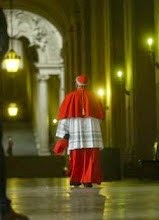
Indeed, B16's selection of Dominik Duka OP (above) -- a 66 year-old Bohemian once barred from ministry and imprisoned under the country's fallen Communist regime -- continues what's essentially been the pontiff's universal model for his major picks worldwide: prelates already well-known in the public square with roots in the classroom, faithful in substance yet provocative only when necessary, savvy in the ways of politics and the media and able to forge solid ties across partisan and ideological lines... but all of it, again, never coming at the expense of the church's message.

Nearly five years into his reign, the sketch fits Benedict's "big four" in the Anglophone world -- the archbishops of Washington, Toronto, Westminster and New York -- as well as his picks for the other leading posts of Warsaw, Munich, Sao Paulo, and most recently, Brussels. Yet while the rest of the pack largely remain in their late 50s or early 60s, Duka's age -- like that of the freshly-named Belgian primate Andre-Joseph Leonard, who'll turn 70 in May -- is an ostensible move to avoid lengthy back-to-back tenures in the Czech capital.

Now 77, Prague's retiring archbishop, Cardinal Miloslav Vlk, took office in 1990, just as Leonard will be installed next month to succeed Cardinal Godfried Danneels, who had led the Brussels church since 1979 before his retirement last month.

The Prague appointment came five months after the Pope's weekend visit to the Czech Republic, during which Benedict pondered the country's turn toward secularism as Vlk took to the airwaves to berate himself for, in his mind, accomplishing little as archbishop. Beyond the religious environment, two elusive goals the cardinal passes to his successor are an agreement for the restoration of church property seized by the Communists and still in the possession of the state, and a concordat governing relations between the government and the Holy See -- an agreement which the Czech Republic is reportedly the lone European entity to lack.

Professed into the Order of Preachers a year before his 1970 ordination, Duka is but the second religious to number among this pontificate's major appointees; the other is the 59 year-old archbishop of Rio de Janiero, Cistertian Orani Tempesta, who was named to the Brazilian post last year. What's more, just weeks after the Pope devoted an entire General Audience to recalling the community's founder, the archbishop-elect is also the second Dominican to be given a major assignment in recent months; in June, Benedict tapped his lead American protege, the Bronx-born Gus di Noia, to become an archbishop and #2 of the Vatican's Congregation for Divine Worship and the Discipline of the Sacraments -- one of the current Curia's most sensitive top slots.

While Prague, Rio and the other archdioceses noted above are traditionally headed by cardinals, such is the backlog in the college -- and Benedict's own custom -- that the new occupants will almost certainly not be elevated until after their predecessors reach their 80th birthdays, at which point the retirees lose their voting rights in a conclave.

Said to enjoy "warm ties" with both current Czech President Vaclav Klaus and his predecessor, Vaclav Havel, Duka's installation in St Vitus' Cathedral -- one of the contested properties still held by the state -- has been scheduled for 10 April.

-30-

Friday, January 06, 2012

Biglietto, 2012

Here, in the Vatican's traditional precedence order, Pope Benedict's slate of cardinals-designate to be elevated on 18 February:
  • Fernando Filoni, prefect of the Congregation for the Evangelization of Peoples;
  • Manuel Monteiro de Castro, Major Penitentiary of the Roman Church;
  • Santos Abril y Castelló, archpriest of St Mary Major;
  • Antonio Maria Veglió, president of the Pontifical Council for Migrants and Refugees;
  • Giuseppe Bertello, president of the Government of the Vatican City-State;
  • Francesco Coccopalmerio, president of the Pontifical Council for Legislative Texts
  • Joao Braz de Aviz, prefect of the Congregation for Religious;
  • Edwin Frederick O'Brien, grand master of the Equestrian Order of the Holy Sepulchre;
  • Domenico Calcagno, president of the Administration of the Patrimony of the Apostolic See;
  • Giuseppe Versaldi, president of the Prefecture for the Economic Affairs of the Holy See;
  • George Alencherry, Major-Archbishop of Erkugnalam-Angamaly of the Syro-Malybars;
  • Thomas Christopher Collins, archbishop of Toronto;
  • Dominik Duka OP, archbishop of Prague;
  • Willem Jacobus Eijk, archbishop of Utrecht;
  • Giuseppe Betori, archbishop of Florence;
  • Timothy Michael Dolan, archbishop of New York;
  • Rainer Maria Woelki, archbishop of Berlin;
  • John Tong Hon, bishop of Hong Kong

...and likewise, the designates older than 80 -- and, ergo, unable to enter a conclave --who are given the red hat as an "honorary" gesture:

  • Lucien Muresan, major archbishop of Fagaras and Alba Julia of the Romanians;
  • Fr Julien Ries, Belgian historian/anthropologist of religion;
  • Prosper Grech OSA, Maltese Biblical scholar;
  • Karl Josef Becker SJ
-30-

Wednesday, June 23, 2010

Of Wool Bands... and Red Hats

On a quick calendar-note (or a couple), the "Vatican year" is ramping toward its end: Tuesday's solemnity of Saints Peter and Paul will see the traditional conferral of the pallium, this time on the 38 metropolitan archbishops appointed during the last year around the globe.

Among the group will be four North Americans -- Archbishops Albert LaGatt of Saint-Boniface, Jerome Listecki of Milwaukee, Dennis Schnurr of Cincinnati and Thomas Wenski of Miami. Other notables in this year's crop include the UK's Archbishops Bernard Longley of Birmingham and Peter Smith of Southwark, the freshly-named Czech primate Dominik Duka OP of Prague, his Belgian counterpart Andre-Joseph Leonard of Brussels, and the new archbishops of Sevilla, Cape Town, Douala and Panama City.

(On a curious side-thread, it's worth noting that, next year's US pallium class is already shaping up to be larger than this year's: Coadjutor-Archbishop José Gomez will have succeeded to the archbishopric of Los Angeles by then, and even with no other metropolitan movements beyond his successor in San Antonio and the forthcoming appointees to Seattle and Oklahoma City, the result will yield a Stateside delegation of four.)

Its roots as sacred garb dating to the third century, for most of its history the woolen "yoke" marked with six crosses was conferred on newly-installed archbishops in their cathedral churches. In 1984, however, John Paul II instituted the custom of calling the metropolitans to Rome to receive it as a further underscore of the vestment's symbolism -- namely, the archbishops' particular link to Peter's chair.

* * *
Come the first days of July, B16 will literally head for the hills, remaining in residence at the papal retreat at Castel Gandolfo until late September. And on his return, one key decision the pontiff will face is the creation of new cardinals and the date of a consistory to elevate new members of the college which advises him in life and, upon his death, will elect his successor.

As of today, the voting complement of the "Pope's Senate" numbers 108 -- twelve short of its maximum 120; the figure's next drop will come on 7 July as Washington's Cardinal Theodore McCarrick reaches the ineligibility age of 80, with at least another six seats falling open by mid-November.

Given the scenario, a mini-frenzy was had in early March as prominent reports in the Italian press circulated that a consistory to fill the 19 foreseen slots would be held over Christ the King weekend, 20-21 November. However, recent chatter in Rome has cast some doubt over the late fall date, with some indications reporting that -- in an economical move -- the pontiff might just hold off for another six months or so, until mid-2011, by which point another half-dozen electors will have aged out of a hypothetical conclave.

Either way, between the present and the end of 2012, another whole quarter of the voting College -- some 30 cardinals -- will superannuate; add in the dozen who've turned 80 since the 2007 consistory, and the figure exceeds a third of the eventual papal electorate.

Along these lines, it's been noted here before but, given the significance, bears repeating: among the recent or upcoming retirees are a full half of the 12 American electors -- a figure without precedent in such a short time-frame.

As history goes, the period ahead offers Benedict an unparalleled free hand at reshaping the Stateside church's topmost rank... and with this pontificate's picks averaging in their early 60s on receiving the red hat, smart money can easily foresee the coming crop of cardinals holding the helm for a generation, or even more.

As if things weren't interesting enough already, eh?

As always, stay tuned.

PHOTO:AP(1)

-30-